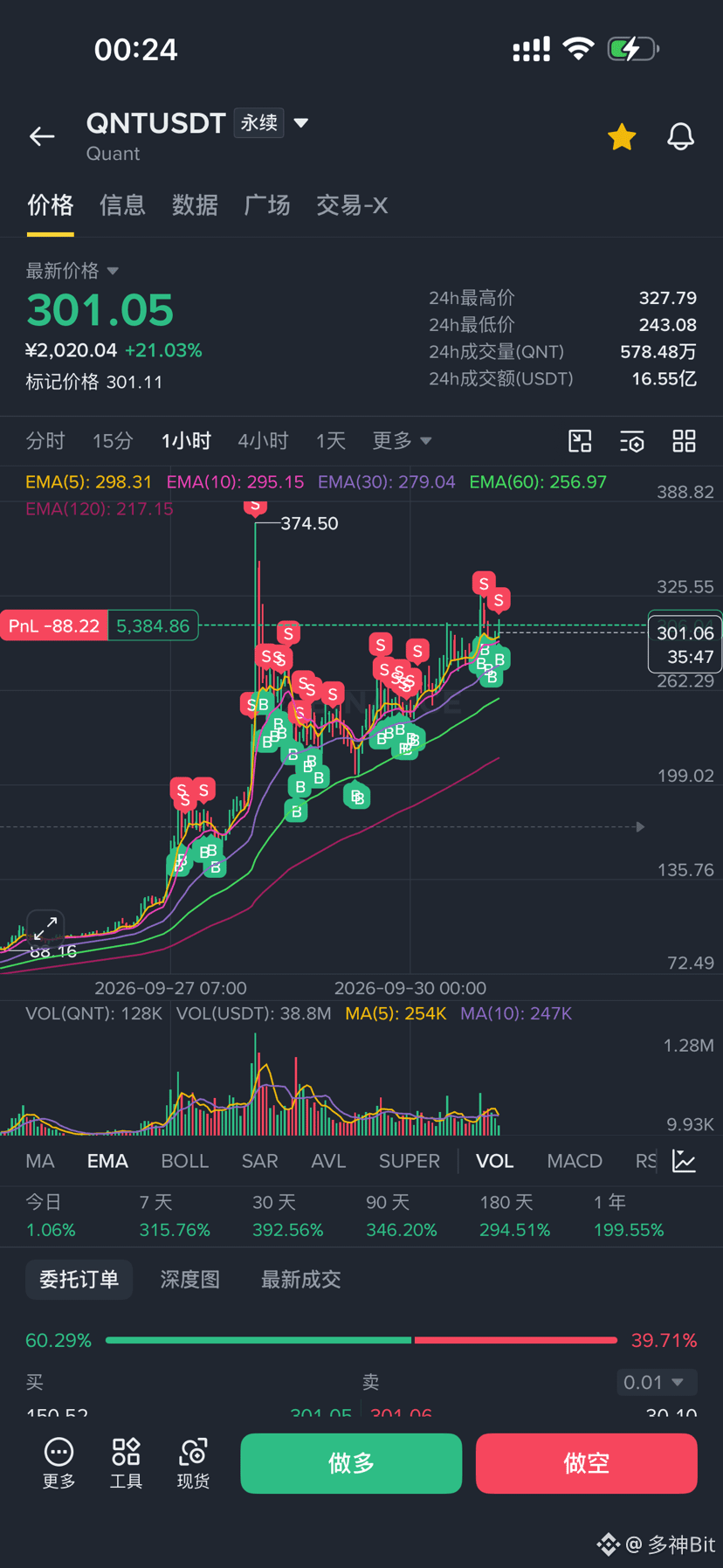
$QNT
People underestimate what a maximum supply of only 14.88 million QNT truly means.
14.88 million is the total supply.
This is not the amount that will always be available for purchase.
Some QNT will be held long-term.
Some may be lost.
Some may end up in institutional custody.
And some may ultimately be locked up by being used over the network.
That’s how a supply shock is formed:
Demand wave 1 buys the cheapest available $QNT .
Demand wave 2 faces fewer sellers.
Demand wave 3 must offer higher prices to convince existing holders to sell.
The total supply doesn’t change.
But the supply available at earlier price levels has disappeared.
This distinction is crucial.
If 1 million investors and institutions try to acquire just 10 $QNT each—
that would be 10 million tokens, roughly 67.2% of the total supply.
If demand keeps growing, owning a whole $QNT will become increasingly difficult.
People can still buy fractional shares.
But there will be fewer and fewer people able to own an entire token.
For example:
When QNT is $100 each, $1,000 can buy 10 $QNT
When QNT is $1,000 each, the same $1,000 can buy 1 $QNT
When QNT is $10,000 each, you can buy 0.1 $QNT
When QNT is $100,000 each, you can buy 0.01 $QNT
When QNT is $1,000,000 each, you can buy 0.001 $QNT
Scarcity itself doesn’t create these prices.
There must be real utility and continually increasing demand.
But if institutional demand starts competing with retail demand for an increasingly limited circulating supply, the market must rise until it finds sellers willing to part with their QNT.
QNT doesn’t need everyone to buy it.
It only needs demand to exceed the amount available at the current price.
That’s where scarcity turns into a supply shock.
And that’s how 14.88 million $QNT becomes extremely expensive.
People underestimate what a maximum supply of only 14.88 million QNT truly means.
14.88 million is the total supply.
This is not the amount that will always be available for purchase.
Some QNT will be held long-term.
Some may be lost.
Some may end up in institutional custody.
And some may ultimately be locked up by being used over the network.
That’s how a supply shock is formed:
Demand wave 1 buys the cheapest available $QNT .
Demand wave 2 faces fewer sellers.
Demand wave 3 must offer higher prices to convince existing holders to sell.
The total supply doesn’t change.
But the supply available at earlier price levels has disappeared.
This distinction is crucial.
If 1 million investors and institutions try to acquire just 10 $QNT each—
that would be 10 million tokens, roughly 67.2% of the total supply.
If demand keeps growing, owning a whole $QNT will become increasingly difficult.
People can still buy fractional shares.
But there will be fewer and fewer people able to own an entire token.
For example:
When QNT is $100 each, $1,000 can buy 10 $QNT
When QNT is $1,000 each, the same $1,000 can buy 1 $QNT
When QNT is $10,000 each, you can buy 0.1 $QNT
When QNT is $100,000 each, you can buy 0.01 $QNT
When QNT is $1,000,000 each, you can buy 0.001 $QNT
Scarcity itself doesn’t create these prices.
There must be real utility and continually increasing demand.
But if institutional demand starts competing with retail demand for an increasingly limited circulating supply, the market must rise until it finds sellers willing to part with their QNT.
QNT doesn’t need everyone to buy it.
It only needs demand to exceed the amount available at the current price.
That’s where scarcity turns into a supply shock.
And that’s how 14.88 million $QNT becomes extremely expensive.