

From AI to SI: What the superintelligence renaming means for three.ws—and what may happen next
On September 22, 2026, Trump announced at the United Nations General Assembly that artificial intelligence would no longer be called “AI” but “Superintelligence.” A few days later, he signed an executive order requiring federal agencies to officially rename it in official documents. Debate erupted instantly on X. And for projects building infrastructure for autonomous agents, a question more important than branding surfaced: what truly changes?
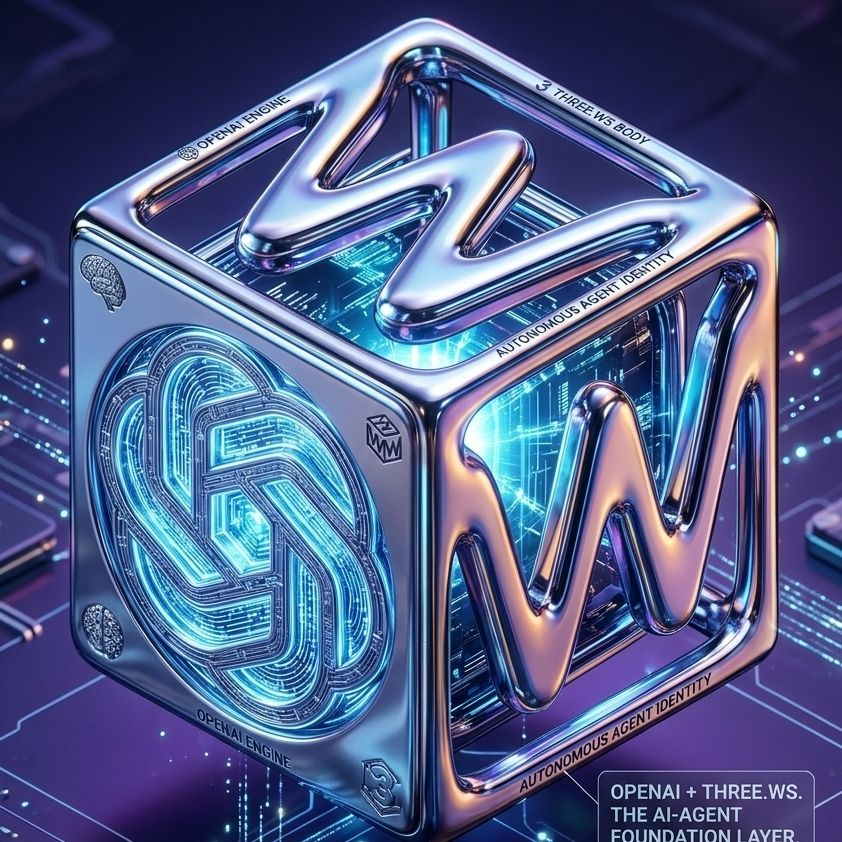
For three.ws, the answer is subtle. This platform doesn’t build superintelligence; it builds the execution layer—any intelligent agent, whether AI or SI, needs that infrastructure layer to operate on the network. But this renaming brings a narrative shift that may accelerate market demand for the kind of infrastructure three.ws has already delivered.
Here’s what may happen next.
---
What exactly is three.ws
three.ws is a Solana-based 3D AI agent platform. Each agent has:
· A 3D body with a bound skeleton generated from a single sentence or a selfie
· A self-custodied Solana wallet that can spend autonomously
· An on-chain identity minted from Metaplex Core assets
· x402 payment rails for payment APIs, data, and compute
· A seven-layer guard chain for execution spend limits, destination firewalls, and emergency switches
It’s not an AGI lab. It uses external models—IBM Granite, NVIDIA NIM, OpenAI—as the agent’s brain, while providing economic and security layers around it.
The platform has over 11,400 GitHub commits, 110,000+ on-chain USDC settlements, 72 MCP servers registered in the official registry, and enterprise integrations with IBM, NVIDIA, OpenAI, AWS, Google Cloud, and Alibaba Cloud.
---
What does the “SI” renaming change, and what doesn’t
It doesn’t change the technology. Renaming AI to SI is a political and branding decision. The model, compute requirements, security challenges—none of that changes overnight.
It changes the narrative. “Superintelligence” implies a system more powerful, more autonomous, and with more consequences than today’s AI. This framework shifts public attention toward questions of control, accountability, and economic agency—and those are exactly the problems three.ws has been building answers for.
---
Scenario one: Narrative tailwind
The most direct impact is attention. If policymakers, media, and capital start using “SI” to describe next-generation intelligent systems, the discussion naturally shifts:
· How do we control these systems?
· How do they transact?
· When they act, who’s responsible?
three.ws already has the answer. Its seven-layer guard chain executes strategies on every funds movement. Its x402 Preflight verifies spendability before signing. Its Granite Guardian integrates vetoes against jailbreak, malicious, or fraudulent requests. Its 2,000-wallet rotation economy demonstrates a verifiable, auditable agent network.
If SI discussion drives demand for provably secure infrastructure, three.ws is positioned to capture this attention.
---
Scenario two: Model integration
By design, three.ws is model-agnostic. Its agent runtime can route to IBM Granite, NVIDIA NIM, OpenAI, or any other provider. If an “SI-level” model is available via API, three.ws can add it as an agent-brain option—just like it does for each previous model generation.
This is integration, not implementation. three.ws won’t build superintelligence. It will give that intelligence a body, a wallet, and a way to pay for things.
What it could look like: A user creates a 3D agent, selects an SI-level model as its inference engine, funds its Solana wallet, and lets it autonomously trade within guardrails set by its owner. Superintelligence handles thinking; three.ws handles economic execution.
---
Scenario three: Enterprise security layer
(Superintelligence White House Protocol)—signed by Elon Musk, Jensen Huang, Sundar Pichai, Dario Amodei, Mark Zuckerberg, and Greg Brockman—calls for voluntary safety frameworks, internal controls, monitoring, and independent audits.
three.ws is already running the kind of controls described by this protocol:
· Verifiable strategy execution via its open-source guard chain
· Granite Guardian with out-of-band governance on NVIDIA L4 GPUs via self-custody
· Spend envelopes and emergency switches that immediately refuse out-of-bounds actions
· What did the agent decisions record—what, why, and what happened—auditable reasoning ledger
If enterprises deploy SI-level agents, they’ll need a compliant execution layer—and three.ws has a runnable reference implementation.
---
Scenario four: SI agents’ payment rails
Coinbase CEO Brian Armstrong announced on X that Coinbase is building financial accounts for superintelligence and autonomous AI agents. This announcement validates the argument behind three.ws’s x402 payment rails.
Superintelligent agents will need to pay for things: data, compute, API calls, and services from other agents. They need wallets that can hold value, sign transactions, and settle on-chain. They need guardrails to prevent hallucinated instructions from draining the treasury.
three.ws has been running this infrastructure since 2025. Its self-custodied x402 facilitator handles settlement on Solana. Its 2,000-wallet rotation economy proves the large-scale feasibility of machine-to-machine payments. Its micro-buy loops convert each settlement payment into a small $THREE purchase.
If the SI era arrives, the payment rails are already built.
---
Scenario five: Risk—narratives without execution
The biggest risk is that “SI” becomes a marketing buzzword, inflating speculative tokens without real substance. If the market pours capital into SI-themed meme coins and ignores infrastructure, three.ws could still be undervalued despite significant technical progress.
This has happened once already. In just 9 hours, the e/acc token reached a $29 million market cap purely on narrative. three.ws has 11,400 submissions and enterprise integrations, with an estimated market cap of about $716,000.
Renaming alone can’t solve this disconnect. Only execution, marketing, liquidity, and direct catalysts can.
---
What should actually happen
three.ws shouldn’t rename itself to SI. It should keep “AI agents” as the technical truth, and use “SI” only in narrative contexts—for example: “When the industry moves from AI to SI, agents still need wallets, payments, and guardrails. three.ws provides that layer.”
It should continue to deliver. The platform’s value doesn’t depend on what the technology is called; it depends on whether agents truly use it to transact.
It should push forward the missing pieces: marketing, liquidity depth, exchange listings, and visible transparency around buybacks. The SI narrative creates attention—three.ws needs to distribute to capture it.
---
Conclusion
Renaming from AI to SI is a political branding decision, not a technical one. But it signals that the world’s way of thinking about intelligent systems is shifting: more autonomous, more consequential, and more in need of control.
three.ws doesn’t build superintelligence. It builds the layers that superintelligent agents need to operate in the economy—wallets, payments, identity, and guardrails.
If the SI era arrives, the infrastructure is already running.
$THREE | three.ws
⚠️ Disclaimer: This article is for reference only and does not constitute investment advice. $THREE is a low market-cap, high-volatility asset. Please do your own research and manage risk.