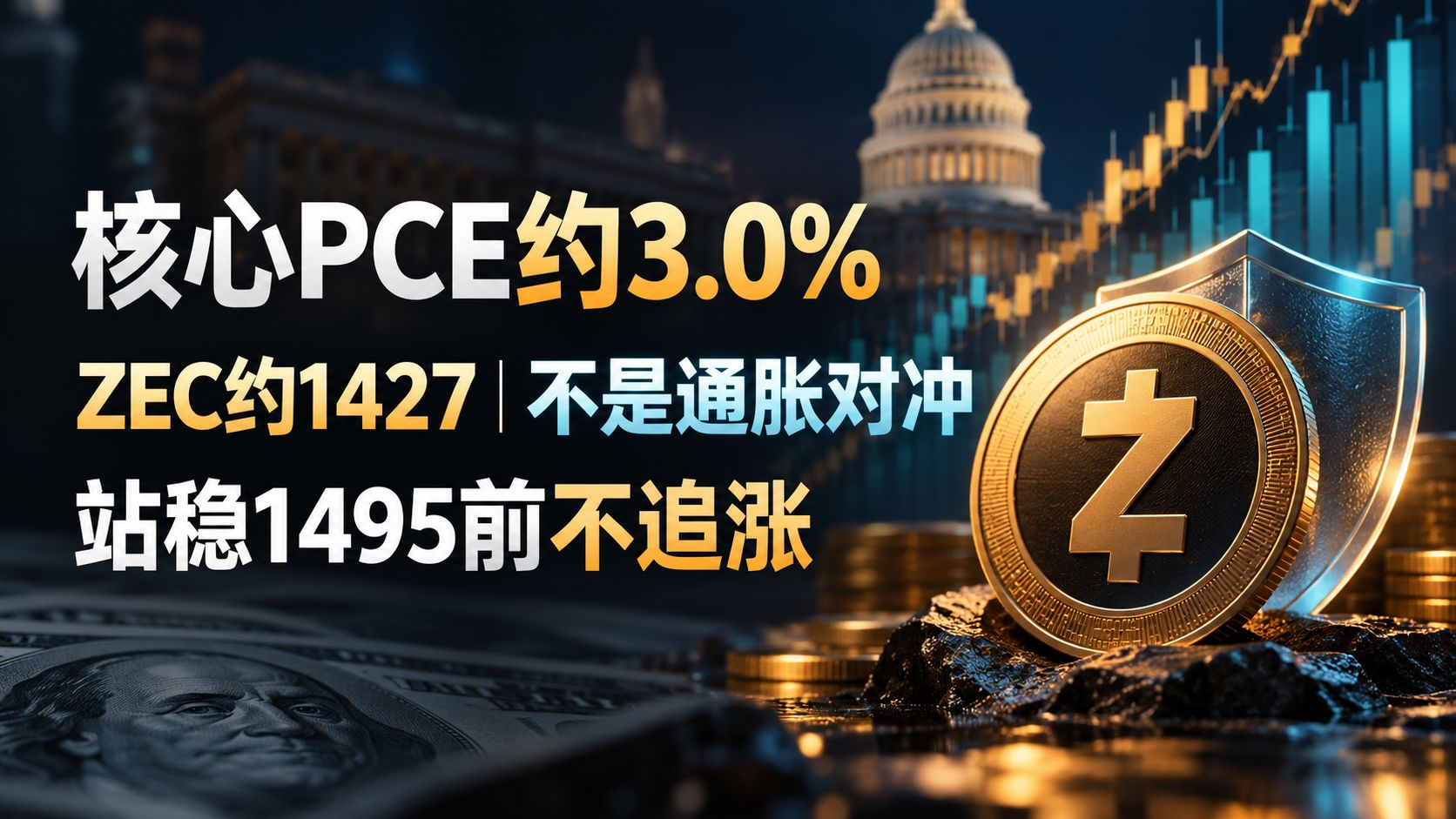
Core PCE cooling remains a hot topic|ZEC’s privacy feature is not an inflation hedge|Around 1427 I’ll wait for now
My attitude is cautious and watchful. I won’t slap a “safe-haven asset” label on ZEC just because inflation data is better than some expectations. Binance Square#USCorePCEEasesTo3%InAugust is still trending. The U.S. Bureau of Economic Analysis reported that August’s core PCE year-on-year is about 3.0%—an inflation gauge that excludes food and energy. It can influence rate expectations and market risk appetite, but by itself it does not say that crypto assets have received new policy support. There are still jobs, subsequent inflation, and officials’ judgments between the inflation prints and the Fed’s actual decisions; you can’t write the data release as if rate cuts have already been made.
Why does this relate to ZEC? Privacy-coin trading still relies on market liquidity. If funds increase risk exposure because rate expectations improve, some high-volatility coins may get bought along the way. However, ZEC’s privacy functionality is an on-chain transaction design, not a guarantee of purchasing power in USD, and it won’t automatically generate cash flow when inflation falls. Mixing up “privacy demand” with “macroeconomic hedging” will underestimate ZEC’s exchange availability, liquidity, and regulatory risks. My take is just an analysis of transmission mechanisms—I’m not claiming that institutions have already bought ZEC due to PCE.
The current price also reminds me to control the pace. When I was drafting, Binance’s ZECUSDT was around $1427.27, up about 0.81% in 24 hours, ranging from $1381 to $1494.52. The price is still above the lower end of the range, but it has clearly fallen back from the intraday high. This suggests that macro tailwinds have not turned into an uninterrupted one-way trend. In the same period, Farside’s table of ZEC-related funds still hasn’t provided complete fund-by-fund flow for September 30. The automatically displayed total zero value on the page can’t be explained away as “institutions aren’t trading.” ZEC fund units, spot coin prices, and real on-chain usage are three different indicators—you can’t casually substitute one for another.
I’d rather use price and information together to verify. If around 1450 it repeatedly meets resistance, then chasing price on the short term isn’t worth it. If it breaks above 1495, you still need trading volume and sustained follow-through to count as a true renewed challenge to the highs. Below, around 1380, is a near-term defensive level. If that level is lost, you can’t keep using the old PCE narrative to find an excuse for the decline. If later U.S. data pushes yields higher again, or fund disclosures show that capital is not being passed along, or if trading channels face new restrictions, my cautious assessment will be strengthened. Conversely, only if real inflows arrive and price stabilizes and holds above 1495 will the current wait-and-see view be overturned.
If I were trading for myself, I wouldn’t participate now—and I wouldn’t short impulsively just because it pulled back. Only if ZEC’s one-hour closing price is above $1495, then it pulls back and holds, with clear spot trading volume, would I consider using up to 3% of total capital to add longs in batches. First target: 1530; second target: 1580. If it reaches 1530, I’d cut the position in half; the remaining position’s stop-loss would be raised to the cost basis. My initial stop-loss would be set below the pullback low, keeping the maximum loss per trade at 0.3% of total capital. If price breaks below 1380 first, or if macro facts and capital evidence overturn the premise, I would cancel the plan and immediately close any existing position. If the conditions aren’t triggered, I’ll only record observations and won’t repackage waiting as execution or profit. #USCorePCEEasesTo3%InAugust #ZEC
The above is purely my personal market observations and does not constitute investment advice.
My attitude is cautious and watchful. I won’t slap a “safe-haven asset” label on ZEC just because inflation data is better than some expectations. Binance Square#USCorePCEEasesTo3%InAugust is still trending. The U.S. Bureau of Economic Analysis reported that August’s core PCE year-on-year is about 3.0%—an inflation gauge that excludes food and energy. It can influence rate expectations and market risk appetite, but by itself it does not say that crypto assets have received new policy support. There are still jobs, subsequent inflation, and officials’ judgments between the inflation prints and the Fed’s actual decisions; you can’t write the data release as if rate cuts have already been made.
Why does this relate to ZEC? Privacy-coin trading still relies on market liquidity. If funds increase risk exposure because rate expectations improve, some high-volatility coins may get bought along the way. However, ZEC’s privacy functionality is an on-chain transaction design, not a guarantee of purchasing power in USD, and it won’t automatically generate cash flow when inflation falls. Mixing up “privacy demand” with “macroeconomic hedging” will underestimate ZEC’s exchange availability, liquidity, and regulatory risks. My take is just an analysis of transmission mechanisms—I’m not claiming that institutions have already bought ZEC due to PCE.
The current price also reminds me to control the pace. When I was drafting, Binance’s ZECUSDT was around $1427.27, up about 0.81% in 24 hours, ranging from $1381 to $1494.52. The price is still above the lower end of the range, but it has clearly fallen back from the intraday high. This suggests that macro tailwinds have not turned into an uninterrupted one-way trend. In the same period, Farside’s table of ZEC-related funds still hasn’t provided complete fund-by-fund flow for September 30. The automatically displayed total zero value on the page can’t be explained away as “institutions aren’t trading.” ZEC fund units, spot coin prices, and real on-chain usage are three different indicators—you can’t casually substitute one for another.
I’d rather use price and information together to verify. If around 1450 it repeatedly meets resistance, then chasing price on the short term isn’t worth it. If it breaks above 1495, you still need trading volume and sustained follow-through to count as a true renewed challenge to the highs. Below, around 1380, is a near-term defensive level. If that level is lost, you can’t keep using the old PCE narrative to find an excuse for the decline. If later U.S. data pushes yields higher again, or fund disclosures show that capital is not being passed along, or if trading channels face new restrictions, my cautious assessment will be strengthened. Conversely, only if real inflows arrive and price stabilizes and holds above 1495 will the current wait-and-see view be overturned.
If I were trading for myself, I wouldn’t participate now—and I wouldn’t short impulsively just because it pulled back. Only if ZEC’s one-hour closing price is above $1495, then it pulls back and holds, with clear spot trading volume, would I consider using up to 3% of total capital to add longs in batches. First target: 1530; second target: 1580. If it reaches 1530, I’d cut the position in half; the remaining position’s stop-loss would be raised to the cost basis. My initial stop-loss would be set below the pullback low, keeping the maximum loss per trade at 0.3% of total capital. If price breaks below 1380 first, or if macro facts and capital evidence overturn the premise, I would cancel the plan and immediately close any existing position. If the conditions aren’t triggered, I’ll only record observations and won’t repackage waiting as execution or profit. #USCorePCEEasesTo3%InAugust #ZEC
The above is purely my personal market observations and does not constitute investment advice.