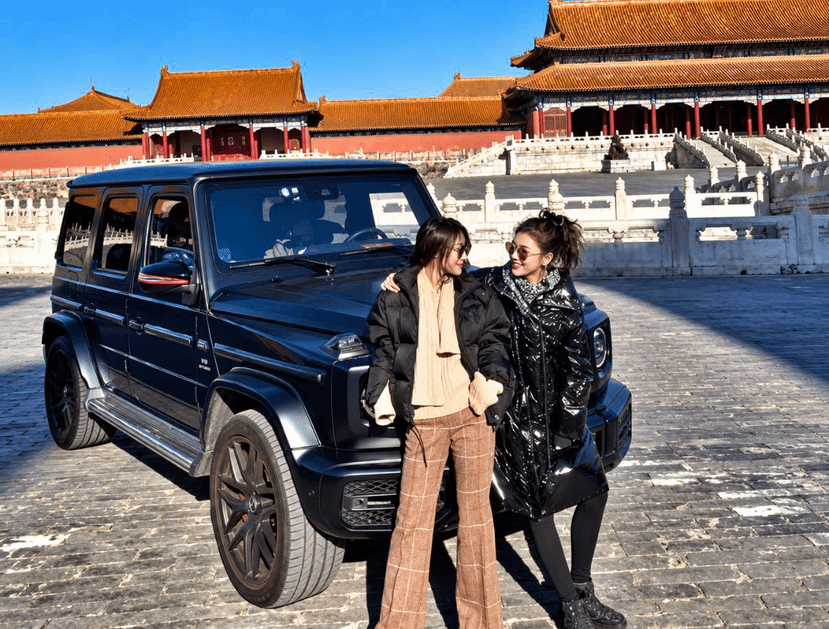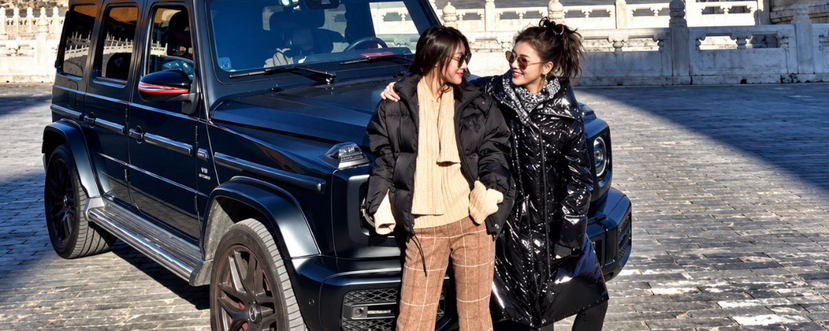

On a Monday when it was closed, two women and a Mercedes-Benz G-Class just drove right into the Taihemen Square in the Forbidden City to take photos.
At the time, that Weibo post was even more striking: it said, “While it’s closed to the public and avoids the crowds, go in and ‘let loose.’” After being criticized, it even replied, “There are too many lemon-sour people.”
You should know that the Forbidden City had banned cars strictly as early as 2013. When foreign dignitaries come to visit, they have to get out of the car outside the Meridian Gate and walk in. Wind can enter, rain can enter, visitors can enter—but cars cannot.
In the end, the car drove in anyway and even stopped at the Taihemen Square to take photos.
The photo made the trending list on the 17th. That evening, the Forbidden City responded: after verification, it was confirmed to be true; they expressed deep sorrow and offered a sincere apology to the public.
Bai Yansong later asked a question on his show:
This isn’t showing off wealth—it’s showing off power. Who put her in there in the first place?
“这句话,当年问到了很多人心里。”
Subsequently, the president of the Forbidden City apologized again and released the investigation findings: On January 13, there indeed was a closed-door event approved in advance, with about 200 attendees. Because the originally allocated parking-lot spaces were full, staff temporarily changed the location when guiding parking. They did not strictly follow the pre-approved parking plan, and the car was parked inside the Noon Gate, on the south side of the Jinshui River. The deputy director in charge and the head of the security office were suspended for investigation.
But some issues later never showed up in more complete public explanations.
Why was she able to take part in this closed-door evening event?
What procedure was followed to clear the vehicle to enter?
Who approved parking the car in that spot for photos?
How many cars actually entered that day?
Someone inside the Forbidden City was held accountable.
Whether the person who drove in, took photos, and posted on Weibo later made any public explanation and apologized to the public is unclear from the information made public at the time. More common, instead, was that posts were deleted, credentials were changed, and then she quickly vanished from the public debate. After that, attention was scattered by major events related to the epidemic, and the matter gradually died down without further developments.
After the incident blew up, there were many speculations online about the person involved. Some said she was simply a former flight attendant, while others linked her to a special family background.
These claims were widely circulated at the time, but in the Palace Museum’s investigation announcements, there was no corresponding explanation regarding identity matters.
So what truly held back the public’s discussion later was not just “who she is,” but another, more straightforward line:
If it were an ordinary tourist with no special access, and on a closed day they drove a car into Taihemen Square and posted it online, would the matter have ended in the same way?
Back then, this question was never answered fully in public.
More than six years later, looking back at those two photos, many people still can’t forget the same kind of contrast.
For ordinary people to visit the Forbidden City, you have to make reservations, queue up, go through security checks, walk on foot, and follow the rules.
And yet someone else could drive a Mercedes G-class into the Taihemen Square on a day when the museum was closed.
What everyone is concerned about is actually this point.
In the same place, the same set of externally announced rules.
Why do some people face a “No entry” sign, while others seem to be met with a door that was temporarily pushed open for them?
The Forbidden City is already over six hundred years old.
The rules are written on the door—they were meant for everyone to see.
The question mark left behind by that photo from back then wasn’t about the car—it was about who the door was actually open to.