Core PCE comes in below expectations; short-term pressure on $BTC may ease
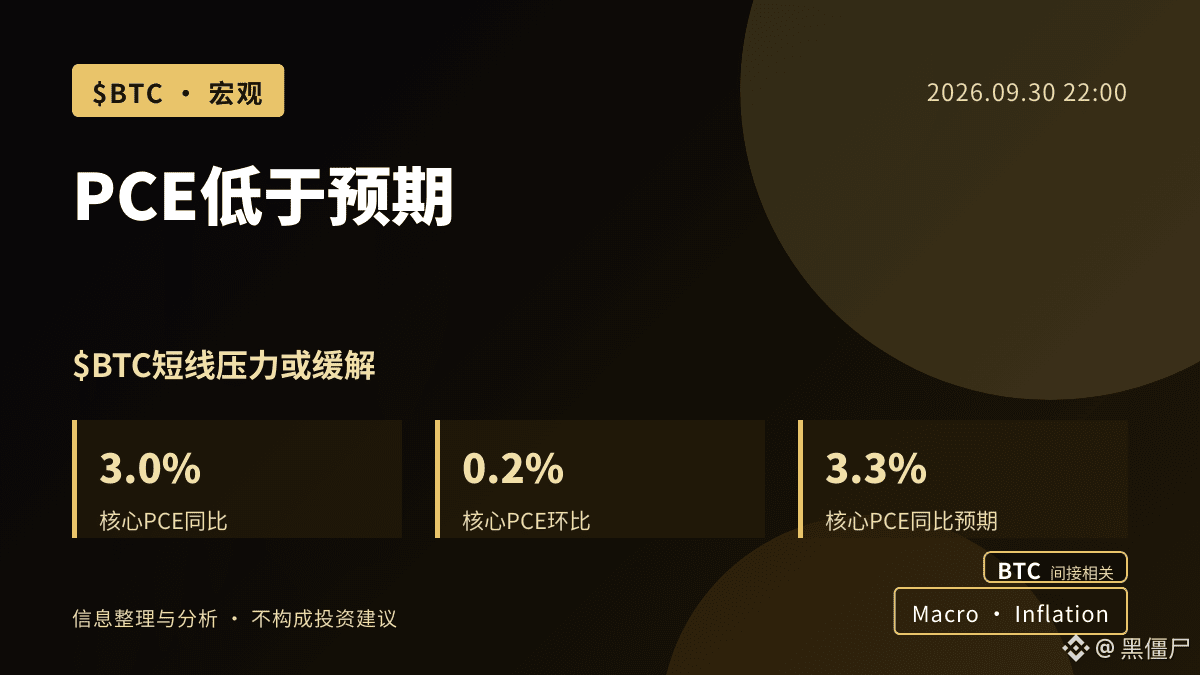
After the core PCE data was released, market sentiment showed a clear short-term repair. According to CNBC, the Federal Reserve’s preferred inflation gauge indicated that the year-over-year core PCE increase in August was 3.0%, well below the market’s prior expectation of 3.3%. Meanwhile, according to CoinDesk, the month-over-month core PCE rose only 0.2%, also below the 0.3% expected. At the same time, CoinDesk noted that after inflation data came in better than expected, U.S. Treasury yields fell and the $BTC price moved higher accordingly.
These data are important because core PCE is a key indicator the Fed uses to judge inflation trends. When the actual reading comes in below expectations, markets often reassess the rate-cut path. For risk assets, a shift downward in interest-rate expectations typically reduces the relative appeal of holding non-yielding assets; capital may reflow toward equities and other risk-on assets such as crypto.
In terms of market reaction, the logic for easing short-term pressure on $BTC is fairly straightforward: cooling inflation → stronger rate-cut expectations → reduced pressure on real rates and the U.S. dollar → improved valuation support for risk assets. However, this still reflects changes at the expectation level, not a confirmed reversal in fundamentals.
Key counterfactors to watch include: the data only reflects August. If inflation rebounds again later or if the Fed turns more hawkish in its language, the current rally could quickly unwind. In addition, whether yields continue to fall depends on the market’s overall assessment of fiscal policy, employment, and financial conditions.
Next, even more worth monitoring is whether $BTC can maintain the short-term repair amid falling yields—rather than only delivering a pulse-like rebound. From a trading perspective, it’s more important to wait for the market to confirm that risk appetite has truly improved, rather than chasing gains right after the data release.
$BTC #Bitcoin #CryptoMarket
The above is an information roundup and personal analysis, and does not constitute investment advice.
Follow me to keep tracking key market changes and data.
After the core PCE data was released, market sentiment showed a clear short-term repair. According to CNBC, the Federal Reserve’s preferred inflation gauge indicated that the year-over-year core PCE increase in August was 3.0%, well below the market’s prior expectation of 3.3%. Meanwhile, according to CoinDesk, the month-over-month core PCE rose only 0.2%, also below the 0.3% expected. At the same time, CoinDesk noted that after inflation data came in better than expected, U.S. Treasury yields fell and the $BTC price moved higher accordingly.
These data are important because core PCE is a key indicator the Fed uses to judge inflation trends. When the actual reading comes in below expectations, markets often reassess the rate-cut path. For risk assets, a shift downward in interest-rate expectations typically reduces the relative appeal of holding non-yielding assets; capital may reflow toward equities and other risk-on assets such as crypto.
In terms of market reaction, the logic for easing short-term pressure on $BTC is fairly straightforward: cooling inflation → stronger rate-cut expectations → reduced pressure on real rates and the U.S. dollar → improved valuation support for risk assets. However, this still reflects changes at the expectation level, not a confirmed reversal in fundamentals.
Key counterfactors to watch include: the data only reflects August. If inflation rebounds again later or if the Fed turns more hawkish in its language, the current rally could quickly unwind. In addition, whether yields continue to fall depends on the market’s overall assessment of fiscal policy, employment, and financial conditions.
Next, even more worth monitoring is whether $BTC can maintain the short-term repair amid falling yields—rather than only delivering a pulse-like rebound. From a trading perspective, it’s more important to wait for the market to confirm that risk appetite has truly improved, rather than chasing gains right after the data release.
$BTC #Bitcoin #CryptoMarket
The above is an information roundup and personal analysis, and does not constitute investment advice.
Follow me to keep tracking key market changes and data.