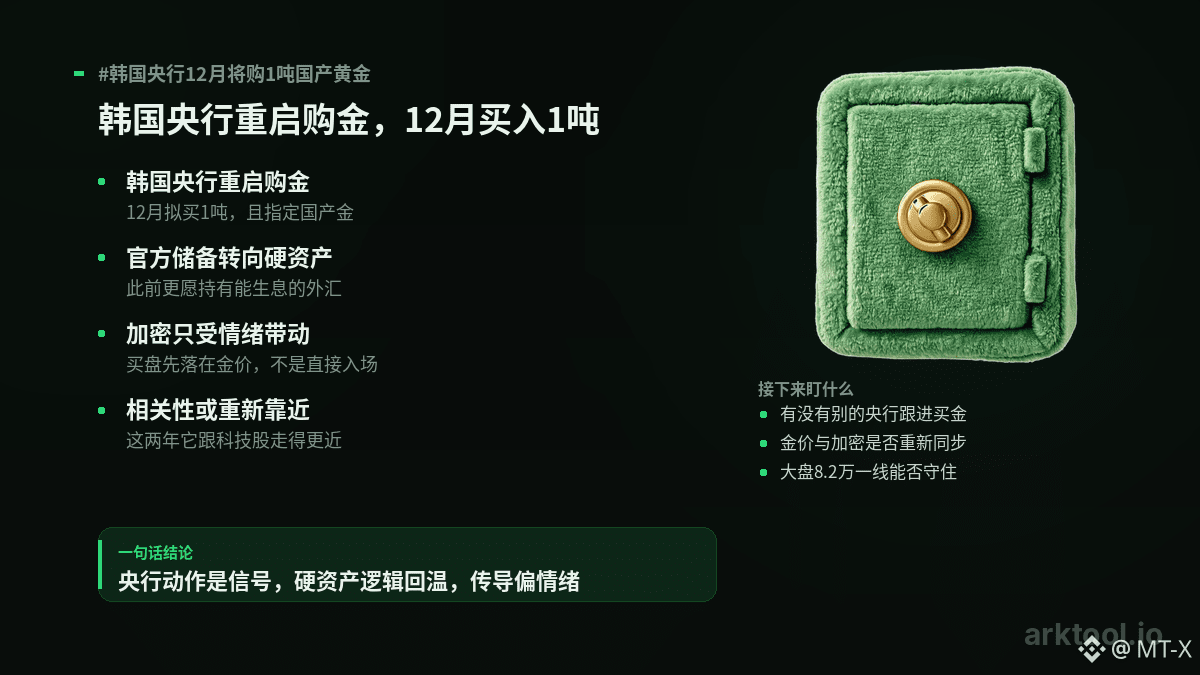
The Bank of Korea plans to buy 1 ton of gold in December, and it will be domestically produced gold. This marks its return to the gold market after 13 years.
For a country’s reserves, 1 ton isn’t that much. The amount itself isn’t the key point—the action is the signal: official funds have started treating gold again as part of its reserves.
Over the past couple of decades, many central banks preferred to hold foreign-exchange assets that can generate interest, leaving gold by the wayside. Now that they’re buying again, it suggests rising concerns about monetary credibility, inflation, and geopolitical risks.
This also connects, in terms of narrative, to the crypto market. $BTC and gold are often placed in the same box: the supply is limited and they don’t rely on any single institution’s endorsement. The difference is that gold is an officially recognized reserve asset, while Bitcoin is a market-priced risk asset. When central banks buy gold, they first react to the gold price; for crypto, any linkage is more emotional sentiment than a direct wave of buying demand.
The asset has long been referred to as “digital gold,” but in the past two years it has tracked tech stocks more closely than it has tracked gold prices. If the official gold-buying trend continues, the hard-asset logic will be brought up repeatedly, and the correlation between the two is worth reassessing.
Next, watch three things: whether other central banks follow suit and buy gold; whether gold prices and crypto assets will fall back into synchrony; and whether the market’s current resistance around 82,000 holds—what happens there will determine the pace of the start to the fourth quarter.
#韩国央行12月将购1吨国产黄金
For a country’s reserves, 1 ton isn’t that much. The amount itself isn’t the key point—the action is the signal: official funds have started treating gold again as part of its reserves.
Over the past couple of decades, many central banks preferred to hold foreign-exchange assets that can generate interest, leaving gold by the wayside. Now that they’re buying again, it suggests rising concerns about monetary credibility, inflation, and geopolitical risks.
This also connects, in terms of narrative, to the crypto market. $BTC and gold are often placed in the same box: the supply is limited and they don’t rely on any single institution’s endorsement. The difference is that gold is an officially recognized reserve asset, while Bitcoin is a market-priced risk asset. When central banks buy gold, they first react to the gold price; for crypto, any linkage is more emotional sentiment than a direct wave of buying demand.
The asset has long been referred to as “digital gold,” but in the past two years it has tracked tech stocks more closely than it has tracked gold prices. If the official gold-buying trend continues, the hard-asset logic will be brought up repeatedly, and the correlation between the two is worth reassessing.
Next, watch three things: whether other central banks follow suit and buy gold; whether gold prices and crypto assets will fall back into synchrony; and whether the market’s current resistance around 82,000 holds—what happens there will determine the pace of the start to the fourth quarter.
#韩国央行12月将购1吨国产黄金