


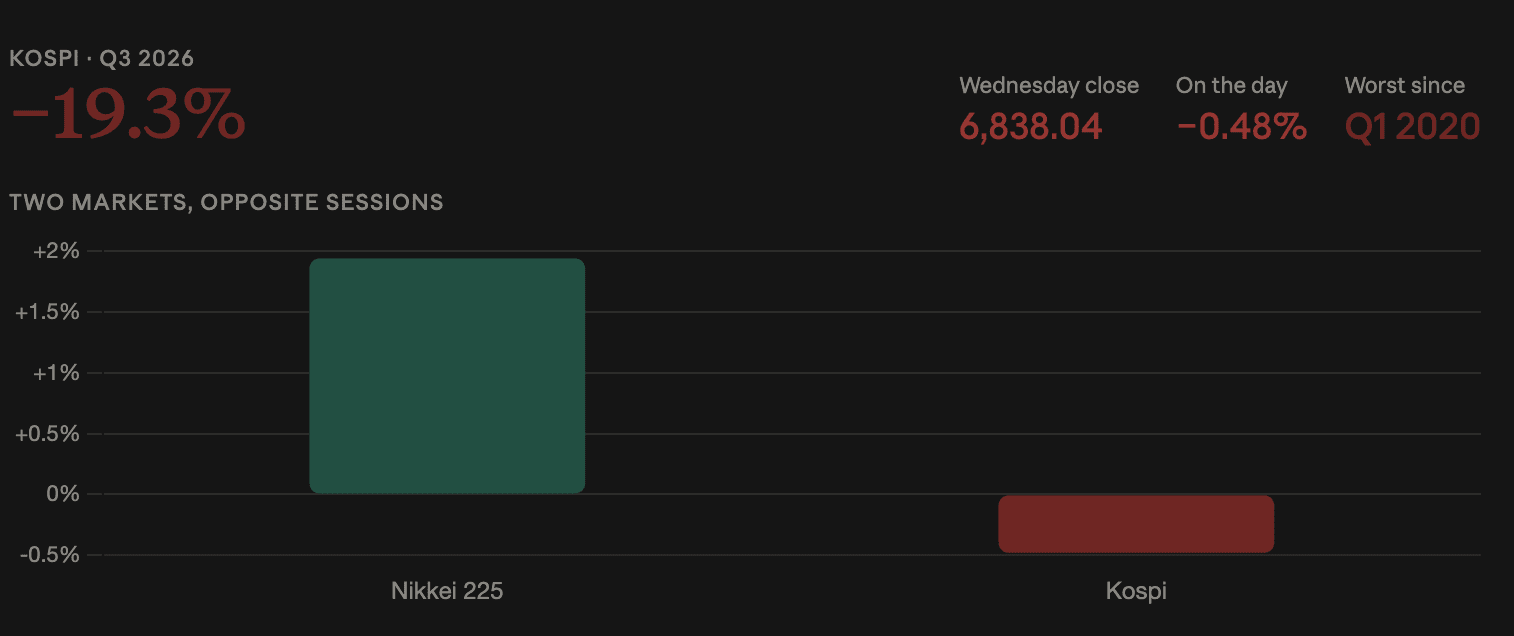
South Korea's Kospi closed down 32.77 points, or 0.48%, at 6,838.04 on Wednesday, per Bitget data.
The index fell 19.3% across the third quarter, its steepest quarterly decline since the first quarter of 2020.
Japan's Nikkei 225 moved the opposite way on the same session, closing up 1,272.45 points, or 1.94%, at 66,753.72.
The 2020 Comparison Sets the Scale
Q1 2020 was the pandemic crash, when global equity markets fell in weeks rather than months.
A quarterly decline matching that period without a comparable systemic event points to something specific to Korea's market composition rather than to a broad risk-off move.
That composition is the explanation. The Kospi carries concentrated exposure to memory manufacturing through Samsung Electronics and SK Hynix, both of which function as the region's AI proxy.
The Quarter Was Defined by Two Selloffs
Korea's market fell hard twice in the period.
A 22% selloff in July followed doubts about returns on AI investment — the same concern that reached US markets months later. The index has struggled to hold above 7,000 since.
September brought a second leg. The Kospi fell 3% on September 14 after Anthropic CEO Dario Amodei called for slowing frontier AI development, with SK Hynix down 6%. It then fell 2.7% on September 28 with both Samsung and SK Hynix down more than 5%.
Between those, the index rose 2% on September 22 as the same names led an Asian rally after Meta's Muse agent overtook ChatGPT as the top free app on Apple's US App Store.
Participation Fell Alongside Price
Turnover has been declining independently of the index.
Kospi average daily turnover fell to 20.6 trillion won, about $15 billion, in September — the lowest of 2026 and less than half the May and June peak.
A market that falls on thinning volume has less depth to absorb further shocks. The retail buying that drove Korean stocks to records earlier in the year was itself a volume story, and it has not returned.
The Nikkei Divergence Is the Session's Other Signal
Japanese equities rising 1.94% while Korea fell separates the two markets on a day they would normally move together.
Japan's index is more diversified across industrials, financials and consumer names, so it carries less direct exposure to the memory cycle driving Korea.
The Bank of Japan also raised its benchmark to a 31-year high in September, and the yen has been weak at around 157.8 per dollar — a level that supports Japanese exporters by making their goods cheaper abroad.
Micron Reports After the US Close
The timing places both markets ahead of a print that will reprice the memory complex.
Micron reports fourth quarter results after Wednesday's US close, with consensus at $31.83 earnings per share against $3.03 a year ago and revenue of $51.49 billion against $11.31 billion.
DRAM is expected to account for $38.22 billion of that, roughly 76% of revenue, and it is the line tied to AI infrastructure demand.
Guidance on DRAM contract pricing into 2027 matters more for Samsung and SK Hynix than the quarter itself, since all three compete in the same market. Monday's Korean selloff may reflect positioning ahead of it.
PCE inflation data arrives before the US open on the same day.