


Traders are betting September job growth will exceed what Wall Street economists expect, opening a visible gap between the two.
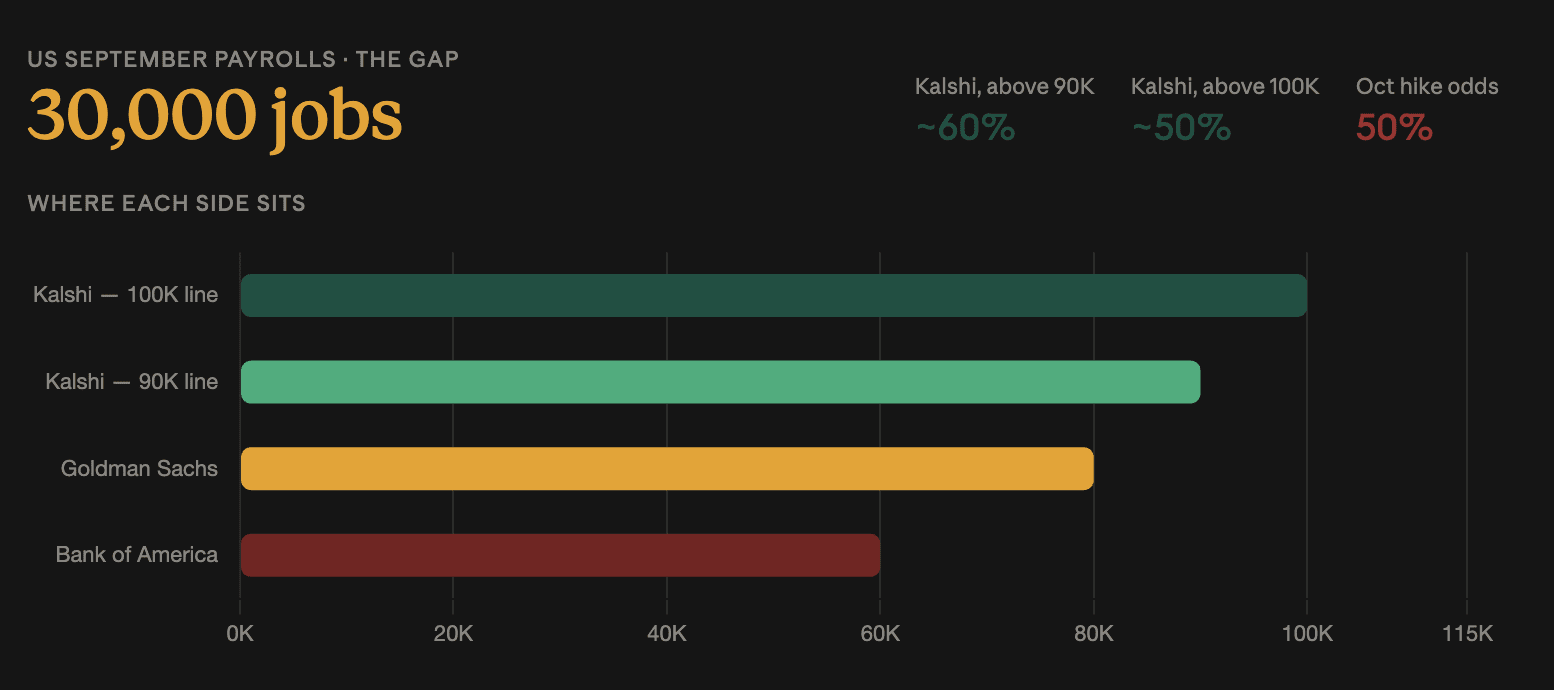
Kalshi data puts the probability of the US adding more than 90,000 non-farm jobs at nearly 60%, with about 50% odds the increase tops 100,000.
Goldman Sachs expects 80,000 with unemployment holding at 4.1%. Bank of America forecasts just 60,000, of which 50,000 would come from the private sector.
The Gap Is Wider Than It Looks
Bank of America's 60,000 sits below the bottom of what prediction markets consider likely.
If Kalshi assigns 60% probability to a print above 90,000, it implies roughly 40% odds of anything below — a range that includes Goldman's 80,000, Bank of America's 60,000 and every outcome beneath.
That is not a modest disagreement about the strength of a rebound. The two groups are describing different labour markets.
Prediction Markets and Bank Forecasts Measure Different Things
The gap has a structural explanation before it has an analytical one.
Bank economists publish point estimates built from models and survey data, and those numbers carry institutional reputation. That tends to pull forecasts toward consensus and away from extremes.
Prediction markets aggregate positions from participants with money at risk and no reputational anchor. They also absorb hedging flow — a trader protecting against a strong print contributes to the implied probability without believing in it.
The same divergence showed up on Fed pricing through September. Polymarket sat at 61% while CME FedWatch showed 76% on the same September hike, a 15-point gap on an identical binary event.
Which measure proved better then is not settled, and it is not obvious here either.
Williams Halved the October Odds
The disagreement matters because rate pricing is finely balanced.
Federal funds futures showed the probability of another hike next month falling from about 71% to 50% after New York Fed President John Williams downplayed the urgency of raising rates on Tuesday.
A move from 71% to 50% is the difference between an expected outcome and a coin flip. Markets that were positioned for a hike are now positioned for nothing in particular.
That is precisely the condition in which a single data point carries disproportionate weight. The jobs report arrives into a pricing deadlock, and a print at either end of the forecast range would resolve it in one direction.
What Each Outcome Would Mean
A print above 100,000 would validate the prediction market view and push October odds back toward where they sat before Williams spoke. It would also sit awkwardly against his comments, raising the question of what he saw that the data did not show.
A print near Bank of America's 60,000 would do the opposite, confirming the caution in bank forecasts and likely taking October odds below 50%.
The Goldman estimate at 80,000 falls between the two and would resolve little — close enough to the Kalshi threshold to leave the argument open.
Unemployment is the second variable. Goldman expects 4.1% to hold, and a rise there would carry more weight for the rate path than the headline number, because it speaks to slack rather than hiring pace.
The Context Around It
The Fed raised rates 25 basis points to 3.75%-4.00% on September 16, its first increase since July 2023, with a dot plot median pointing to one more move in 2026.
The long end has sold off regardless. The 30-year Treasury yield crossed 5.6% on Tuesday, its highest since June 2002, and the 10-year reached a fresh 2007 high near 5.3%.
That divergence — long yields setting extremes while October hike odds halve — suggests the bond market is pricing fiscal and inflation concerns rather than the policy path.
Brent traded at $96.43 after falling Tuesday, well below the $100 level that accompanied Monday's selloff, which removes part of the inflation impulse behind this month's rate-hike bets.
For crypto, Bitcoin has consolidated near $83,000 since the failed breakout at $87,300 on September 21, with 30-day implied volatility staying calm all week. A jobs print that resolves the rate deadlock in either direction would be the first real test of that calm.