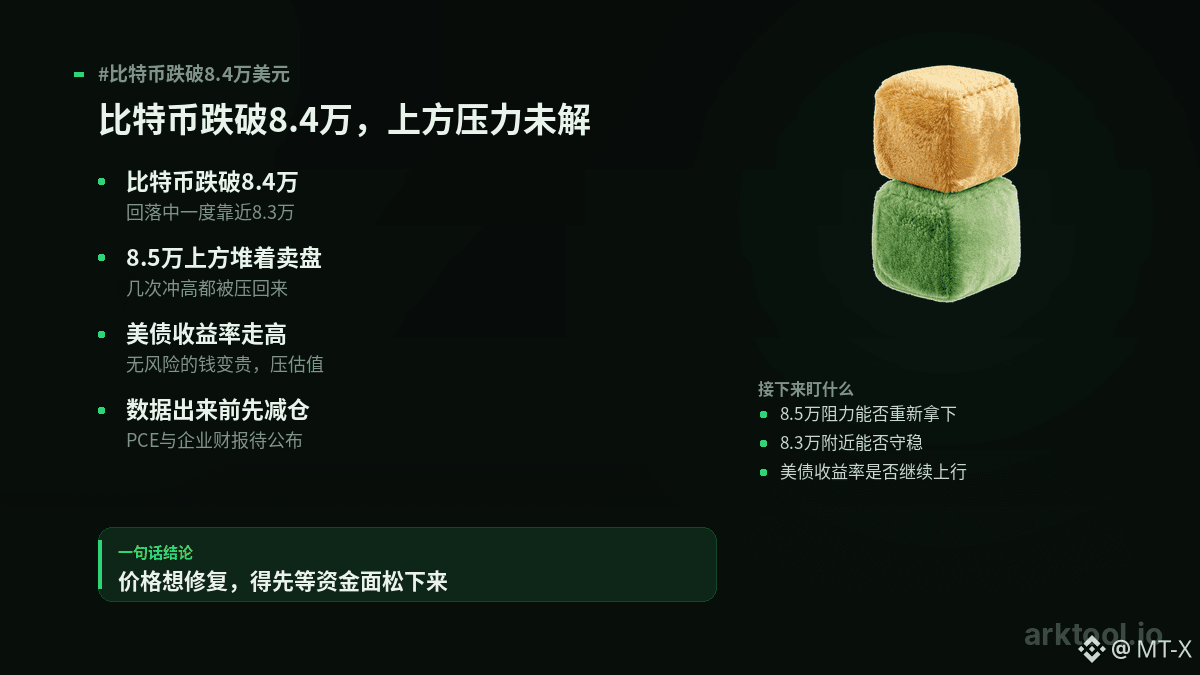
Bitcoin has fallen below $84,000 and, during the pullback, briefly moved close to $83,000.
The key point isn’t how far it dropped, but the breakout line around $85,000 above. This rebound has tried several times to push through that level only to be pushed back down each time, suggesting a sizable sell wall there—at least for the short term, that area has become a clear resistance zone.
On the other side is the macro picture. U.S. Treasury yields are rising, meaning risk-free money is getting more expensive. As a result, capital willing to take risks has less incentive to do so—not just in crypto, but valuations across the broader market are being pressured. That’s the backdrop for this pullback.
Timing matters just as much. PCE inflation data and corporate earnings are both ahead. The former shapes how the market interprets inflation and the subsequent interest-rate path, while the latter is a direct read on the tech sector’s outlook. Before the results come out, funds generally tend to de-risk first and place fewer bets, so volatility is easily amplified.
For $BTC , there are three things to watch next: whether the resistance at $85,000 can be reclaimed, whether support around $83,000 can hold, and whether Treasury yields will continue trending higher. The first two are about price structure; the third is about liquidity and positioning. If price is to repair, it must wait for liquidity conditions to loosen first.
Before and after key data releases is exactly when the market is most prone to changing its face. Until the direction is clear, any conclusions are still too early.
#Bitcoin falls below $84,000
The key point isn’t how far it dropped, but the breakout line around $85,000 above. This rebound has tried several times to push through that level only to be pushed back down each time, suggesting a sizable sell wall there—at least for the short term, that area has become a clear resistance zone.
On the other side is the macro picture. U.S. Treasury yields are rising, meaning risk-free money is getting more expensive. As a result, capital willing to take risks has less incentive to do so—not just in crypto, but valuations across the broader market are being pressured. That’s the backdrop for this pullback.
Timing matters just as much. PCE inflation data and corporate earnings are both ahead. The former shapes how the market interprets inflation and the subsequent interest-rate path, while the latter is a direct read on the tech sector’s outlook. Before the results come out, funds generally tend to de-risk first and place fewer bets, so volatility is easily amplified.
For $BTC , there are three things to watch next: whether the resistance at $85,000 can be reclaimed, whether support around $83,000 can hold, and whether Treasury yields will continue trending higher. The first two are about price structure; the third is about liquidity and positioning. If price is to repair, it must wait for liquidity conditions to loosen first.
Before and after key data releases is exactly when the market is most prone to changing its face. Until the direction is clear, any conclusions are still too early.
#Bitcoin falls below $84,000