

灼见Cryptosighted
951 Posts
灼见Cryptosighted
灼见|K线只是表象,人心才是博弈的终点。
13年实战沉淀,拒绝废话,只做最硬核的技术拆解与宏观透视。帮你看清下一步。如果你厌倦了噪音,这里是你的最后一站。
Open Trade

BTC Holder
Occasional Trader
8.5 Years
630 Following
28.2K+ Followers
9.9K+ Liked
Posts
Portfolio
All
Quotes
Videos
Live

辛迪cindy
·
--
[Replay] 🎙️ Good morning... How is the Thursday trading market? BNB forecast~
02 h 11 m 40 s · 2.6k listens

分析师尤斯1688
·
--
comment to get your bonus.🧧



光明社区-阿波罗
·
--
Along the mountainside, the breeze is light and the clouds are thin, and some choose to set up camp and linger here. But those who aspire to the summit will not be lured by the tenderness of the mountainside.
The narrower the mountain path becomes, the quieter it grows; fewer companions remain. Along the way, let go of comfort and hesitation, and climb upward, treading on past weakness.
There’s no need to fear loneliness or hardship. If the direction is right, every step matters. Your gaze should always be fixed on that LUCiC ray of light atop the peak.
The narrower the mountain path becomes, the quieter it grows; fewer companions remain. Along the way, let go of comfort and hesitation, and climb upward, treading on past weakness.
There’s no need to fear loneliness or hardship. If the direction is right, every step matters. Your gaze should always be fixed on that LUCiC ray of light atop the peak.


猫咪神9527
·
--
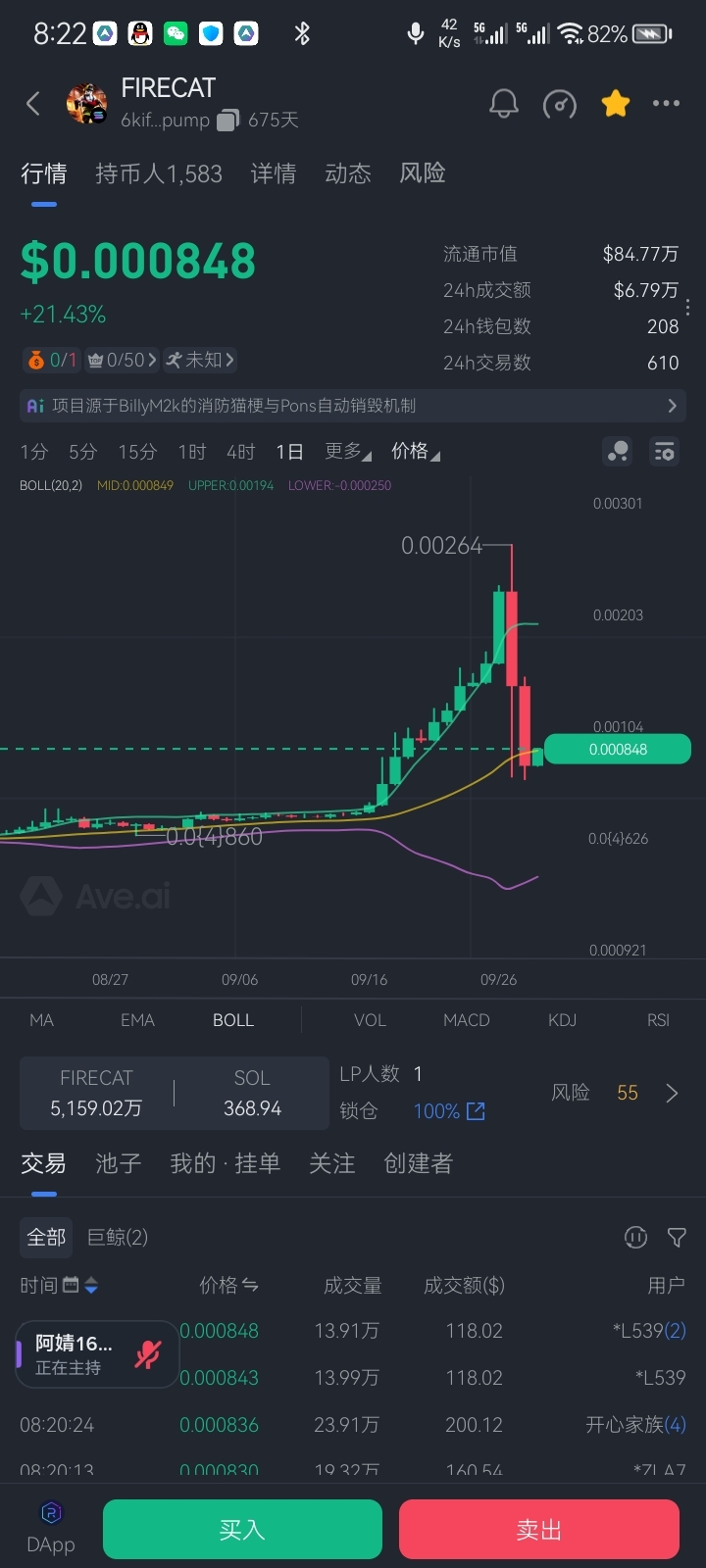
The fire alarm cat is currently in the callback phase 🔥 Ready to set sail and go! 🔥 Let those who believe make money, let those who work hard make a fortune. A great target/asset 🔥 The cost of missing out is low 🔥 The price of missing the chance is a bit regrettable. 🔥 Grab the opportunity and you’ll grab wealth.


林仙姑131419
·
--
🔥🔥🔥🔥🔥🔥 The fire-alarm cat’s train has departed 👉👉👉 for you and me who are on the road to financial freedom 👌👌👌 Let’s welcome everyone who can board this train to financial freedom and keep it up 💪💪💪💪💪💪



圣克斯Lucky1688
·
--
🧧🎁🌹🧧🎁🌹
The SEC Chair Speaks Out in Support of Asset Tokenization: In an interview, Paul Atkins, Chairman of the U.S. Securities and Exchange Commission (SEC), said he hopes to actively promote the transition of traditional stock markets to on-chain operations, and bluntly stated that the entire financial system is accelerating toward the Bitcoin and cryptocurrency era.
Robinhood Launches Perpetual Contracts Service: Major broker Robinhood has officially launched a Perps (perpetual contracts) product for U.S. traders, supporting 24/7 trading and up to 10x leverage. With this, it has become the first compliant mainstream platform to connect six major asset classes—stocks, options, cryptocurrencies, futures, prediction markets, and perpetual contracts—on a single platform.
Binance Suspends Base Network Deposits and Withdrawals: To support the network upgrade and hard fork planned for the Layer 2 network Base being incubated by Coinbase, Binance suspended token deposits and withdrawals on that network on September 30 (related token trading remains normal).
Prediction Market Kalshi Seeks Massive Funding: Prediction market operator Kalshi is in deep negotiations for a new round of $1 billion in funding, aiming for an evaluation as high as $40 billion, with existing investors such as Sequoia Capital participating in the discussions
Follow me and answer 1 to take the $SOL 红包!
The SEC Chair Speaks Out in Support of Asset Tokenization: In an interview, Paul Atkins, Chairman of the U.S. Securities and Exchange Commission (SEC), said he hopes to actively promote the transition of traditional stock markets to on-chain operations, and bluntly stated that the entire financial system is accelerating toward the Bitcoin and cryptocurrency era.
Robinhood Launches Perpetual Contracts Service: Major broker Robinhood has officially launched a Perps (perpetual contracts) product for U.S. traders, supporting 24/7 trading and up to 10x leverage. With this, it has become the first compliant mainstream platform to connect six major asset classes—stocks, options, cryptocurrencies, futures, prediction markets, and perpetual contracts—on a single platform.
Binance Suspends Base Network Deposits and Withdrawals: To support the network upgrade and hard fork planned for the Layer 2 network Base being incubated by Coinbase, Binance suspended token deposits and withdrawals on that network on September 30 (related token trading remains normal).
Prediction Market Kalshi Seeks Massive Funding: Prediction market operator Kalshi is in deep negotiations for a new round of $1 billion in funding, aiming for an evaluation as high as $40 billion, with existing investors such as Sequoia Capital participating in the discussions
Follow me and answer 1 to take the $SOL 红包!

开心哥1314
·
--
#美联储加息是否已成定局



@火警猫
is speaking[LIVE] 🎙️ Fire alarm cat 🐱 year-end target rises to 0.1U
7.3k listens

紫气东来M天官赐福
·
--
🌹🌹🌹🌹🌹🌹🌹🌹🌹🌹
A new “cat” sensation in the world of fire alarms—fired up to the sky.
In tribute to the fire heroes, spreading vigilance against fire.
Keep safety in your heart, and protect the peace and well-being of every household
☯️☯️☯️☯️☯️☯️☯️☯️☯️☯️☯️☯️
A new “cat” sensation in the world of fire alarms—fired up to the sky.
In tribute to the fire heroes, spreading vigilance against fire.
Keep safety in your heart, and protect the peace and well-being of every household
☯️☯️☯️☯️☯️☯️☯️☯️☯️☯️☯️☯️


阿婧1688
·
--
Peace and joy, every day is a good day, and my mood is wonderful.🌹🌹🌹🌹🌹🌹🎁🎁🎁🎁🎁🎁

🎙️ Hey… how is the Thursday trading market going? BNB prediction~
End
02 h 11 m 40 s
2.5k
6

Sherry长得帅不如跑的快1688
·
--
🚨 BITCOIN’S BULL SCORE JUST HIT 90/100.
But there’s one problem:
WHERE ARE THE BUYERS?
BTC recently pushed to around $87.4K.
Now it’s back near $83K.
And underneath the price:
🟢 Bull Score → 90/100
📉 30-day spot demand → down ~170K BTC
⚡ Futures demand growth → down ~90% in 15 days
💰 Short-term unrealized profit → ~33%
That creates a fascinating contradiction:
THE MARKET LOOKS BULLISH.
BUT DEMAND IS COOLING.
So the real question isn’t:
“Is Bitcoin still in a bull market?”
It’s:
WHO BUYS THE NEXT LEG HIGHER?
Because a rally needs more than fewer sellers.
It needs:
FRESH DEMAND.
If new buyers return,
$87K could become another breakout level.
But if demand keeps fading,
highly profitable holders may start taking money off the table.
Now I’m watching:
💰 BTC spot demand
⚡ New futures positioning
📍 $80K–$83K zone
🧱 The recent ~$87K high
👇 Your take?
FRESH BUYERS RETURN 🟢
or
THE BULL MARKET NEEDS TO COOL 🔴?
#BTC #ETH #BNB
But there’s one problem:
WHERE ARE THE BUYERS?
BTC recently pushed to around $87.4K.
Now it’s back near $83K.
And underneath the price:
🟢 Bull Score → 90/100
📉 30-day spot demand → down ~170K BTC
⚡ Futures demand growth → down ~90% in 15 days
💰 Short-term unrealized profit → ~33%
That creates a fascinating contradiction:
THE MARKET LOOKS BULLISH.
BUT DEMAND IS COOLING.
So the real question isn’t:
“Is Bitcoin still in a bull market?”
It’s:
WHO BUYS THE NEXT LEG HIGHER?
Because a rally needs more than fewer sellers.
It needs:
FRESH DEMAND.
If new buyers return,
$87K could become another breakout level.
But if demand keeps fading,
highly profitable holders may start taking money off the table.
Now I’m watching:
💰 BTC spot demand
⚡ New futures positioning
📍 $80K–$83K zone
🧱 The recent ~$87K high
👇 Your take?
FRESH BUYERS RETURN 🟢
or
THE BULL MARKET NEEDS TO COOL 🔴?
#BTC #ETH #BNB



Binance Announcement
·
--
Binance Pay partners with PayPay to bring PayPay QR payments to visitors traveling to Japan—10% discount for a limited time!
This is a general announcement, and the products and services mentioned here may not be available in your location.
Dear users:
Binance Pay now supports international crypto payments for visitors traveling to Japan, allowing you to pay with cryptocurrency at millions of locations across Japan that support PayPay.
With this feature, visitors can scan the QR codes supported by merchants, or show their own payment code for the merchant to scan, completing payment directly using the cryptocurrency balance in the Binance account, with zero network fee.
To celebrate this launch, eligible international visitors traveling to Japan who use Binance Pay to pay at PayPay-supported merchants can enjoy a [限时10%即时折扣](https://app.binance.com/zh-CN/events/10-percent-off-PayPay-QR?utm_source=launchannouncement&_dp=L3dlYnZpZXcvd2Vidmlldz90eXBlPWRlZmF1bHQmdXJsPWFIUjBjSE02THk5M2QzY3VZbWx1WVc1alpTNWpiMjB2WlhabGJuUnpMekV3TFhCbGNtTmxiblF0YjJabUxWQmhlVkJoZVMxUlVqOTFkRzFmYzI5MWNtTmxQV3hoZFc1amFHRnVibTkxYm1ObGJXVnVkQQ).
Dear users:
Binance Pay now supports international crypto payments for visitors traveling to Japan, allowing you to pay with cryptocurrency at millions of locations across Japan that support PayPay.
With this feature, visitors can scan the QR codes supported by merchants, or show their own payment code for the merchant to scan, completing payment directly using the cryptocurrency balance in the Binance account, with zero network fee.
To celebrate this launch, eligible international visitors traveling to Japan who use Binance Pay to pay at PayPay-supported merchants can enjoy a [限时10%即时折扣](https://app.binance.com/zh-CN/events/10-percent-off-PayPay-QR?utm_source=launchannouncement&_dp=L3dlYnZpZXcvd2Vidmlldz90eXBlPWRlZmF1bHQmdXJsPWFIUjBjSE02THk5M2QzY3VZbWx1WVc1alpTNWpiMjB2WlhabGJuUnpMekV3TFhCbGNtTmxiblF0YjJabUxWQmhlVkJoZVMxUlVqOTFkRzFmYzI5MWNtTmxQV3hoZFc1amFHRnVibTkxYm1ObGJXVnVkQQ).
Log in to explore more content