

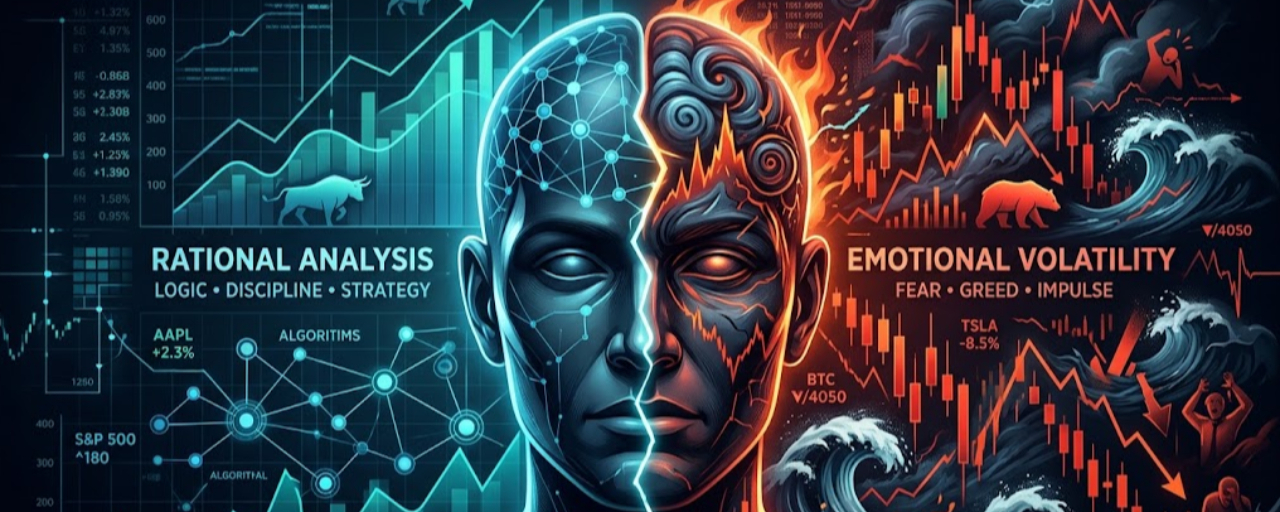

In the financial market, whether you trade cryptocurrencies, stocks, or Forex, it’s common to think that the key to success lies in mastering technical analysis, deciphering candlestick patterns, or following the latest macroeconomic news. However, experienced traders know that a perfect strategy is worth very little if the trader’s mind is not under control. Trading psychology accounts for more than 80% of consistent investment success.
The 4 Horsemen of the Trader’s Apocalypse
To trade with discipline, you must first learn to recognize the most common mental traps that lead to capital loss:
1. Fear (Fear of losing and FOMO)
Fear of losing: It makes you close winning trades too early out of fear that the market will turn, or it keeps you from entering valid trades due to analysis paralysis.
FOMO (Fear Of Missing Out): The fear of being left out pushes you to buy at the highest point when an asset has already risen too much, exposing you to severe corrections.
2. Greed
It leads you to overleverage, ignore risk management, or not take profits in time while waiting for the price to rise indefinitely. Greed turns structured trading into casino gambling.
3. Confirmation Bias
It’s the natural tendency to look only for information, news, or analysis that supports your current position (whether bullish or bearish), ignoring objective market signals that indicate you’re wrong.
4. Revenge Trading
It happens after suffering a painful loss. Driven by pride and rage, you look for payback by opening positions immediately without prior analysis, which usually triggers even greater losses.
Strategies to Master Your Mind When Trading
Accept uncertainty and the cost of trading: Losses are an inevitable part of the process. No system has 100% effectiveness. Understand that losing in a single trade doesn’t define your ability as a trader.
Build a strict Trading Plan: Define your entry points, Stop Loss, Take Profit, and the risk percentage per trade before opening any position. Trading without a plan means trading under the influence of emotion.
Keep a Trading Journal: Record not only the technical data (price, asset, result), but also your emotional state before, during, and after the trade. Identifying your emotional patterns will allow you to correct them.
Follow the 1-2% Rule: Don’t risk more than 1% or 2% of your total capital on a single trade. Knowing that a loss won’t wipe out your account will keep your stress level under control.
Know when to step back: If you experience a streak of consecutive losses or feel frustration, close the platform. The market will still be there tomorrow.
Trading isn’t a test of speed; it’s a test of endurance. Mastering the chart is only half the journey; the other half is mastering the inner dialogue that happens every time you click "buy" or "sell".$BTC $ETH $BNB


