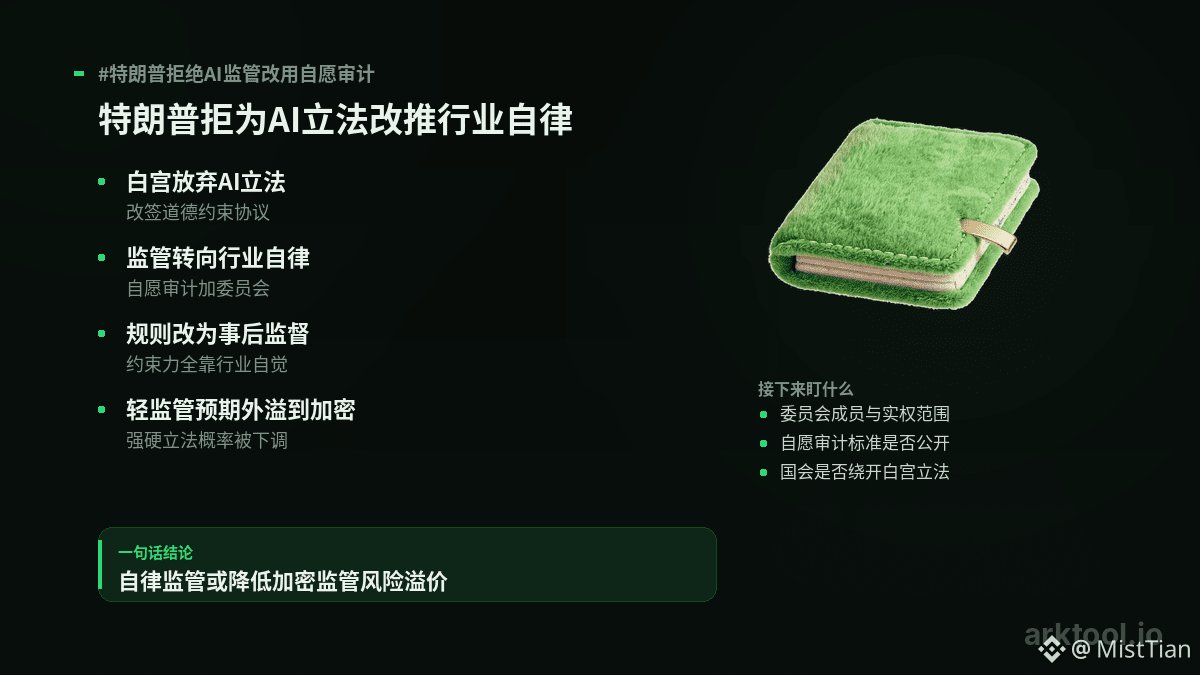
Trump does not plan to set regulations for AI. He signed a “moral restraint” agreement, asking the industry to police itself, with voluntary audits in cooperation, and also forming a supervisory committee.
The key point is that the nature of the rules has changed: from “legal compulsion and pre-approval” to “industry self-regulation and post-hoc oversight.” The threshold is low and it moves fast, but the binding force relies entirely on self-discipline.
This has to do with crypto, because the regulatory interpretation will spill over. When Washington chooses to pause a new technology and let the industry set its own standards first, the market will infer that for the same kind of fast-iterating, ambiguous-boundary sectors, the probability of tough legislation is also falling. If the risk premium drops a bit, investors are more willing to price the growth narrative a little more.
$SOL is a fairly typical vehicle for this kind of narrative. The direction combining AI with on-chain applications mostly needs an environment with high throughput and low fees to run—this chain fits that positioning perfectly. Once the expectation of light regulation is established, the imagination space for AI concepts and public-chain application-layer use cases will be brought back into the conversation.
Next, watch three things: who makes up the supervisory committee and whether it has real authority; what voluntary audits actually audit and whether the results are public; and whether Congress will bypass the White House and push legislation of its own. If the committee is only a rubber-stamp, then this whole move is just a matter of sentiment. But if it truly sets a set of auditable standards that can be enforced, then it effectively lays out a compliance pathway for the industry—only then does it have a chance of sustaining momentum.
#特朗普拒绝AI监管改用自愿审计
The key point is that the nature of the rules has changed: from “legal compulsion and pre-approval” to “industry self-regulation and post-hoc oversight.” The threshold is low and it moves fast, but the binding force relies entirely on self-discipline.
This has to do with crypto, because the regulatory interpretation will spill over. When Washington chooses to pause a new technology and let the industry set its own standards first, the market will infer that for the same kind of fast-iterating, ambiguous-boundary sectors, the probability of tough legislation is also falling. If the risk premium drops a bit, investors are more willing to price the growth narrative a little more.
$SOL is a fairly typical vehicle for this kind of narrative. The direction combining AI with on-chain applications mostly needs an environment with high throughput and low fees to run—this chain fits that positioning perfectly. Once the expectation of light regulation is established, the imagination space for AI concepts and public-chain application-layer use cases will be brought back into the conversation.
Next, watch three things: who makes up the supervisory committee and whether it has real authority; what voluntary audits actually audit and whether the results are public; and whether Congress will bypass the White House and push legislation of its own. If the committee is only a rubber-stamp, then this whole move is just a matter of sentiment. But if it truly sets a set of auditable standards that can be enforced, then it effectively lays out a compliance pathway for the industry—only then does it have a chance of sustaining momentum.
#特朗普拒绝AI监管改用自愿审计