



Author: Gemini, Deepwave TechFlow
On September 29, Bitwise was formally listed and began trading its first U.S. NEAR spot ETF on the NYSE Arca (ticker: NRR). After the news was released, nerves across the entire crypto market were stirred again. After all, over just the past month, NEAR rallied from lows around $1.6 to $5.4, delivering a performance of nearly a threefold gain.
Amid the frenzy of bullish sentiment, many investors instinctively interpret this ETF as a signal of large-scale institutional capital finally moving in.
However, when you break down the underlying terms of this fund and cross-check them against the actual business changes that have occurred over the past two months in NEAR, you’ll find that the background color of the market is more complex than what the press release suggests.
For NEAR’s token, this isn’t a fresh wave of institutional incremental bull market—the market has already run ahead of expectations.
The channel isn’t running water—Wall Street’s gateway is discounted too early
The launch of the first single-asset spot ETF is significant mainly because it opens a compliant entry path for U.S. traditional capital. But building a pipeline doesn’t mean the pipeline will be filled with money immediately.
From the product details disclosed by Decrypt, Bitwise has designed a “spot holdings plus staking” model for NRR:
The fund charges a 0.75% annual management fee and invests all underlying tokens into on-chain staking to earn roughly a 5% annualized return. To cover node setup and custody costs, Bitwise takes 33% of the staking rewards; the remaining two-thirds are then converted back into the fund’s net asset value.
Logically, this structure is seamless. As long as there are net inflows of funds from outside the chain, the custodian Coinbase must buy an equivalent amount of tokens in the spot market and lock them up.
But the crux of the problem lies in the time lag.
The near threefold rally from late August to late September has, in fact, already consumed most of the market’s favorable expectations for a “successful review” and an “initial listing.” Before Bitwise discloses truly scalable, sustainable daily net subscription data, NRR is only an entry ticket displayed in a storefront. If the off-exchange buy orders don’t form the expected flood, the combination of overly high leverage and a crowded positioning structure is extremely likely to be hit hard by profit-taking selloffs.
Intent Network (Intents) and AI agents
If the ETF itself is merely the point where expectations get realized, then what actually drove NEAR to deliver a strong independent行情 in the third quarter was a valuation anchor change achieved through its ecosystem positioning.
In its Wall Street pitch materials, Bitwise completely abandons the outdated “Ethereum killer” narrative and instead redefines NEAR as machine money and a cross-chain settlement layer for the era of autonomous AI agents. This positioning precisely hits the current market’s logic for chasing AI infrastructure in the next market.
More importantly, NEAR has produced a business carrier that can be verified.
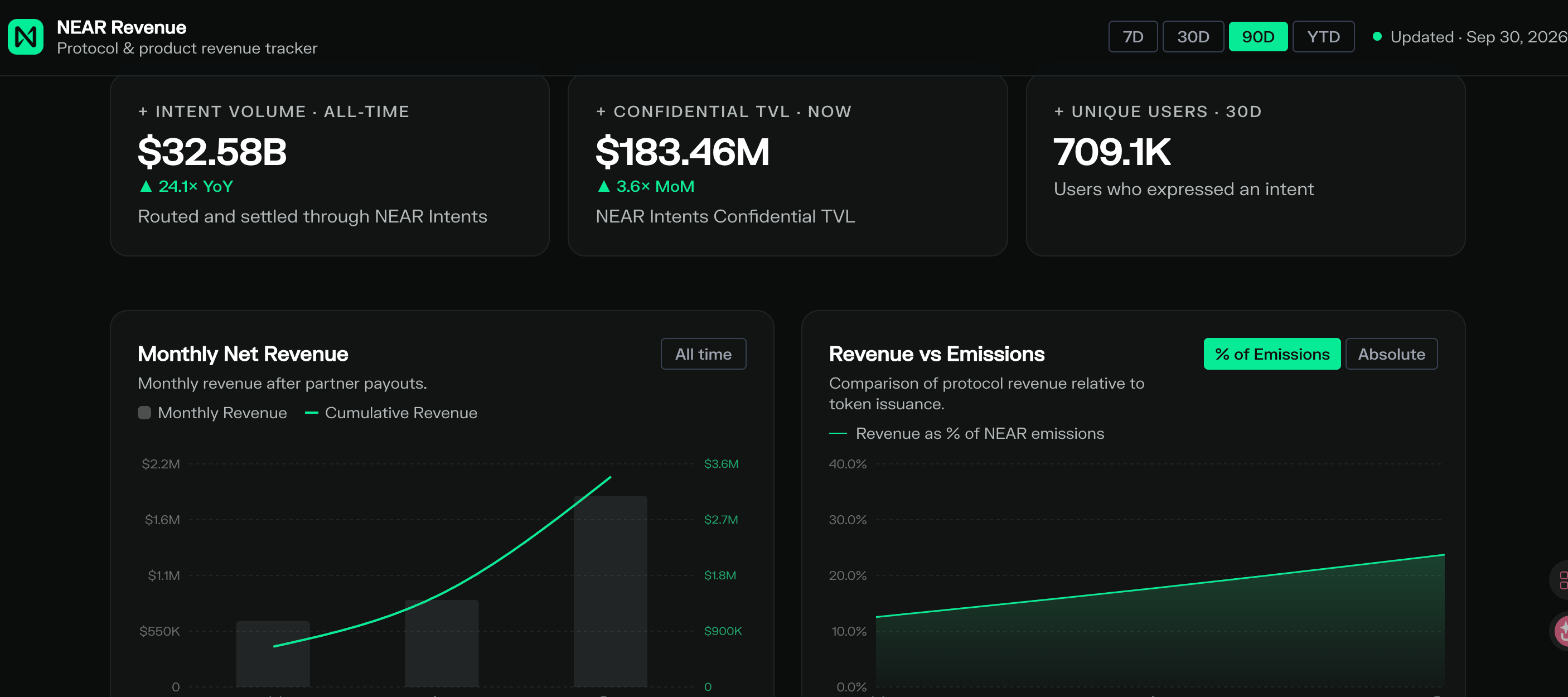
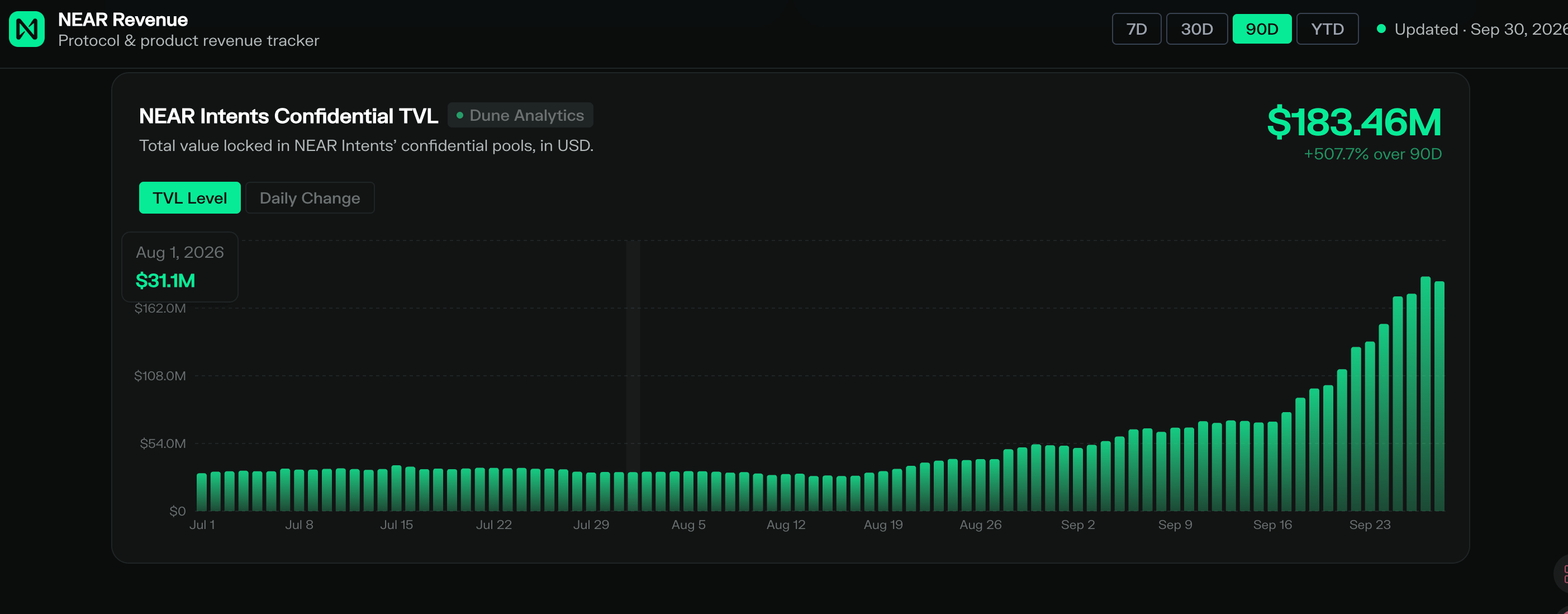
Relying on the cross-chain intent protocol (NEAR Intents), its historical cumulative matched transaction volume has exceeded $32 billion, connecting dozens of public chains. For future AI agents that will interact with high frequency on-chain, they need a funds routing channel that isn’t tied to a single custodian, has low friction, and responds quickly. NEAR’s use of chain-signature technology perfectly locks in this ecosystem niche for machine routing. In addition, after its confidential intents (Confidential Intents) launched in mid-September, the throughput of privacy channels rapidly surged, once taking up nearly half of the action on the front end. This tapped into the industry-wide resonance rhythm of privacy trading on-chain heating back up.
Instead of discounting NEAR according to traditional Layer 1 hardware logic, Julia is elevating it to the level of a global settlement gateway in the AI era—this is the very hype target that long positions are so eager to pump.
Two hundred million in revenue VS one and a half hundred million in inflation
With a surge in network usage, NEAR has accordingly rewritten its token economics model, hopping onto the hottest current “protocol buyback” shuttle.
Currently, the protocol has already cut the annual inflation cap from 5% to 2.5%, and token allocations for early investors and the team were fully settled last autumn as well, leaving no massive unlock cliff on the books. Even more crucially, the protocol has opened a fee switch this year, taking the trading fees earned by Intents—real money—and using them to buy back tokens in the public market.
This closed-loop system sounds very enticing, but if you carefully run the numbers using the real ledgers, you’ll find it’s still in the early phase of a fragile equilibrium. Based on current data, NEAR’s protocol net revenue for one year is roughly around $20 million. Meanwhile, at today’s market cap of over $6 billion, annual inflation of 2.5% means there will still be about $150 million of additional sell pressure created out of thin air every year.
This means that buybacks from fees at the current stage can only offset about 13% of the new inflation. The notion of “buybacks equal deflation” is still a distant critical-point expectation. The higher the coin price rises, the larger the dollar market value of inflation corresponds to. To achieve balanced income and expenses, the protocol’s threshold for average daily trading volume is pushed even higher. Once the matching volume of cross-chain intents later declines, this self-reinforcing flywheel based on perfect assumptions could be falsified at any time.
Clarifying a misreading
During the rapid price surge, panic emerged in the community: that once the token rises to $6.66, it will trigger large unlock selling pressure. This panic peaked after NEAR’s official X (Twitter) posted a preview poster on September 26: “NEAR@6.66 next.”
Officially, they did set $6.66 as the trigger condition for the next round of the event and clearly marked in the poster an unlock reward pool of 666,666 NEAR. Many investors instinctively view it as overhead sell-pressure. But with a simple book calculation, you’ll find that this worry lacks any support from common sense.

First of all, the size is extremely small. Even if the final 666,000 tokens are fully exchanged into the circulating supply at a price of $6.66, their total value would be only around $4.4 million. For an asset with a circulating market cap of over $6 billion and daily trading volume often reaching hundreds of millions of dollars, the market-cap share of this activity capital is less than 0.07%—and when thrown into the market, it can barely stir up any ripples.
Second, the rules haven’t been implemented yet. Referring to the official previous $3.33 reward mechanism, token distribution requires simultaneously meeting two demanding conditions: “privacy application TVL meeting the threshold” and “the price maintaining the target level for several days.” So far, the official has only released a preview poster; the specific TVL threshold and number of maintenance days have not been announced.
Put aside these imaginary noises. This doubled行情 leaves traders with a proposition that is extremely real: the narrative has already been fully told, and the ETF is already listed. What will determine whether NEAR can hold steady above $5 or slides into a slow downturn are only two indicators that cannot be falsified:
First, Bitwise, in the coming trading days, will release consistent and solid ETF net inflow data, proving that traditional financial capital truly recognizes this AI story. Second, can NEAR Intents keep weekly trading volume stable above $800 million to $1 billion, thereby providing a steady supply of ammunition for buybacks? Before the data answers come in, treating a brand-new compliance entry point as a chase-high trump card usually requires paying a heavy liquidity cost.