#Chainlink推出银行接入SWIFT账本框架 The key to this trending topic is not “SWIFT all payments have been fully put on-chain,” but how banks can connect to a new ledger while retaining control.
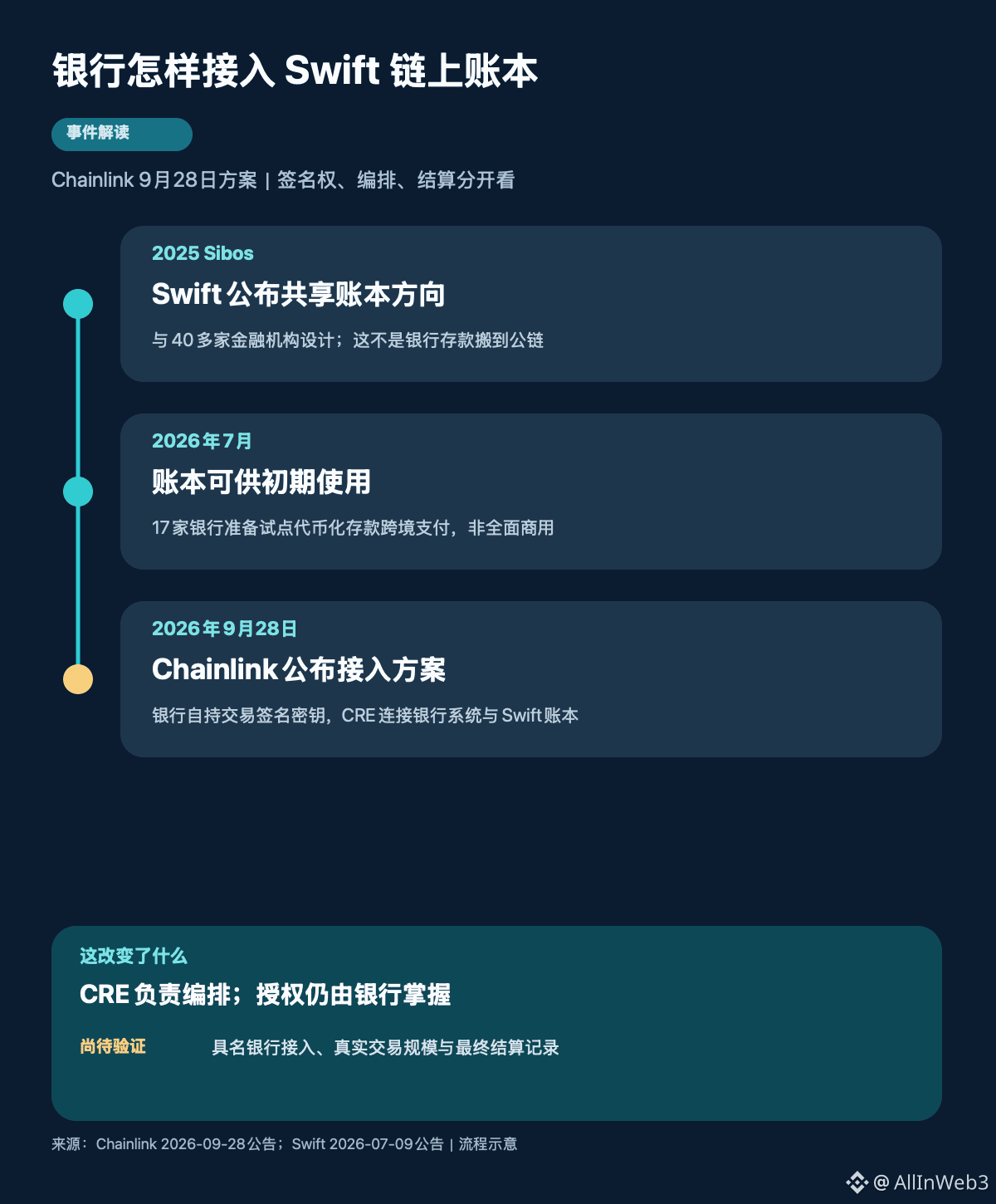
First, look at the timeline. In 2025, Swift unveiled a blockchain shared-ledger direction at Sibos. In July 2026, it said the ledger is already available for initial use, and 17 banks are preparing to test cross-border transactions with tokenized deposits. On September 28, Chainlink published a separate integration approach: using the Chainlink Runtime Environment (CRE) to connect banks’ existing systems, signing infrastructure, and the Swift ledger. The first two nodes cover ledger progress, while the newest node covers the integration method—these cannot be conflated into “the 17 banks have already completed commercial payments via Chainlink.”
What’s most important to distinguish in the proposal are three layers. First, deposits are still recorded on each bank’s own ledger; the Swift ledger coordinates participation among banks in the transfer. Second, the transaction authorization keys remain controlled by the financial institutions themselves. CRE orchestrates cross-system workflows, but it does not replace bank signatures or take custody of deposits. Third, the Swift ledger is responsible for coordination before final settlement; final settlement still uses the mechanisms agreed by the parties—for example, real-time gross settlement systems. “All day” means the tokenized-deposit process can be initiated at night and on weekends; it does not mean all cross-border payments have immediate finality.
This should also be separated from another CCIP 2.0 upgrade published on September 28. CCIP focuses on cross-chain interoperability, while the bank integration approach for the Swift ledger emphasizes banks retaining their own keys and the CRE workflow. You cannot infer from two announcements that all Swift messages will go through CCIP, nor can you translate the cooperation framework directly into LINK immediate revenue.
What to look at next? When the named banks complete the integration, whether they can disclose the true number of pilot transactions and amounts, and which final settlement mechanisms are actually used. Chainlink’s announcement says 17 lead institutions are using the ledger for pilots, while Swift’s July statement is “preparing for pilots.” Progress may change, so continued mutual verification and disclosure are still needed. Sources: Chainlink’s September 28 announcement and Swift’s July 9 announcement.
First, look at the timeline. In 2025, Swift unveiled a blockchain shared-ledger direction at Sibos. In July 2026, it said the ledger is already available for initial use, and 17 banks are preparing to test cross-border transactions with tokenized deposits. On September 28, Chainlink published a separate integration approach: using the Chainlink Runtime Environment (CRE) to connect banks’ existing systems, signing infrastructure, and the Swift ledger. The first two nodes cover ledger progress, while the newest node covers the integration method—these cannot be conflated into “the 17 banks have already completed commercial payments via Chainlink.”
What’s most important to distinguish in the proposal are three layers. First, deposits are still recorded on each bank’s own ledger; the Swift ledger coordinates participation among banks in the transfer. Second, the transaction authorization keys remain controlled by the financial institutions themselves. CRE orchestrates cross-system workflows, but it does not replace bank signatures or take custody of deposits. Third, the Swift ledger is responsible for coordination before final settlement; final settlement still uses the mechanisms agreed by the parties—for example, real-time gross settlement systems. “All day” means the tokenized-deposit process can be initiated at night and on weekends; it does not mean all cross-border payments have immediate finality.
This should also be separated from another CCIP 2.0 upgrade published on September 28. CCIP focuses on cross-chain interoperability, while the bank integration approach for the Swift ledger emphasizes banks retaining their own keys and the CRE workflow. You cannot infer from two announcements that all Swift messages will go through CCIP, nor can you translate the cooperation framework directly into LINK immediate revenue.
What to look at next? When the named banks complete the integration, whether they can disclose the true number of pilot transactions and amounts, and which final settlement mechanisms are actually used. Chainlink’s announcement says 17 lead institutions are using the ledger for pilots, while Swift’s July statement is “preparing for pilots.” Progress may change, so continued mutual verification and disclosure are still needed. Sources: Chainlink’s September 28 announcement and Swift’s July 9 announcement.