

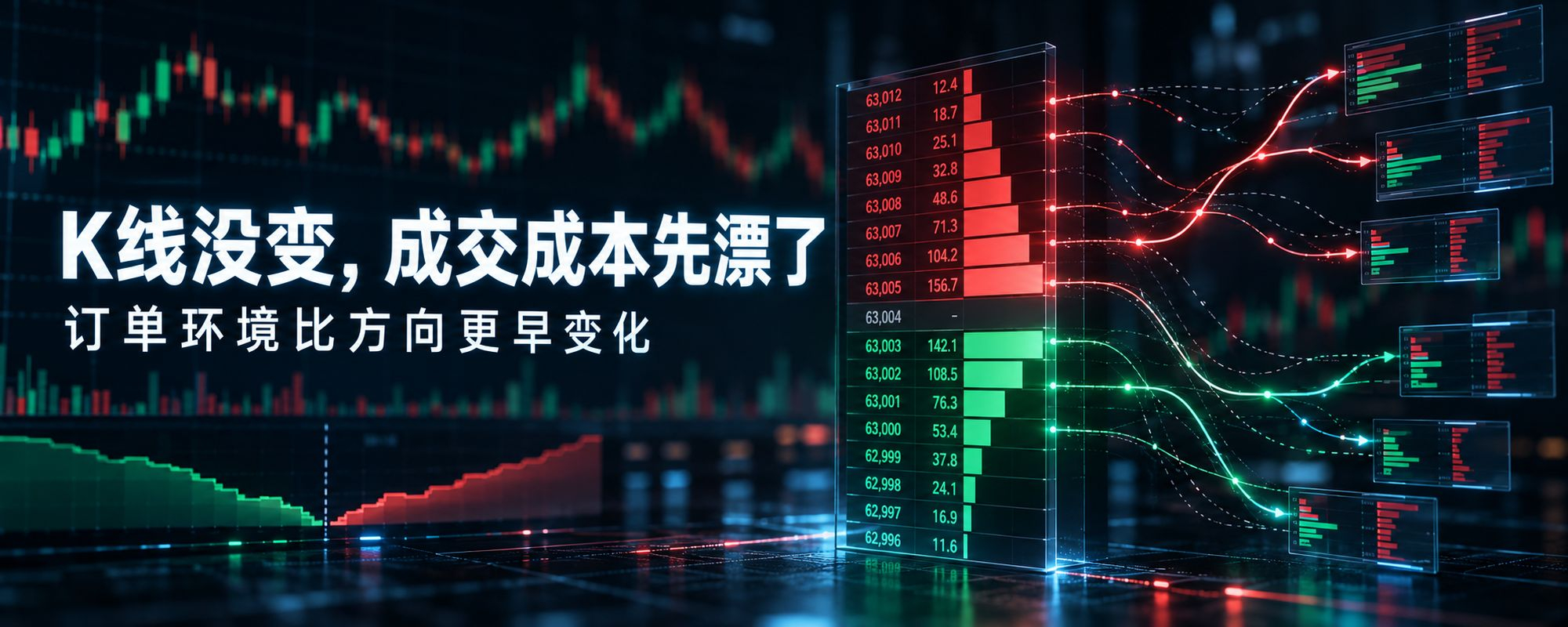

The K-line hasn’t changed—the execution cost has drifted first
Today BTC is still hovering around $83,000, and on the surface the chart doesn’t look too extreme: price moves aren’t big, and trading is still concentrated among major assets. But the more a market looks like it “hasn’t moved much,” the easier it is for short-term traders to misjudge one thing: just because the chart hasn’t changed dramatically doesn’t mean the order environment hasn’t changed.
Many people review a perpetual contract trade, only looking at the entry price and the final profit or loss. The problem is that what truly ruins the experience in between is often not that single K-line, but rather the order book quote levels you face when placing the order: the depth, the bid-ask spread, and the execution slippage.
It’s the same with chasing a BTC or ETH trade: on the chart, it might look like you’re only off by a few dollars, but the actual fills can be completely different. What you see is the price line, while what the order actually consumes is the order book. The first layer of bids still being there doesn’t mean all of the target quantity can be filled at that first layer; the total depth remaining doesn’t mean that canceling your order didn’t happen before you pressed the button; a marked price that looks stable doesn’t mean the trigger conditions, fees, and risk buffers are the same across every route.
That’s what I want to talk about today: “execution cost drift.”
It’s not a very obvious form of slippage in the traditional sense, and it may not loudly warn you on the order confirmation page. It’s more like a hidden kind of wear and tear: the spread widens from very tight to slightly wider, the quote levels shift from continuous to broken gaps, the available quantity in the first few tiers suddenly thins out, the speed of fill replenishment slows down, and when you exit, the execution holding your liquidity isn’t as comfortable as when you entered. Individually, none of these items sounds terrifying, but put them together in high-frequency test orders, chasing rallies and fading pullbacks, and quickly switching direction—and it turns into profit losses trade by trade.
The most troublesome part is that this drift often happens before the price has even clearly started to move.
When the market just heats up, traders focus on the breakout and act fast. But liquidity providers focus on risk—canceling orders and adjusting quotes may happen even earlier than retail traders react. So you think you’re trading the same chart, but you’re actually trading in different order environments: one person gets filled at the front-of-book quotes, another gets filled farther back; when someone exits, depth is still there, while someone else can only accept worse fills; some people think the direction is right, only to find that their profits were shaved down by execution costs.
So I’m not too keen on attributing every bad outcome to “you got the direction wrong.”
Direction certainly matters, but in perpetual futures, direction is only the first-layer problem. The second-layer problem is: is the order environment at this moment actually worth placing a trade? How many quote layers will your target size consume? Has the spread suddenly widened? After the fill deviation expands, is the original risk buffer still sufficient? Are the entry path and the exit path equally smooth? Have venue rules, depth, and fee structures started to diverge?
If you don’t check these questions before placing the order, what people call a “buy at the same price” is really just psychological comfort. The real result will be repriced by a chain of execution details.
I prefer to break the pre-trade checks into three steps:
First, look at the quote tiers, not just the latest price. The latest price tells you where the market is currently showing; the quote tiers tell you how far your order might actually eat into the book.
Second, look at depth changes, not only total traded volume. Total traded volume shows what happened in the past, while depth changes are much closer to what your next order will encounter.
Third, look at path differences rather than assuming every place is the same. Perpetual futures aren’t just one “price.” Behind it are also trading fees, spread, mark price, trigger conditions, matching speed, and how well your exit will be absorbed.
That’s also why I think execution-views like PerpEX will become more and more meaningful. Not to help you judge direction, but to put the quote tiers, depth, fees, fill deviation, and rules from different venues together before you hit the button. Choose the asset first, then compare the order environment, and finally decide which path this order will take.
In a fast-moving market, the most expensive thing isn’t watching for a few more seconds—it’s that you think you’re only buying the direction, while you’re actually buying an entire set of execution conditions at the same time.
#BTC #contract trading