


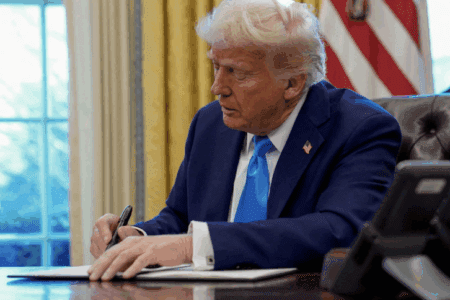
On the 29th at the White House, U.S. President Trump and senior executives from multiple technology companies signed a voluntary artificial intelligence (AI) safety agreement. The agreement calls on companies developing cutting-edge AI models to put in place more robust internal controls, external review, and board oversight mechanisms to ensure AI systems operate as intended. The Trump administration currently favors having companies manage AI risks themselves, and views AI technology development and U.S.-China competition as one of its policy considerations.
Trump advocates for corporate “self-regulation.”
Titled the “Joint Commitment on Frontier Responsibilities,” the agreement requires companies to establish enhanced internal control mechanisms, with internal teams responsible for supervision, followed by review by independent external audit firms. It also calls for a committee of the company’s board of directors to oversee relevant audit findings. The agreement mainly addresses cybersecurity and system-containment risks that frontier AI models may pose, including scenarios where models hack into or access technical systems under unintended conditions.
In the White House, Trump said he has already seen the technology industry move toward “large-scale self-regulation,” and that companies understand they must take responsibility for management themselves. He described the agreement as having “moral force,” but it is not a regulatory measure with legal compulsion. The agreement also leaves open the possibility of incorporating the related commitments into laws or regulatory frameworks in the future.
Technology executives who participated in signing include Google CEO Sundar Pichai, Anthropic CEO Dario Amodei, Meta CEO Mark Zuckerberg, OpenAI President Greg Brockman, Nvidia CEO Jensen Huang, and xAI CEO Elon Musk.
This agreement comes as global attention to the risks of advanced AI systems continues to heat up. Trump has continued to oppose reducing risk by slowing down AI development, and he listed maintaining the United States’ technological advantage in AI and competing with China as key considerations.
The White House also同步 uses the term “Super Intelligence”
That day, Trump also signed an executive order requiring relevant federal government documents to replace the term “Artificial Intelligence” (AI) with “Super Intelligence” (SI). The Trump administration believes that “super intelligence” better reflects the potential brought by rapid advances in the relevant technologies.
Besides discussing AI safety, the White House meeting also covered industry development and data center construction. Trump also said the United States will not promote joint-venture companies for joint AI development between the United States and China.
David Sacks, chair of the President’s Council of Advisors on Science and Technology, said the meeting brought together leaders from chip, data center, and advanced AI model companies. Through signing the agreement, companies commit to strengthening product-safety development, internal controls, and external audits. He believes that in situations where international agreements may take longer to form, having companies first establish self-regulatory mechanisms can advance both AI safety and industry development at the same time.
Overall, this agreement does not establish any new mandatory AI regulatory regime. Instead, it relies on companies to pledge to set up their own safety controls, external reviews, and board oversight mechanisms, while leaving room for the possibility of further incorporation into legal or regulatory frameworks in the future.
Source