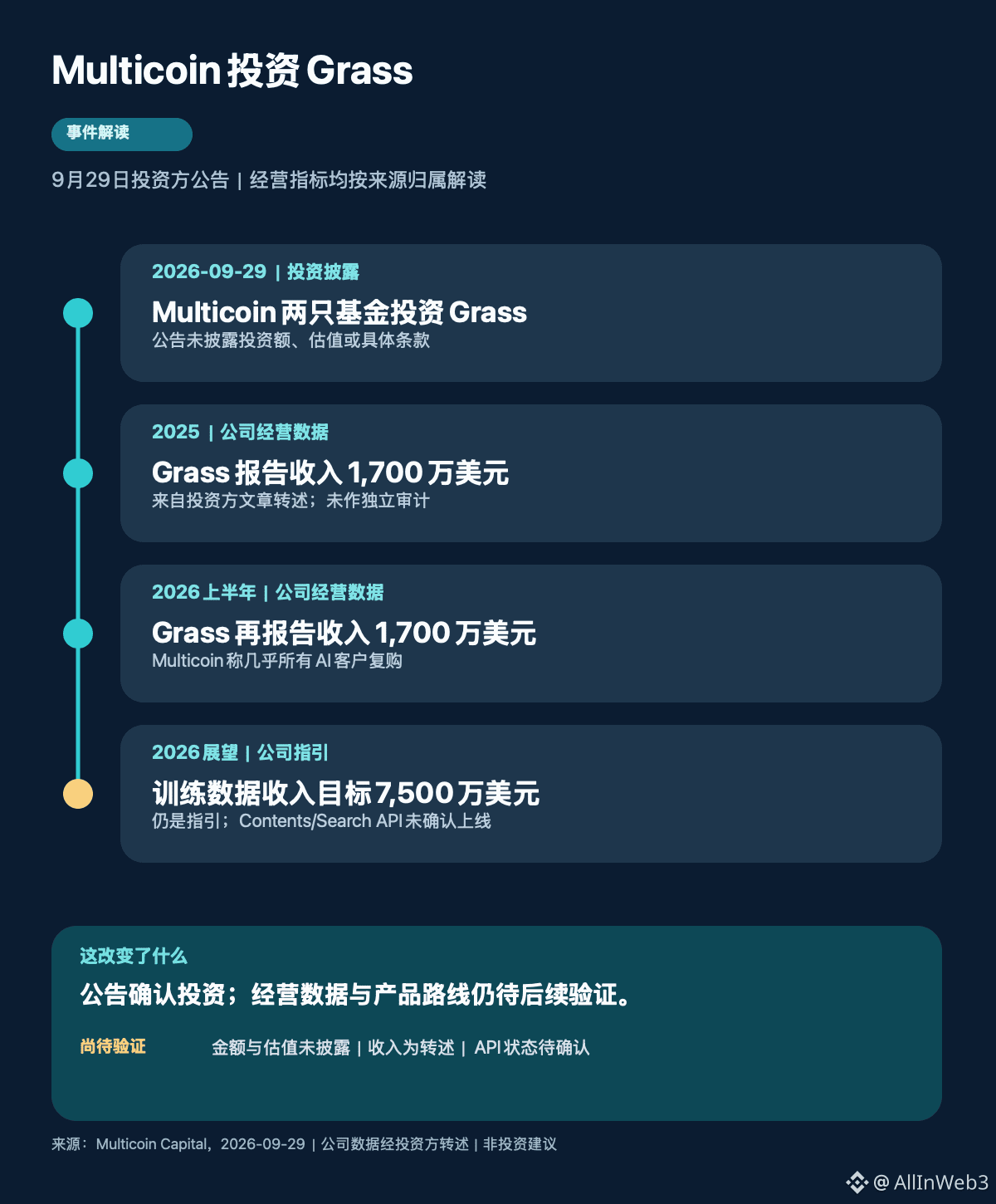
#Grass:Multicoin, on September 29, stated that both its hedge fund and its venture capital fund have invested in Grass. The announcement confirms institutional participation, but it does not disclose the investment amount, valuation, round, or terms. Therefore, we cannot expand “investment” into specific fundraising figures, nor infer directly any value capture by the token. Because the amounts and terms have not been made public, external readers cannot assess what proportion this investment represents within Grass’s capital structure, nor can they determine whether the investment is accompanied by token purchases, token lockups, or other arrangements. These questions require further disclosure from the project team or the investor.
What is more worth dissecting this time is the commercialization narrative. In its article, Multicoin cites Grass as saying: 2025 revenue was $17 million, and in the first half of 2026 it was another $17 million; nearly all AI customers have made repeat purchases, and the article also claims that Grass is profitable. The data source here is a retelling of Grass’s figures by an investor’s article, not financial statements independently audited by us. If the accounting basis is sustainable, it suggests the project is not only pitching a bandwidth-contributor network, but also attempting to demonstrate that there is paid demand for its training-data service. However, customer repeat purchases and platform revenue do not automatically translate into GRASS token demand. The investor’s article provides important clues, but it is still a public statement from a single interested party. At present, “profitability” should not be taken as an audited profit margin, cash flow, or a guarantee of future growth.
The third layer is the product and expectations. Multicoin writes that the next product directions include the Contents API and the Search API, plus web indexing; this is not proof that these features are already live. The article also states that 2026 training-data revenue of $75 million is part of the company’s guidance, which still remains to be realized. In terms of timeline, already occurred are the September 29 investment announcement and earlier company operational disclosures; still to be verified are when the APIs will be available, whether customer revenue can be repeated, and whether growth can be converted into value that token holders can observe.
Compared with the GRASS perpetual market-structure post (372019651315781) sent by this account at 05:11, what this piece adds is the investor’s announcement and commercialization leads. It does not establish a causal link between the two and short-term price fluctuations. Next, we should look for official product launches, verifiable revenue/customer disclosures, and clearly defined token-value capture mechanisms. Information comes from public investor articles and is attributed as stated in the original text; it does not constitute investment advice.
What is more worth dissecting this time is the commercialization narrative. In its article, Multicoin cites Grass as saying: 2025 revenue was $17 million, and in the first half of 2026 it was another $17 million; nearly all AI customers have made repeat purchases, and the article also claims that Grass is profitable. The data source here is a retelling of Grass’s figures by an investor’s article, not financial statements independently audited by us. If the accounting basis is sustainable, it suggests the project is not only pitching a bandwidth-contributor network, but also attempting to demonstrate that there is paid demand for its training-data service. However, customer repeat purchases and platform revenue do not automatically translate into GRASS token demand. The investor’s article provides important clues, but it is still a public statement from a single interested party. At present, “profitability” should not be taken as an audited profit margin, cash flow, or a guarantee of future growth.
The third layer is the product and expectations. Multicoin writes that the next product directions include the Contents API and the Search API, plus web indexing; this is not proof that these features are already live. The article also states that 2026 training-data revenue of $75 million is part of the company’s guidance, which still remains to be realized. In terms of timeline, already occurred are the September 29 investment announcement and earlier company operational disclosures; still to be verified are when the APIs will be available, whether customer revenue can be repeated, and whether growth can be converted into value that token holders can observe.
Compared with the GRASS perpetual market-structure post (372019651315781) sent by this account at 05:11, what this piece adds is the investor’s announcement and commercialization leads. It does not establish a causal link between the two and short-term price fluctuations. Next, we should look for official product launches, verifiable revenue/customer disclosures, and clearly defined token-value capture mechanisms. Information comes from public investor articles and is attributed as stated in the original text; it does not constitute investment advice.