



Bitcoin’s recent rally may face a short-term correction. CryptoQuant research head Julio Moreno noted that the unrealized profit rate of short-term traders has risen to a 21-month high, and with spot demand continuing to contract and growth in futures market demand slowing, multiple indicators suggest that market momentum is weakening.
Profit-taking heats up as short-term traders’ profit margin hits a record high
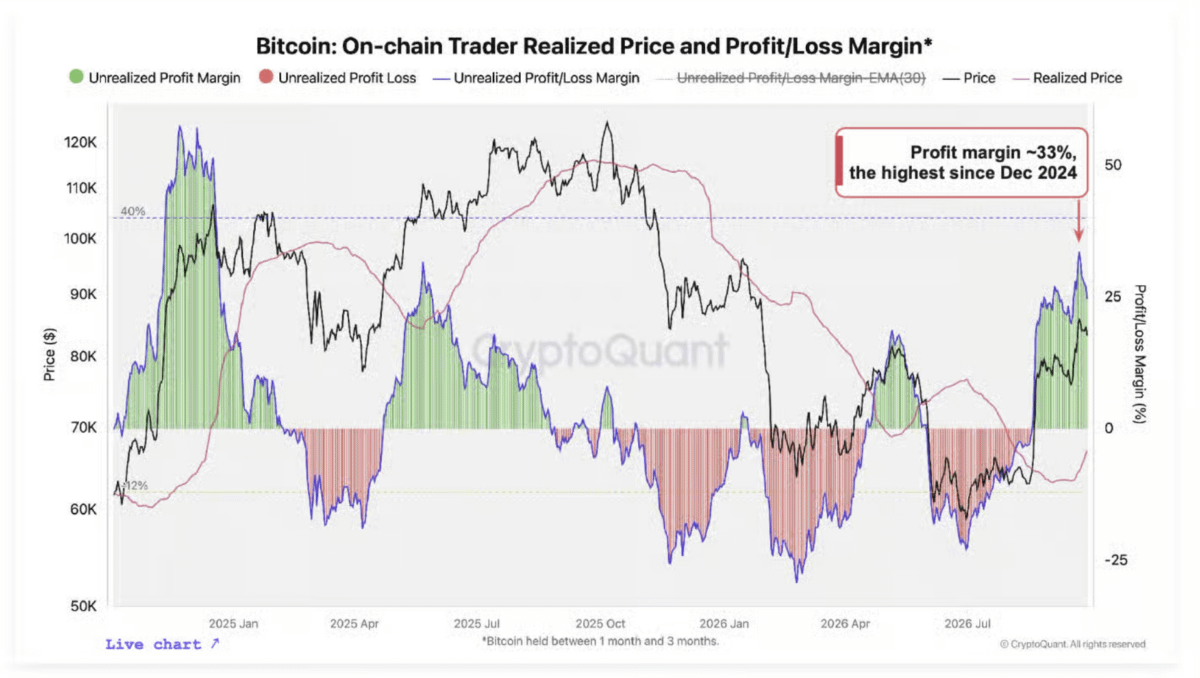
In a report released on Tuesday, Moreno said that Bitcoin closed last week above the 365-day moving average, confirming that the market has entered a new bull market phase; CryptoQuant’s “Bitcoin Bull Market Score Index” currently stands at 90 points and is in the “extremely bullish” range. However, after Bitcoin once rose to an eight-month high of $87,400, the market began showing signs of taking profits.
CryptoQuant data shows that the on-chain unrealized profit rate for short-term traders has risen to 33%, the highest level since December 2024. Moreno said that when profit rates reach similar levels, traders typically have more incentive to lock in some gains, which may increase market sell pressure.
On September 22, Bitcoin holders realized profits of 25,700 BTC in a single day, setting the highest single-day record since 2026. Moreno said this indicates that as Bitcoin approaches recent highs, holders have begun increasing profit-taking. Similar patterns that have occurred before market local highs often follow strong rallies.
A similar signal has also emerged in the altcoin market. Over the past 7 days, the cumulative number of transactions involving altcoin deposits to exchanges reached 76,000, the highest since October 17, 2025. In the same period, the number of addresses depositing altcoins to exchanges rose to 51,000, also hitting a near-one-year high. Moreno noted that this increase was not driven by a small number of large wallets, but rather by broader fund movements. Since transferring tokens to exchanges is usually related to intentions to sell, the data may reflect rising potential sell pressure.
Spot demand contracts while futures growth slows significantly
Apart from profit-taking pressure, market demand has also started to cool. Moreno said Bitcoin’s “apparent spot demand” has fallen by about 170,000 BTC over the past 30 days. On the other hand, one of the main forces driving Bitcoin’s rise recently—speculative futures demand—has also seen its growth scale sharply slow from 164,000 BTC on September 14 to 16,000 BTC on September 29.
Moreno believes that without new demand, the price uptrend will be harder to sustain. As spot demand continues to contract and futures demand growth begins to stall, further upside for Bitcoin in the short term may be limited.
Corrections may still be healthy consolidation within a bull market
If Bitcoin experiences a correction, Moreno believes the 365-day moving average of around $80,000 will become the first support. If price moves further downward, the 200-day moving average of about $71,000 and the on-chain realized price of around $67,000 would be important support zones.
Moreno said that as long as the above support levels hold, a pullback to these zones can still be viewed as a healthy consolidation within a “young bull market,” not a reversal of the market trend.
Overall, CryptoQuant believes that while Bitcoin is still in a bull market, signs of weakening momentum have appeared in the short term, including elevated profit rates for short-term traders, record highs in daily profit-taking in 2026, increased altcoin inflows to exchanges, and a simultaneous cooling in both spot and futures demand—all of which raise the likelihood of a near-term price correction.
Source