
Gm, #学堂日报 September 30 Market Overview
1️⃣ Market Overview
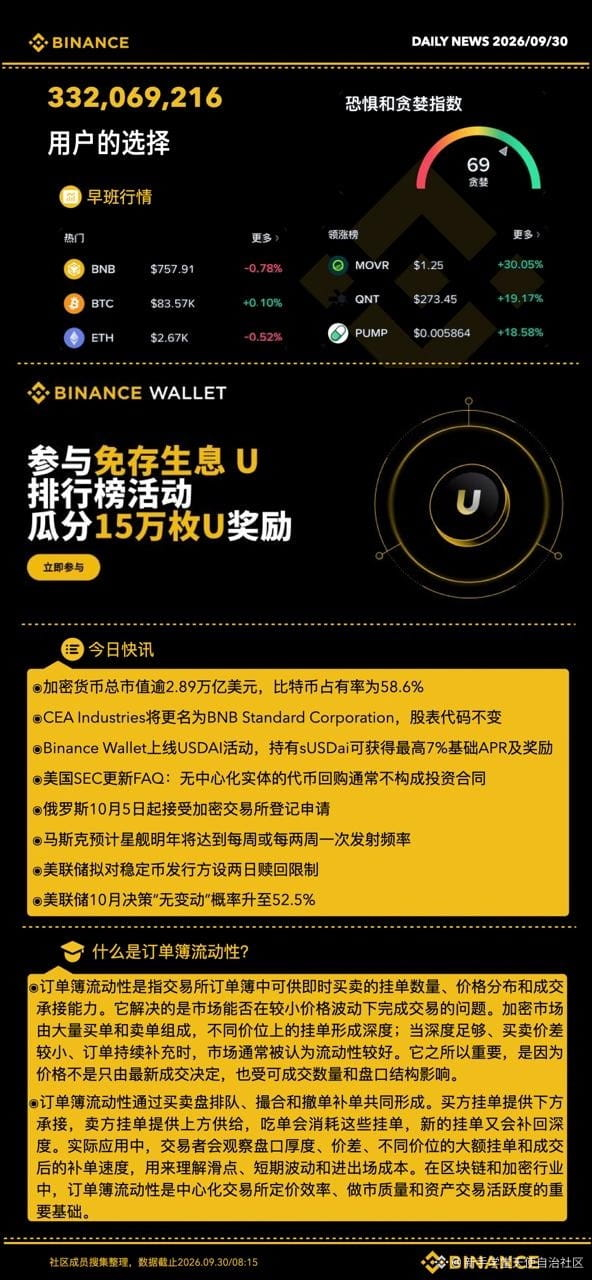
▪ The total market capitalization of cryptocurrencies is approximately $2.89 trillion, with Bitcoin accounting for a 58.6% market share.
▪ The Fear & Greed Index is 69 (Greed), and market sentiment remains relatively strong.
2️⃣ Binance Updates
▪ Binance Wallet has launched an “Earn Without Depositing” U leaderboard campaign. Users can participate to share a rewards pool of 150,000 U tokens.
▪ Binance Wallet has launched a USDAI campaign. Holding sUSDAI can earn up to a 7% base APR and related rewards.
▪ Binance Wallet continues to expand stablecoin yield and on-chain wealth management scenarios, offering users more asset management choices.
3️⃣ Industry Highlights
▪ CEA Industries will be renamed BNB Standard Corporation, with the stock ticker code unchanged.
▪ The U.S. SEC updates its FAQ, stating that token buybacks by entities without decentralization typically do not constitute an investment contract.
▪ Russia will begin accepting registration applications from crypto exchanges starting October 5.
▪ Musk expects Starlink could reach a launch frequency of once per week or once every two weeks next year.
▪ The Federal Reserve plans to impose a two-day redemption limit on stablecoin issuers.
▪ The market estimates the probability of the Federal Reserve keeping interest rates unchanged in October rises to 52.5%.
4️⃣ Today’s Quick Lesson: What is order book liquidity?
🔸 What is order book liquidity?
▪ Order book liquidity refers to the number of buy and sell orders available for immediate trading in an exchange’s order book, the distribution of prices, and the ability to match and execute trades.
▪ Simply put, it determines whether the market can complete a trade with relatively small price fluctuations.
🔸 How to read liquidity?
▪ The more orders on both the buy and sell sides, and the more tightly clustered the prices are, the better liquidity typically is.
▪ If the order book is thin, large trades are more likely to push prices to change quickly.
🔸 Why does it matter?
▪ The better the liquidity, the smaller the typical bid-ask spread, and the lower the slippage.
▪ When liquidity is insufficient, even if the market price looks good, the actual execution price may deviate from expectations.
🔸 How does the order book change?
▪ Buy and sell orders are continuously filled, canceled, and re-posted, so order book depth is dynamic.
▪ Traders usually assess short-term market conditions by combining order book depth, bid-ask spread, and trading volume.
Follow @新手学堂天使自治社区 for more updates 🚀
1️⃣ Market Overview
▪ The total market capitalization of cryptocurrencies is approximately $2.89 trillion, with Bitcoin accounting for a 58.6% market share.
▪ The Fear & Greed Index is 69 (Greed), and market sentiment remains relatively strong.
2️⃣ Binance Updates
▪ Binance Wallet has launched an “Earn Without Depositing” U leaderboard campaign. Users can participate to share a rewards pool of 150,000 U tokens.
▪ Binance Wallet has launched a USDAI campaign. Holding sUSDAI can earn up to a 7% base APR and related rewards.
▪ Binance Wallet continues to expand stablecoin yield and on-chain wealth management scenarios, offering users more asset management choices.
3️⃣ Industry Highlights
▪ CEA Industries will be renamed BNB Standard Corporation, with the stock ticker code unchanged.
▪ The U.S. SEC updates its FAQ, stating that token buybacks by entities without decentralization typically do not constitute an investment contract.
▪ Russia will begin accepting registration applications from crypto exchanges starting October 5.
▪ Musk expects Starlink could reach a launch frequency of once per week or once every two weeks next year.
▪ The Federal Reserve plans to impose a two-day redemption limit on stablecoin issuers.
▪ The market estimates the probability of the Federal Reserve keeping interest rates unchanged in October rises to 52.5%.
4️⃣ Today’s Quick Lesson: What is order book liquidity?
🔸 What is order book liquidity?
▪ Order book liquidity refers to the number of buy and sell orders available for immediate trading in an exchange’s order book, the distribution of prices, and the ability to match and execute trades.
▪ Simply put, it determines whether the market can complete a trade with relatively small price fluctuations.
🔸 How to read liquidity?
▪ The more orders on both the buy and sell sides, and the more tightly clustered the prices are, the better liquidity typically is.
▪ If the order book is thin, large trades are more likely to push prices to change quickly.
🔸 Why does it matter?
▪ The better the liquidity, the smaller the typical bid-ask spread, and the lower the slippage.
▪ When liquidity is insufficient, even if the market price looks good, the actual execution price may deviate from expectations.
🔸 How does the order book change?
▪ Buy and sell orders are continuously filled, canceled, and re-posted, so order book depth is dynamic.
▪ Traders usually assess short-term market conditions by combining order book depth, bid-ask spread, and trading volume.
Follow @新手学堂天使自治社区 for more updates 🚀