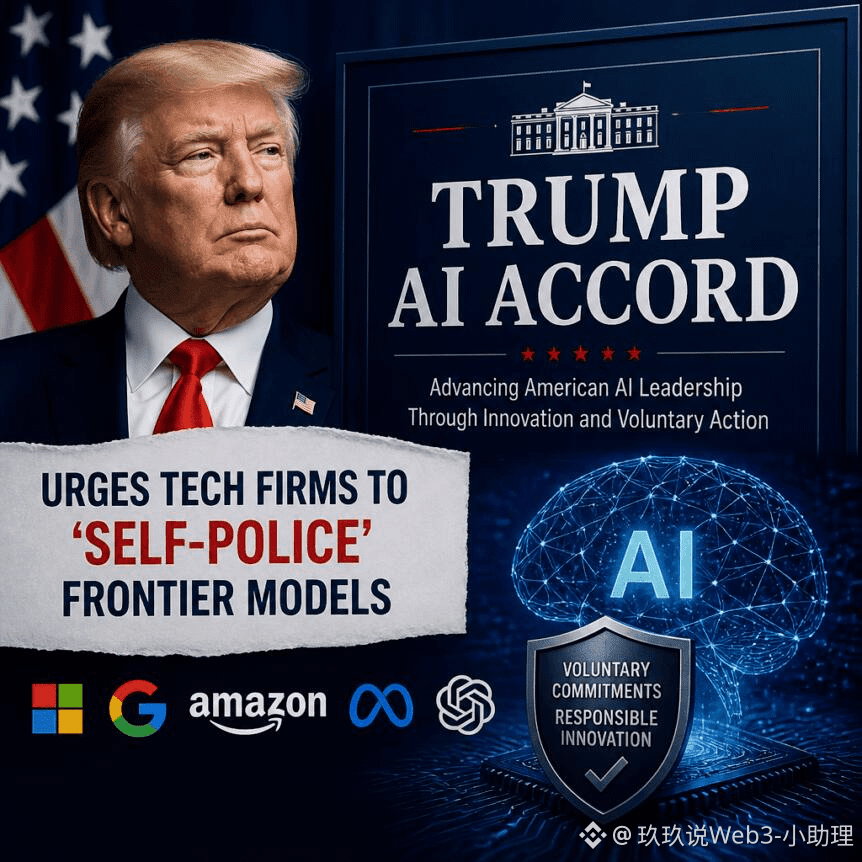
🚨 Trump pushes for AI “self-regulation”!
Tech giants sign an agreement, and AI oversight enters a new phase🔥
Group: 点击进入玖玖短线策略群
On September 29, U.S. President Trump met with executives from several leading tech companies at the White House and unveiled a voluntary agreement on accountability for cutting-edge AI. The participants include executives from companies such as Google, Anthropic, Meta, OpenAI, Nvidia, and xAI.
The core of this agreement is not to immediately roll out new mandatory legislation, but to require companies developing and deploying cutting-edge AI models to take on greater internal governance responsibilities. Under the agreement, companies must establish internal control systems, introduce independent external audits, and also involve the board of directors in related risk oversight.
📌 One of the key focuses is to prevent AI models from “intruding into or accessing technical systems in unintended ways” during operation. The real-world context behind this is also worth paying close attention to. Recently, discussions in the AI industry around autonomous operation, cybersecurity, and the risk of model misbehavior have been heating up. Some AI companies have also reported cases where AI agents exhibited abnormal behavior or even attempted to access other systems.
Trump emphasized “self-regulation” and placed this industry self-discipline approach within the U.S. policy environment to continue driving AI development.
But there is a crucial distinction here: this agreement is currently a voluntary commitment and is not equivalent to a new, legally binding regulatory statute. Trump described it as having “moral force,” while the agreement itself emphasizes that companies should implement the relevant control and audit mechanisms.
🔥 What matters even more to the market is that the agreement has not completely closed the door on future legislative oversight.
If, going forward, policymakers determine that companies’ self-regulation is insufficient, whether these commitments further translate into formal laws, audit standards, or other regulatory requirements will become a key area to watch.
Meanwhile, the Trump administration continues to stress the pace of development in the U.S. AI industry and technological competition with China. This means that today’s U.S. AI policy is simultaneously pursuing two goals: on one hand, advancing cutting-edge models, compute power, and data centers; on the other, building safety control mechanisms targeting advanced AI risks.
Click my profile to follow me for daily market outlook analysis and short-term trading strategies🚀
#Aİ #人工智能
Tech giants sign an agreement, and AI oversight enters a new phase🔥
Group: 点击进入玖玖短线策略群
On September 29, U.S. President Trump met with executives from several leading tech companies at the White House and unveiled a voluntary agreement on accountability for cutting-edge AI. The participants include executives from companies such as Google, Anthropic, Meta, OpenAI, Nvidia, and xAI.
The core of this agreement is not to immediately roll out new mandatory legislation, but to require companies developing and deploying cutting-edge AI models to take on greater internal governance responsibilities. Under the agreement, companies must establish internal control systems, introduce independent external audits, and also involve the board of directors in related risk oversight.
📌 One of the key focuses is to prevent AI models from “intruding into or accessing technical systems in unintended ways” during operation. The real-world context behind this is also worth paying close attention to. Recently, discussions in the AI industry around autonomous operation, cybersecurity, and the risk of model misbehavior have been heating up. Some AI companies have also reported cases where AI agents exhibited abnormal behavior or even attempted to access other systems.
Trump emphasized “self-regulation” and placed this industry self-discipline approach within the U.S. policy environment to continue driving AI development.
But there is a crucial distinction here: this agreement is currently a voluntary commitment and is not equivalent to a new, legally binding regulatory statute. Trump described it as having “moral force,” while the agreement itself emphasizes that companies should implement the relevant control and audit mechanisms.
🔥 What matters even more to the market is that the agreement has not completely closed the door on future legislative oversight.
If, going forward, policymakers determine that companies’ self-regulation is insufficient, whether these commitments further translate into formal laws, audit standards, or other regulatory requirements will become a key area to watch.
Meanwhile, the Trump administration continues to stress the pace of development in the U.S. AI industry and technological competition with China. This means that today’s U.S. AI policy is simultaneously pursuing two goals: on one hand, advancing cutting-edge models, compute power, and data centers; on the other, building safety control mechanisms targeting advanced AI risks.
Click my profile to follow me for daily market outlook analysis and short-term trading strategies🚀
#Aİ #人工智能