#sec主席拟推动股市上链
The SEC wants to put the stock market on-chain, but on-chain stocks are not the kind of stocks you think.
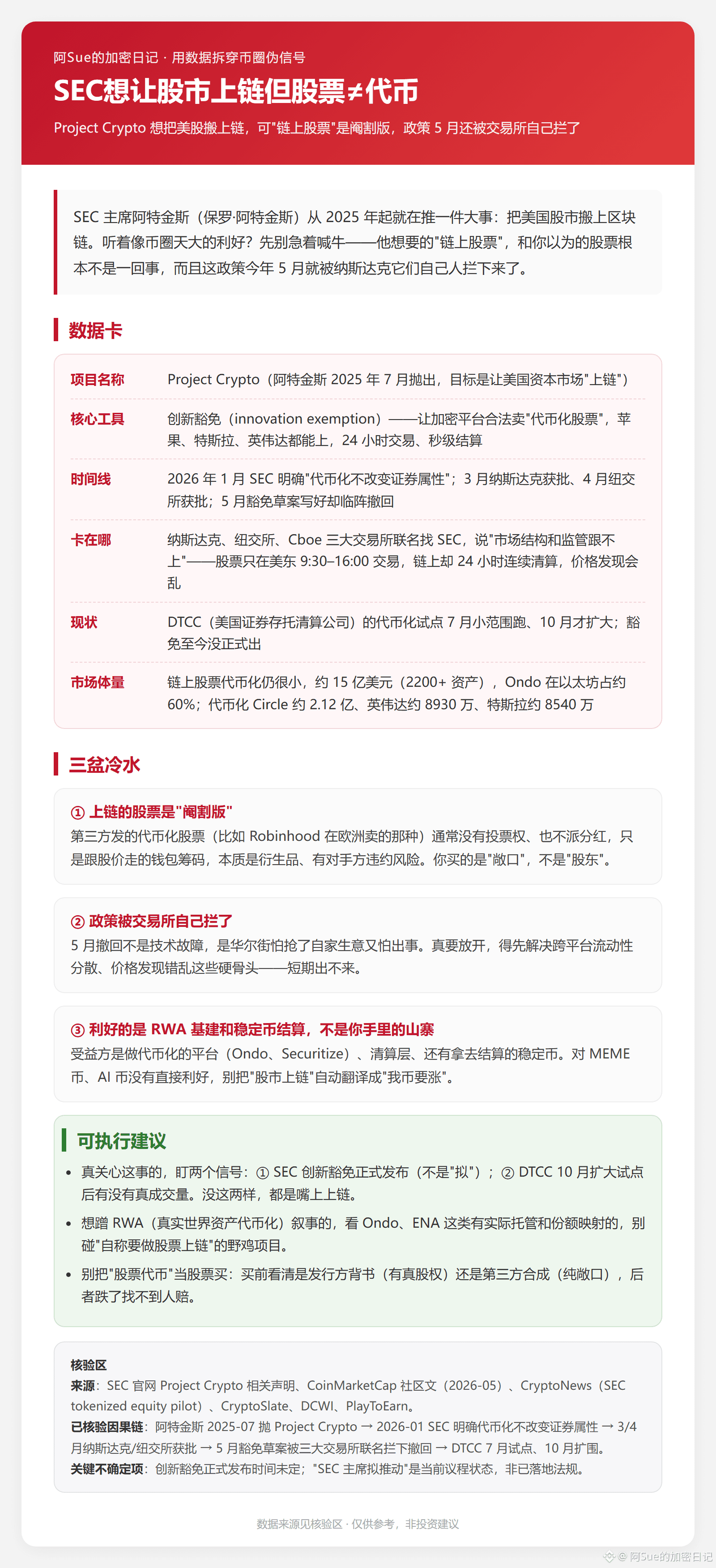
Starting in 2025, SEC Chair Gary Gensler successor Paul Atkins (Paul Atkins) is pushing Project Crypto. He wants to use an “innovation exemption” to allow crypto platforms to legally sell tokenized stocks—Apple, Tesla, Nvidia included—with 24/7 trading and settlement on a near-second timescale.
Sounds like a huge win for the crypto world?
Three buckets of cold water:
① On-chain stocks are a “crippled version.” Tokens issued by a third party (e.g., those Robinhood sells in Europe) usually have no voting rights or dividends—they’re basically trading the wallet exposure that tracks the share price. In essence, they’re derivatives, with counterparty default risk. You’re buying “exposure,” not being a “shareholder.”
② The policy was blocked by exchanges themselves. In May, the exemption draft was written. Nasdaq, the NYSE, and Cboe then jointly told the SEC that “the market structure can’t keep up.” Stocks trade only 9:30–16:00 ET, but on-chain would settle continuously 24/7, so price discovery would get messy. The draft was withdrawn at the last minute and hasn’t been officially issued to date.
③ What’s actually positive is RWA infrastructure and stablecoin settlement—not the altcoins in your wallet. The beneficiaries are tokenization platforms like Ondo and Securitize, the settlement layers, and the stablecoins used for settlement. MEME coins and AI coins get no direct benefit.
Current state: On-chain stock tokenization is still tiny—about $1.5 billion (2,200+ assets). Ondo accounts for roughly 60% on Ethereum. The DTCC (U.S. Depository Trust & Clearing Corporation) is running a pilot in July and only plans to expand in October.
What ordinary people should watch: ① Whether the innovation exemption is officially published (not just “proposed”); ② After the DTCC expands in October, whether there is real trading volume. Without these two, it’s just talk about putting stocks on-chain. Before buying “stock tokens,” make sure you understand whether the issuance is backed by the issuer (real equity) or is a third-party synthetic (pure exposure). If the latter goes under, there’s no one to hold accountable.
The SEC wants to put the stock market on-chain, but on-chain stocks are not the kind of stocks you think.
Starting in 2025, SEC Chair Gary Gensler successor Paul Atkins (Paul Atkins) is pushing Project Crypto. He wants to use an “innovation exemption” to allow crypto platforms to legally sell tokenized stocks—Apple, Tesla, Nvidia included—with 24/7 trading and settlement on a near-second timescale.
Sounds like a huge win for the crypto world?
Three buckets of cold water:
① On-chain stocks are a “crippled version.” Tokens issued by a third party (e.g., those Robinhood sells in Europe) usually have no voting rights or dividends—they’re basically trading the wallet exposure that tracks the share price. In essence, they’re derivatives, with counterparty default risk. You’re buying “exposure,” not being a “shareholder.”
② The policy was blocked by exchanges themselves. In May, the exemption draft was written. Nasdaq, the NYSE, and Cboe then jointly told the SEC that “the market structure can’t keep up.” Stocks trade only 9:30–16:00 ET, but on-chain would settle continuously 24/7, so price discovery would get messy. The draft was withdrawn at the last minute and hasn’t been officially issued to date.
③ What’s actually positive is RWA infrastructure and stablecoin settlement—not the altcoins in your wallet. The beneficiaries are tokenization platforms like Ondo and Securitize, the settlement layers, and the stablecoins used for settlement. MEME coins and AI coins get no direct benefit.
Current state: On-chain stock tokenization is still tiny—about $1.5 billion (2,200+ assets). Ondo accounts for roughly 60% on Ethereum. The DTCC (U.S. Depository Trust & Clearing Corporation) is running a pilot in July and only plans to expand in October.
What ordinary people should watch: ① Whether the innovation exemption is officially published (not just “proposed”); ② After the DTCC expands in October, whether there is real trading volume. Without these two, it’s just talk about putting stocks on-chain. Before buying “stock tokens,” make sure you understand whether the issuance is backed by the issuer (real equity) or is a third-party synthetic (pure exposure). If the latter goes under, there’s no one to hold accountable.