#欧洲央行探索数字欧元ai支付
The ECB spends on AI—things only really move in 2029
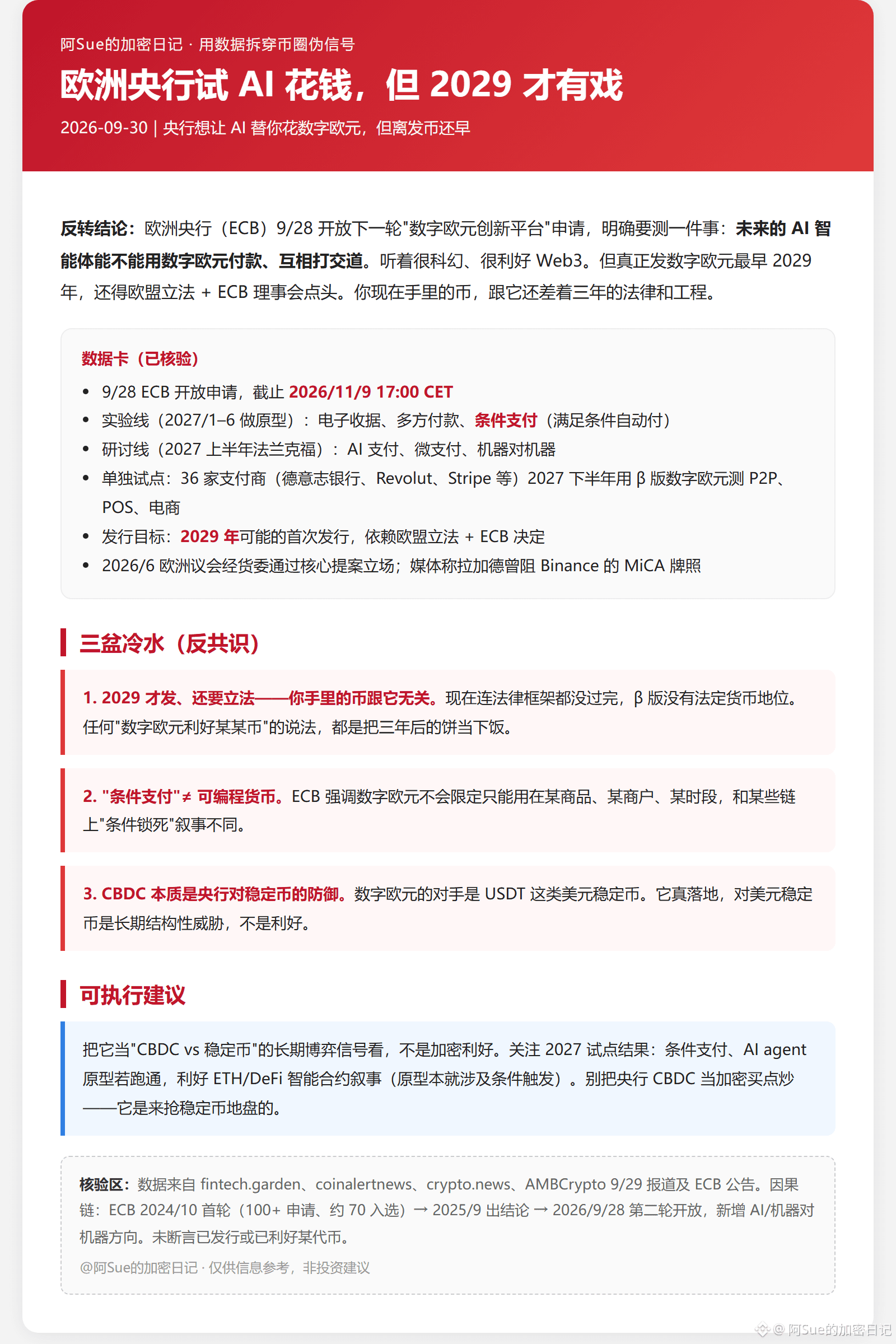
On 9/28, the European Central Bank (ECB) opened the next round of applications for its “digital euro innovation platform,” clearly aiming to test one thing: whether future AI agents can use the digital euro to pay and interact with each other. It sounds very sci‑fi, and very positive for Web3. But the earliest you can actually issue digital euros is 2029—and that requires EU legislation plus the ECB Council’s approval. The coins you have in your hands are still three years away in terms of both law and engineering.
Data check (verified): On 9/28, the ECB opened applications, with a deadline of 17:00 CET on 11/9/2026. Two tracks: an experimental track running prototypes from January to June 2027 (e-receipts, multi-party payments, and conditional payments—payments automatically executed when conditions are met), and a discussion track in the first half of 2027 in Frankfurt covering AI payments, micro-payments, and machine-to-machine. A standalone pilot involves 36 payment providers (Deutsche Bank, Revolut, Stripe, etc.) using a β version of the digital euro in the second half of 2027 to test P2P, POS, e-commerce, and mobile. The issuance target is a possible initial issuance in 2029, depending on EU legislation and the ECB’s decision. In 2026/6, the European Parliament’s Committee on Economic and Monetary Affairs passed the core proposal position. Media reports say Lagarde previously intervened to block Binance’s MiCA licensing, which has been interpreted as protection for the digital euro.
Three buckets of cold water. First, if it’s issued only in 2029 and requires legislation, then the coins you have now have nothing to do with it. Even the legal framework hasn’t been completed yet, and the β version has no status as legal tender. Second, “conditional payments” doesn’t mean “programmable money.” The ECB emphasizes that the digital euro won’t be limited to use for a specific good, merchant, or time window; unlike certain on-chain narratives where conditions are locked to particular criteria. Third, CBDC is fundamentally the central bank’s defense against stablecoins. The digital euro’s counterpart is stablecoins like USDT. If it truly takes off against dollar stablecoins, that’s a long-term structural threat—not a positive for the space.
Recommendation: Treat it as a long-term “CBDC vs stablecoins” signal of an ongoing power struggle, not as a crypto-positive headline. Focus on the 2027 pilot results: if conditional payments and AI agent prototypes work as intended, that would be beneficial to the ETH/DeFi smart-contract narrative (the prototypes already involve conditional triggers). Don’t treat the central bank’s CBDC as a buy-the-dip moment for crypto speculation—it’s meant to take stablecoin market share, not to raise the market for everyone.
The ECB spends on AI—things only really move in 2029
On 9/28, the European Central Bank (ECB) opened the next round of applications for its “digital euro innovation platform,” clearly aiming to test one thing: whether future AI agents can use the digital euro to pay and interact with each other. It sounds very sci‑fi, and very positive for Web3. But the earliest you can actually issue digital euros is 2029—and that requires EU legislation plus the ECB Council’s approval. The coins you have in your hands are still three years away in terms of both law and engineering.
Data check (verified): On 9/28, the ECB opened applications, with a deadline of 17:00 CET on 11/9/2026. Two tracks: an experimental track running prototypes from January to June 2027 (e-receipts, multi-party payments, and conditional payments—payments automatically executed when conditions are met), and a discussion track in the first half of 2027 in Frankfurt covering AI payments, micro-payments, and machine-to-machine. A standalone pilot involves 36 payment providers (Deutsche Bank, Revolut, Stripe, etc.) using a β version of the digital euro in the second half of 2027 to test P2P, POS, e-commerce, and mobile. The issuance target is a possible initial issuance in 2029, depending on EU legislation and the ECB’s decision. In 2026/6, the European Parliament’s Committee on Economic and Monetary Affairs passed the core proposal position. Media reports say Lagarde previously intervened to block Binance’s MiCA licensing, which has been interpreted as protection for the digital euro.
Three buckets of cold water. First, if it’s issued only in 2029 and requires legislation, then the coins you have now have nothing to do with it. Even the legal framework hasn’t been completed yet, and the β version has no status as legal tender. Second, “conditional payments” doesn’t mean “programmable money.” The ECB emphasizes that the digital euro won’t be limited to use for a specific good, merchant, or time window; unlike certain on-chain narratives where conditions are locked to particular criteria. Third, CBDC is fundamentally the central bank’s defense against stablecoins. The digital euro’s counterpart is stablecoins like USDT. If it truly takes off against dollar stablecoins, that’s a long-term structural threat—not a positive for the space.
Recommendation: Treat it as a long-term “CBDC vs stablecoins” signal of an ongoing power struggle, not as a crypto-positive headline. Focus on the 2027 pilot results: if conditional payments and AI agent prototypes work as intended, that would be beneficial to the ETH/DeFi smart-contract narrative (the prototypes already involve conditional triggers). Don’t treat the central bank’s CBDC as a buy-the-dip moment for crypto speculation—it’s meant to take stablecoin market share, not to raise the market for everyone.