Aggressive dump-plate collection of chips pattern (prepare positioning)
The one that looks most similar right now is $DOT: around the 1.13 integer level. It retraced from 1.076 up to 1.181—big downside, and the selling pressure is likely exhausted in the short term. Next, check the on-chain data: if exchange balances show net outflows and giant whales are picking up, it may fall into the left-side range. Similar ones to watch are WIF (0.185 low point) and $APT (0.595 low point). Confirmation conditions: a long lower wick or a hammer line; then 1–3 candles that reclaim most of the losses; RSI bearish divergence; and after OI sharply drops, the funding rate returns to neutral. The more conditions it matches, the more worth it it is to set traps—but you must wait until the close fully recaptures the level before adding.
Confirmation to board after the shakeout ends
Three requirements must all be met simultaneously: the close reclaims the key level (wick/pin counts not); a retreat on decreasing volume that doesn’t break (volume is ≤ 50% of the shakeout segment’s volume); and a volume-led breakout making a new high (volume ≥ 2× the average volume of the shakeout segment), with contract OI rising mildly and the funding rate not getting overheated. Current candidates: $MATIC, $PEPE, $BONK.
Chip distribution short pattern
If there are 4 or more conditions falling into the list above, suspect distribution. What to be especially wary of at the moment is coins that may be distributed after a breakout: AAVE, $PYTH , $THETA . The most important thing is to watch volume (rebound on reduced volume, followed by selling on increased volume), key levels (a valid breakdown with failed rebounds), and rebound performance (weak, without making new highs). If it falls between the two, stay on the sidelines.
Three high-win-rate factors (pick 3 to 5 right now)
Relay breakout or bottom reversal: AAVE (breakout with volume standing above 162 to look for acceleration), AVAX (standing above 121 to look for extension), DOT (1.13 integer level not breached). K-line requirement: close above the neckline or upper boundary, and volume ≥ 2×.
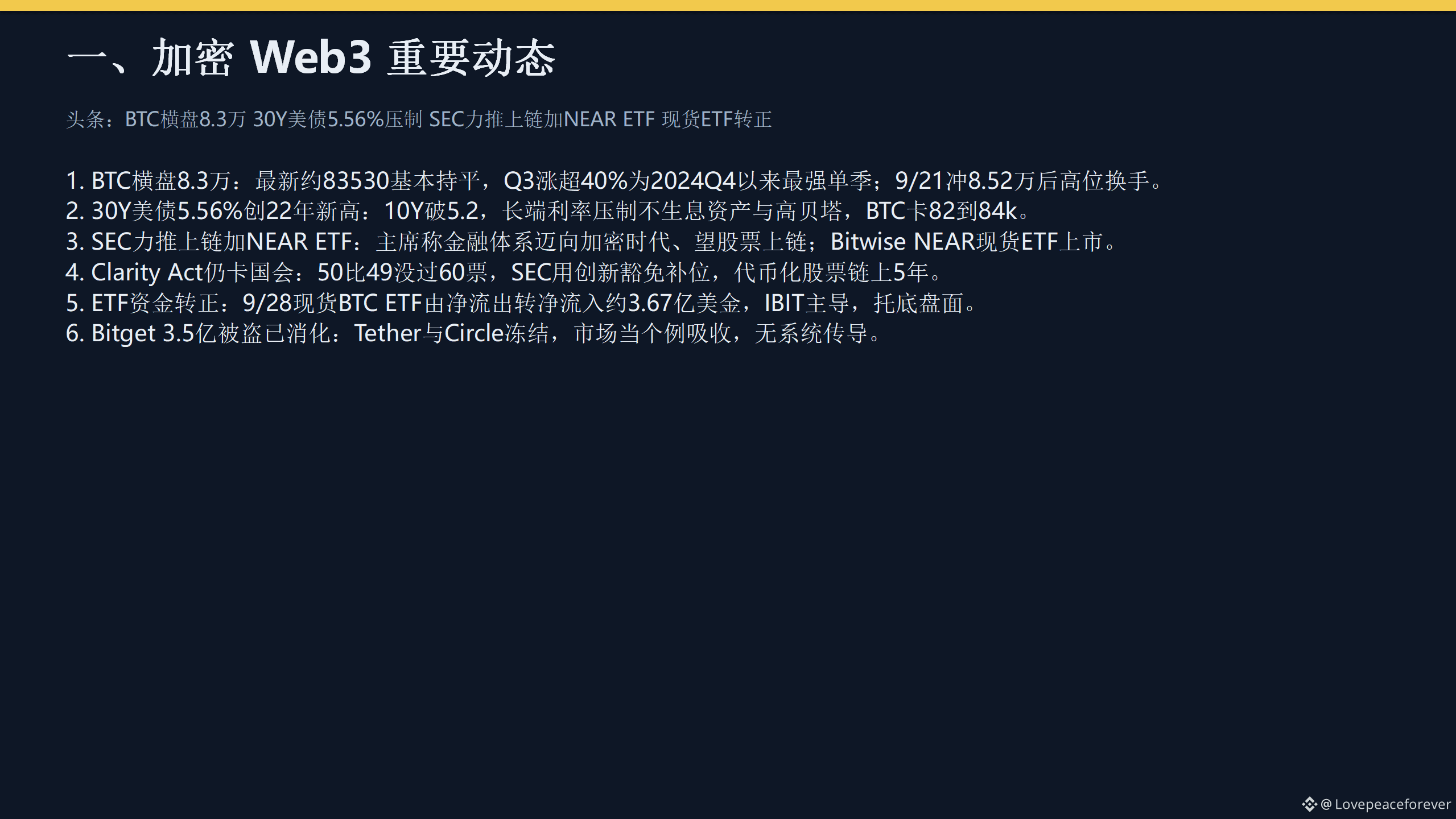
Hot money inflow and alt-season catch-up: BTC consolidating around 83k; and the ETH/BTC ratio plus BTC dominance are alt-season signals. AI and the RWA chain sectors (NEAR, DOT, AAVE) are where capital moves first; DeFi ($LDO, UNI) comes next. Only when BTC dominance clearly declines and the ETH/BTC ratio keeps rising is it the timing for a heavy-position catch-up.
“Flooding” liquidity and stablecoin inflow: Currently, the Fed has instead hiked rates to 3.75–4.00; 30Y US Treasuries yield at 5.56% hit a 22-year high. The dollar and long-end yields are strengthening, and stablecoin market cap hasn’t shown sustained net growth. This setup hasn’t been triggered—only when it truly triggers is it worth going heavy against the small-cycle trend.
Overall high-win technical candidates right now: AAVE, AVAX, $NEAR, DOT, BOME—but they all come with the macro “tightening spell” (30Y yields under high pressure, plus Clarity card in Congress and Middle East oil price pressures), so don’t take oversized positions. Avoid $LINK and $APT for now as they’ve been selling off after reaching high levels.
The one that looks most similar right now is $DOT: around the 1.13 integer level. It retraced from 1.076 up to 1.181—big downside, and the selling pressure is likely exhausted in the short term. Next, check the on-chain data: if exchange balances show net outflows and giant whales are picking up, it may fall into the left-side range. Similar ones to watch are WIF (0.185 low point) and $APT (0.595 low point). Confirmation conditions: a long lower wick or a hammer line; then 1–3 candles that reclaim most of the losses; RSI bearish divergence; and after OI sharply drops, the funding rate returns to neutral. The more conditions it matches, the more worth it it is to set traps—but you must wait until the close fully recaptures the level before adding.
Confirmation to board after the shakeout ends
Three requirements must all be met simultaneously: the close reclaims the key level (wick/pin counts not); a retreat on decreasing volume that doesn’t break (volume is ≤ 50% of the shakeout segment’s volume); and a volume-led breakout making a new high (volume ≥ 2× the average volume of the shakeout segment), with contract OI rising mildly and the funding rate not getting overheated. Current candidates: $MATIC, $PEPE, $BONK.
Chip distribution short pattern
If there are 4 or more conditions falling into the list above, suspect distribution. What to be especially wary of at the moment is coins that may be distributed after a breakout: AAVE, $PYTH , $THETA . The most important thing is to watch volume (rebound on reduced volume, followed by selling on increased volume), key levels (a valid breakdown with failed rebounds), and rebound performance (weak, without making new highs). If it falls between the two, stay on the sidelines.
Three high-win-rate factors (pick 3 to 5 right now)
Relay breakout or bottom reversal: AAVE (breakout with volume standing above 162 to look for acceleration), AVAX (standing above 121 to look for extension), DOT (1.13 integer level not breached). K-line requirement: close above the neckline or upper boundary, and volume ≥ 2×.
Hot money inflow and alt-season catch-up: BTC consolidating around 83k; and the ETH/BTC ratio plus BTC dominance are alt-season signals. AI and the RWA chain sectors (NEAR, DOT, AAVE) are where capital moves first; DeFi ($LDO, UNI) comes next. Only when BTC dominance clearly declines and the ETH/BTC ratio keeps rising is it the timing for a heavy-position catch-up.
“Flooding” liquidity and stablecoin inflow: Currently, the Fed has instead hiked rates to 3.75–4.00; 30Y US Treasuries yield at 5.56% hit a 22-year high. The dollar and long-end yields are strengthening, and stablecoin market cap hasn’t shown sustained net growth. This setup hasn’t been triggered—only when it truly triggers is it worth going heavy against the small-cycle trend.
Overall high-win technical candidates right now: AAVE, AVAX, $NEAR, DOT, BOME—but they all come with the macro “tightening spell” (30Y yields under high pressure, plus Clarity card in Congress and Middle East oil price pressures), so don’t take oversized positions. Avoid $LINK and $APT for now as they’ve been selling off after reaching high levels.