What is Aavenomics 3.0?
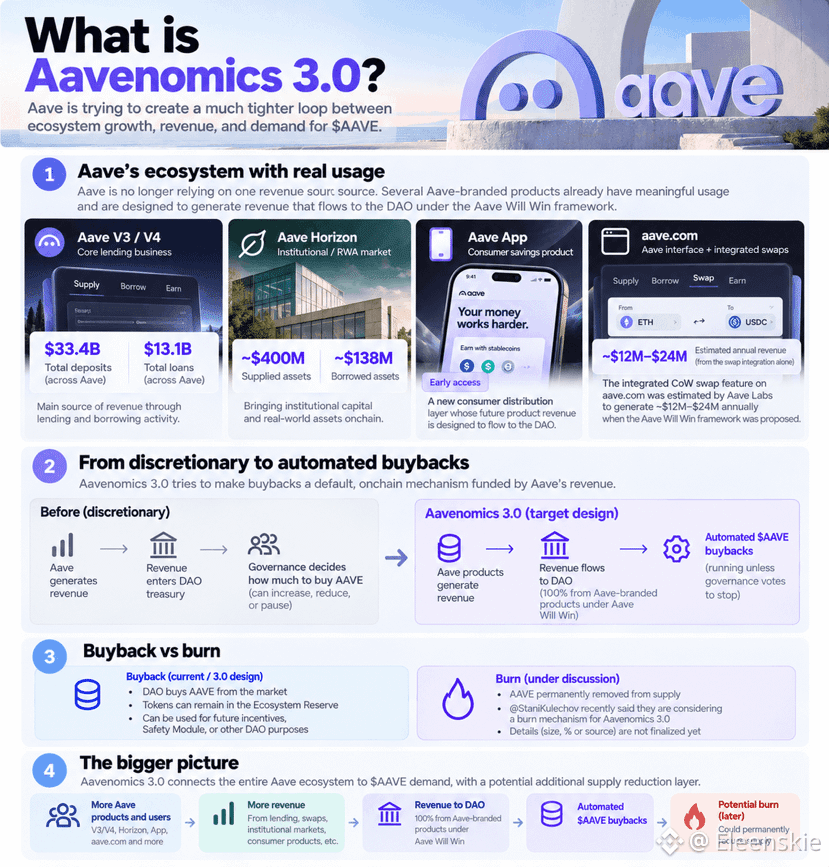
Aave is working to create a much tighter relationship between ecosystem growth, revenue, and demand for $AAVE . The old buyback model was more discretionary. Those buybacks can be increased, reduced, or temporarily paused depending on conditions.
Aavenomics 3.0 aims to make this relationship more structural.
This is increasingly important because Aave no longer relies on a single source of revenue.
There are already several parts of the ecosystem with real usage:
• Aave V3/V4 → the core lending business, with roughly $RWA in deposits and $13B in loans across Aave
• Aave Horizon → the institutional/RWA market has grown to about $400M in supplied assets
• Aave App → now in early access, creating a new consumer distribution layer whose product revenue in the future is designed to flow back to the DAO
There are also other monetization sources. For example, swap integrations on aave .com alone were estimated by Aave Labs to generate around $12 million–$24M per year when the Aave Will Win framework was proposed.
Under Aave Will Win, 100% of revenue from Aave-branded products developed by Aave Labs should flow to the DAO.
This is where Aavenomics 3.0 becomes far more interesting.
Instead of just:
The protocol earns fees
→ the DAO decides how much AAVE to buy
The system starts to look more like:
More Aave products
→ more users and activity
→ more revenue flowing into the DAO
→ automatic buyback $AAVE
That last part is a major improvement. Aave already had buybacks before.
Aavenomics 3.0 aims to make them a more structural part of how economic value flows back to the token, rather than relying on repeated discretionary decisions.
Then there is another potential layer: burn.
@StaniKulechov recently said that they are also considering adding a burn mechanism.
$AAVE
Aave is working to create a much tighter relationship between ecosystem growth, revenue, and demand for $AAVE . The old buyback model was more discretionary. Those buybacks can be increased, reduced, or temporarily paused depending on conditions.
Aavenomics 3.0 aims to make this relationship more structural.
This is increasingly important because Aave no longer relies on a single source of revenue.
There are already several parts of the ecosystem with real usage:
• Aave V3/V4 → the core lending business, with roughly $RWA in deposits and $13B in loans across Aave
• Aave Horizon → the institutional/RWA market has grown to about $400M in supplied assets
• Aave App → now in early access, creating a new consumer distribution layer whose product revenue in the future is designed to flow back to the DAO
There are also other monetization sources. For example, swap integrations on aave .com alone were estimated by Aave Labs to generate around $12 million–$24M per year when the Aave Will Win framework was proposed.
Under Aave Will Win, 100% of revenue from Aave-branded products developed by Aave Labs should flow to the DAO.
This is where Aavenomics 3.0 becomes far more interesting.
Instead of just:
The protocol earns fees
→ the DAO decides how much AAVE to buy
The system starts to look more like:
More Aave products
→ more users and activity
→ more revenue flowing into the DAO
→ automatic buyback $AAVE
That last part is a major improvement. Aave already had buybacks before.
Aavenomics 3.0 aims to make them a more structural part of how economic value flows back to the token, rather than relying on repeated discretionary decisions.
Then there is another potential layer: burn.
@StaniKulechov recently said that they are also considering adding a burn mechanism.
$AAVE