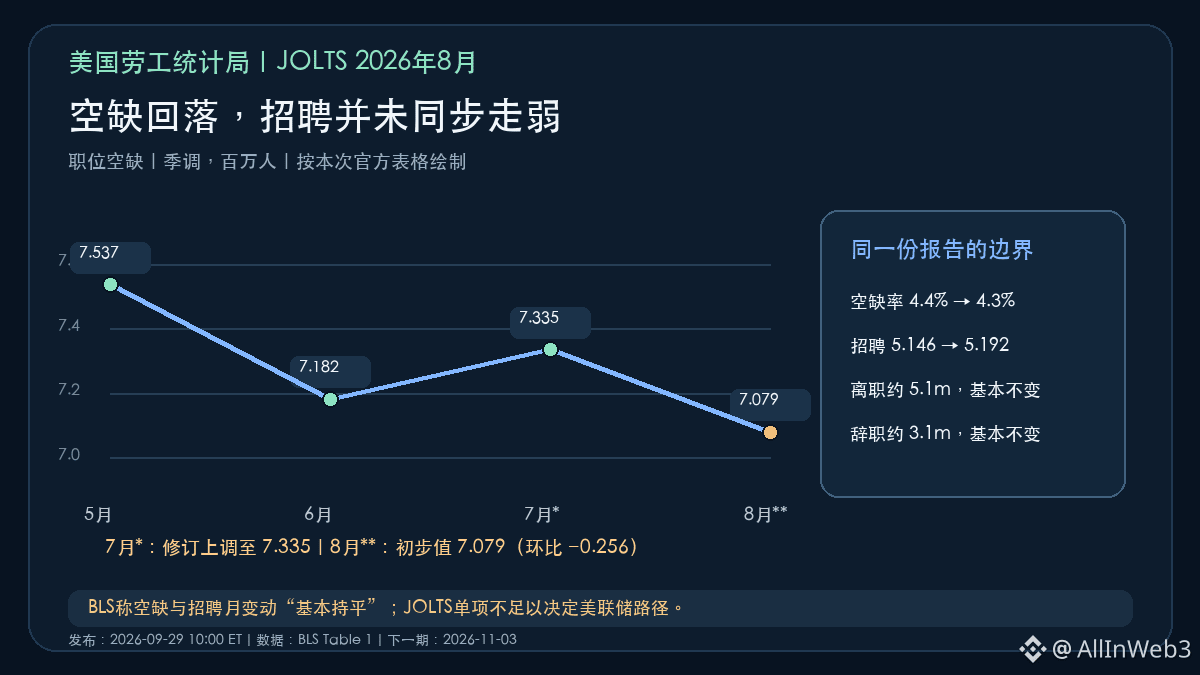
# U.S. August JOLTS: Job openings fell to about 7.1 million, but the BLS describes the monthly change as “essentially flat.” These two claims are not in conflict. Seasonally adjusted openings were revised down from 7.335 million (July, revised) to 7.079 million, a decrease of 0.256 million; the vacancy rate fell from 4.4% to 4.3%. The “five-month low” in the headline can be used as a horizontal comparison, but it can’t be translated directly into a sudden collapse in hiring.
The easiest item to overlook in the timeline is revisions. July openings were raised by 64,000 to 7.335 million; therefore, when looking at the latest month-to-month change, the baseline is not the older estimate from an earlier period. August hiring was 5.192 million, slightly higher than the revised July figure of 5.146 million. Total quits were about 5.07 million, and the BLS says it was essentially unchanged; voluntary quits were about 3.10 million, also basically unchanged. With openings trending downward and hiring staying steady, it suggests some cooling in labor demand, but this report does not provide evidence of a broad hiring freeze. In terms of definitions, job openings are the stock of positions still open on the last business day of each month, while hiring measures the number of people added to payrolls over the entire month. One is a point-in-time stock and the other is a monthly flow; you can’t treat the difference between them as unemployment figures or a direct measure of net employment change.
At the industry level, the BLS says job openings across sectors overall changed little in August. Therefore, a safer phrasing is that the total number fell, but the subcategories have not yet shown a synchronous, sharp stop. Only if hiring continues to trend lower and quits/layoffs show clear shifts afterward would the evidence weight for “demand further weakening” increase. For interest rates and crypto assets, all you can say is that this is a macro input: falling job openings may ease wage and demand pressure, but a single JOLTS component can’t determine the Fed’s path, nor can it explain the price of crypto on its own. Next, we need to wait for cross-validation with wage data, employment figures, and inflation, and to see how interest rates and the U.S. dollar respond. This BLS release was published at 10:00 a.m. ET on September 29 (22:00 Beijing time). The data are preliminary estimates; the next JOLTS release is scheduled for November 3. Source: The original BLS press release and tables for August JOLTS.
The easiest item to overlook in the timeline is revisions. July openings were raised by 64,000 to 7.335 million; therefore, when looking at the latest month-to-month change, the baseline is not the older estimate from an earlier period. August hiring was 5.192 million, slightly higher than the revised July figure of 5.146 million. Total quits were about 5.07 million, and the BLS says it was essentially unchanged; voluntary quits were about 3.10 million, also basically unchanged. With openings trending downward and hiring staying steady, it suggests some cooling in labor demand, but this report does not provide evidence of a broad hiring freeze. In terms of definitions, job openings are the stock of positions still open on the last business day of each month, while hiring measures the number of people added to payrolls over the entire month. One is a point-in-time stock and the other is a monthly flow; you can’t treat the difference between them as unemployment figures or a direct measure of net employment change.
At the industry level, the BLS says job openings across sectors overall changed little in August. Therefore, a safer phrasing is that the total number fell, but the subcategories have not yet shown a synchronous, sharp stop. Only if hiring continues to trend lower and quits/layoffs show clear shifts afterward would the evidence weight for “demand further weakening” increase. For interest rates and crypto assets, all you can say is that this is a macro input: falling job openings may ease wage and demand pressure, but a single JOLTS component can’t determine the Fed’s path, nor can it explain the price of crypto on its own. Next, we need to wait for cross-validation with wage data, employment figures, and inflation, and to see how interest rates and the U.S. dollar respond. This BLS release was published at 10:00 a.m. ET on September 29 (22:00 Beijing time). The data are preliminary estimates; the next JOLTS release is scheduled for November 3. Source: The original BLS press release and tables for August JOLTS.