🚨 Let me say something that hurts: back then, that little country was the most enthusiastic about embracing crypto; now its most standout product runs on dollar-denominated tokens
Group: 点击进入玖玖的粉丝群
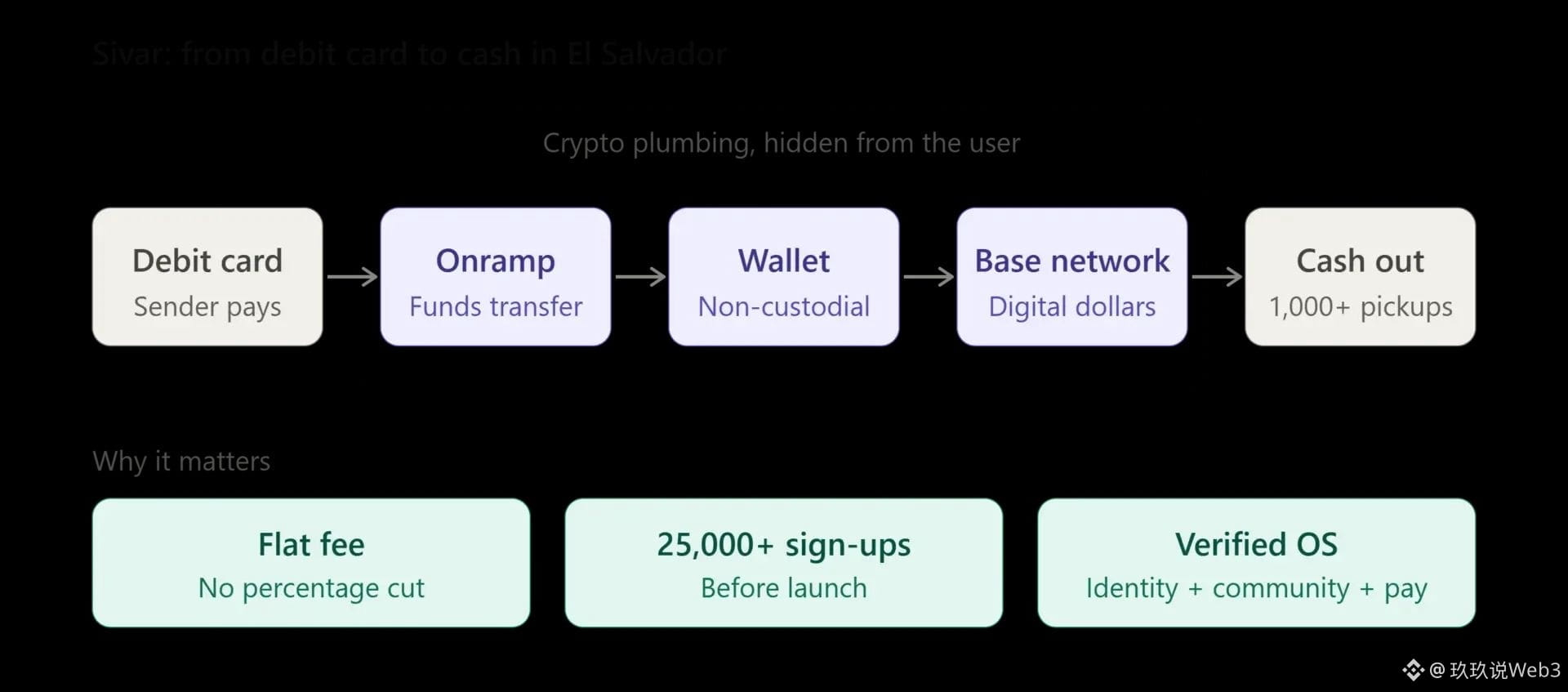
📊 Here’s what’s going on: A remittance and identity app called Sivar launched in El Salvador, backed by the U.S. exchange Coinbase’s payment infrastructure. Cross-border remittances have a fixed $2 fee—no matter how much you send. The official says that before launch, more than 25,000 Salvadorans had already registered.
🔥 On the front end, it looks like a normal payments app. Behind the scenes, it’s the exchange’s interfaces running. Value is settled via stablecoins on Base, and recipients can withdraw cash at more than a thousand locations nationwide.
💡 What’s truly worth paying attention to isn’t just another app—it’s this country’s shift in direction. In 2021, it made Bitcoin legal tender, the first country in the world to do so. Later, under a loan framework with the IMF, in January 2025 it amended Bitcoin law: accepting Bitcoin became voluntary for merchants, and it also can’t be used to pay taxes. The majority ownership and operational control of the state wallet Chivo has already been transferred to a private operator—this deal unlocks about $140 million.
📌 Put plainly: Salvadorans in the U.S. contributed about 9.2 billion out of the roughly 10 billion remitted in 2025. With remittances that huge, in the end it’s the dollar stablecoin rails—not Bitcoin.
⚠️ A splash of cold water: don’t rush to say “Bitcoin failed.” Stablecoins are, after all, just a digital extension of the U.S. dollar—perfectly logical for high-frequency, small-ticket scenarios like remittances. Bitcoin’s whole “let everyone hold coins” model never really fit this use case.
👀 One side says this is a pragmatic shift; the other says it’s bowing to the dollar. Which side are you on with El Salvador’s move? Drop your pick in the comments👇
Click the avatar to watch the live stream + join the Jiujiu chat group for daily strategy🚀
#稳定币 #比特币 #El Salvador
Group: 点击进入玖玖的粉丝群
📊 Here’s what’s going on: A remittance and identity app called Sivar launched in El Salvador, backed by the U.S. exchange Coinbase’s payment infrastructure. Cross-border remittances have a fixed $2 fee—no matter how much you send. The official says that before launch, more than 25,000 Salvadorans had already registered.
🔥 On the front end, it looks like a normal payments app. Behind the scenes, it’s the exchange’s interfaces running. Value is settled via stablecoins on Base, and recipients can withdraw cash at more than a thousand locations nationwide.
💡 What’s truly worth paying attention to isn’t just another app—it’s this country’s shift in direction. In 2021, it made Bitcoin legal tender, the first country in the world to do so. Later, under a loan framework with the IMF, in January 2025 it amended Bitcoin law: accepting Bitcoin became voluntary for merchants, and it also can’t be used to pay taxes. The majority ownership and operational control of the state wallet Chivo has already been transferred to a private operator—this deal unlocks about $140 million.
📌 Put plainly: Salvadorans in the U.S. contributed about 9.2 billion out of the roughly 10 billion remitted in 2025. With remittances that huge, in the end it’s the dollar stablecoin rails—not Bitcoin.
⚠️ A splash of cold water: don’t rush to say “Bitcoin failed.” Stablecoins are, after all, just a digital extension of the U.S. dollar—perfectly logical for high-frequency, small-ticket scenarios like remittances. Bitcoin’s whole “let everyone hold coins” model never really fit this use case.
👀 One side says this is a pragmatic shift; the other says it’s bowing to the dollar. Which side are you on with El Salvador’s move? Drop your pick in the comments👇
Click the avatar to watch the live stream + join the Jiujiu chat group for daily strategy🚀
#稳定币 #比特币 #El Salvador