【CJ Arbitrage Advanced 05/14】
The most dangerous moment for funding-rate arbitrage is often not when you open a position, but when you think you’ve already made enough and are ready to exit.
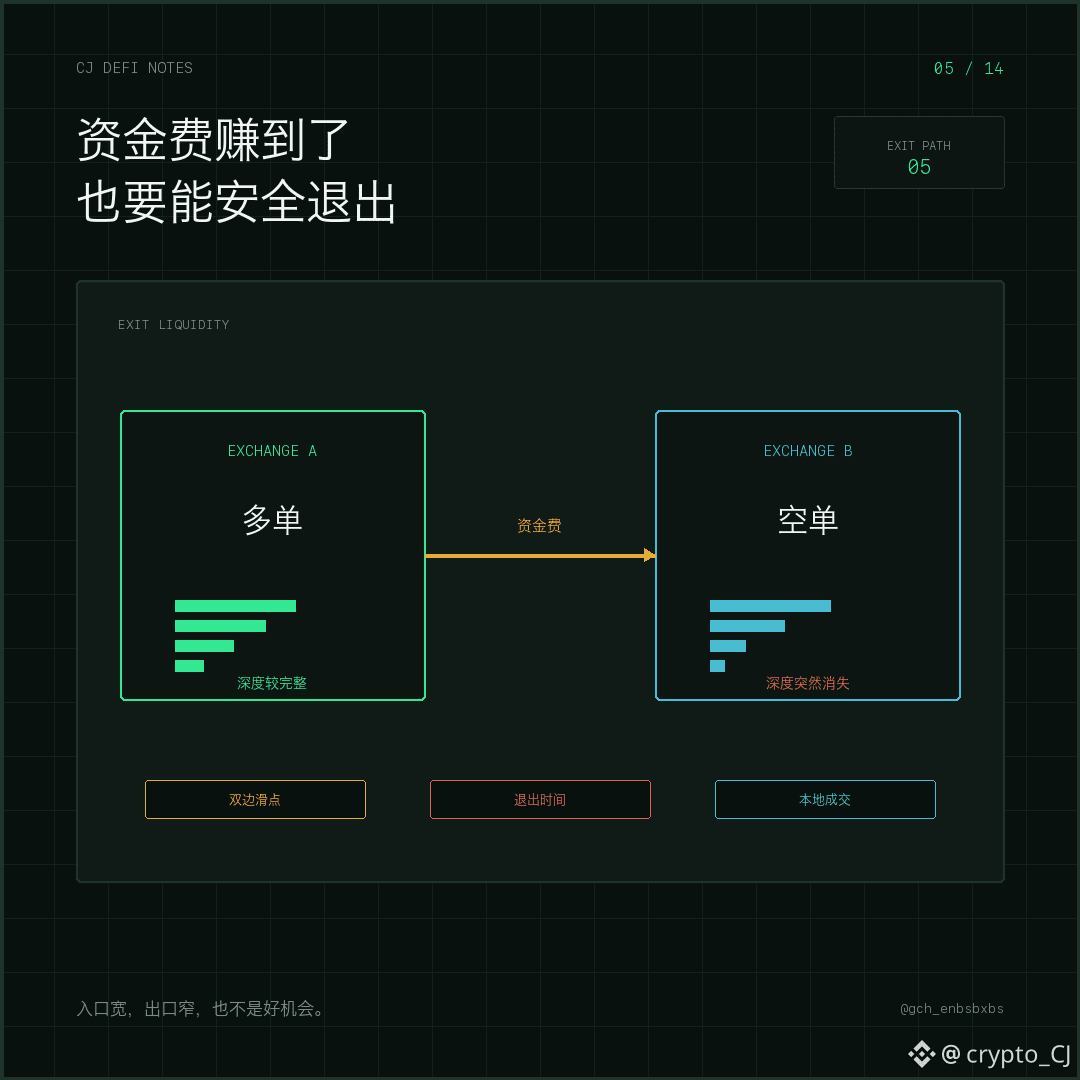
Spot arbitrage can move assets from a cheaper platform to a more expensive one. After settlement, the inventory on both sides can rebalance. Cross-exchange futures hedging is different: a long position on platform A can’t be “moved” to platform B to close it. Both sides’ positions must be executed locally. As long as the order book depth differs, exits can’t naturally synchronize.
On the surface, you hold one long and one short, with direction exposure close to neutral, and you keep receiving funding. But in extreme market moves, the small platform’s depth may suddenly disappear: one side fills first, while the other side has to bear massive slippage. Meanwhile, the basis on both sides may keep widening instead of converging as expected. The funding-rate difference you accumulated over days on paper can all be given back in a single closing trade.
Therefore, before opening a position, you can’t just compare funding rates. You also need to test both sides’ order-book slippage under different traded volumes, fees, available margin, and the worst possible exit time. Arbitrage isn’t “open the trade and wait to get paid”—it’s a path that must work end-to-end. The entrance looks wide, but the exit has only a single narrow gap. Opportunities like this are not suitable for relying on position size to magnify returns.
Next article: Some price spreads exist for only a few seconds—why is a spot wick both an opportunity and a trap?
#资金费率 #Arbitrage Risk Control
The most dangerous moment for funding-rate arbitrage is often not when you open a position, but when you think you’ve already made enough and are ready to exit.
Spot arbitrage can move assets from a cheaper platform to a more expensive one. After settlement, the inventory on both sides can rebalance. Cross-exchange futures hedging is different: a long position on platform A can’t be “moved” to platform B to close it. Both sides’ positions must be executed locally. As long as the order book depth differs, exits can’t naturally synchronize.
On the surface, you hold one long and one short, with direction exposure close to neutral, and you keep receiving funding. But in extreme market moves, the small platform’s depth may suddenly disappear: one side fills first, while the other side has to bear massive slippage. Meanwhile, the basis on both sides may keep widening instead of converging as expected. The funding-rate difference you accumulated over days on paper can all be given back in a single closing trade.
Therefore, before opening a position, you can’t just compare funding rates. You also need to test both sides’ order-book slippage under different traded volumes, fees, available margin, and the worst possible exit time. Arbitrage isn’t “open the trade and wait to get paid”—it’s a path that must work end-to-end. The entrance looks wide, but the exit has only a single narrow gap. Opportunities like this are not suitable for relying on position size to magnify returns.
Next article: Some price spreads exist for only a few seconds—why is a spot wick both an opportunity and a trap?
#资金费率 #Arbitrage Risk Control