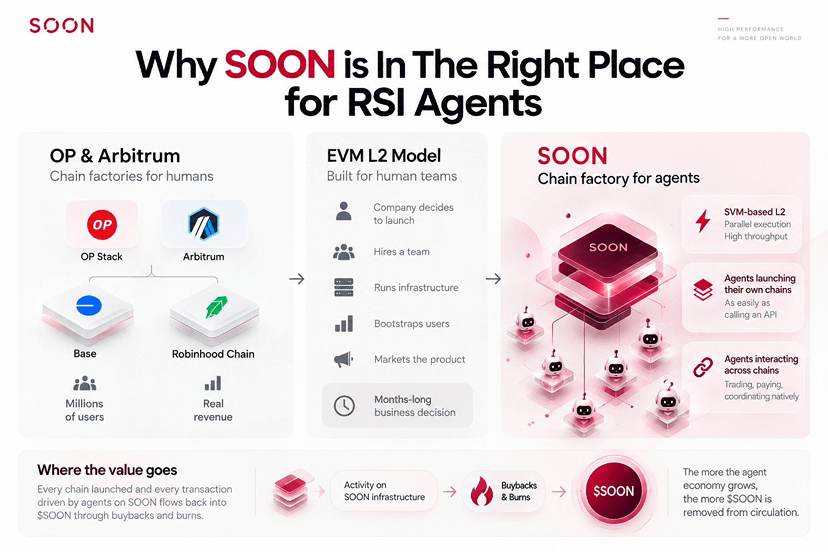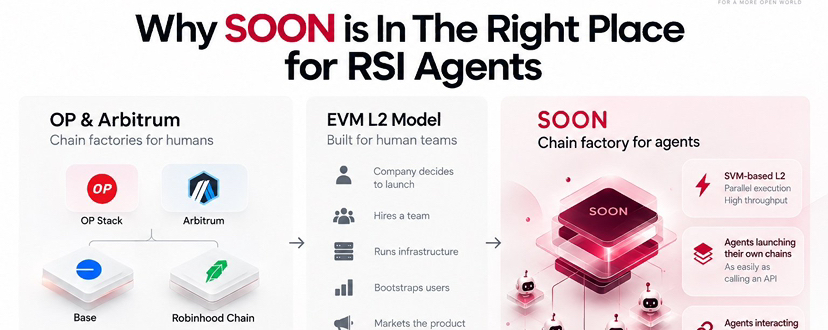


OP and Arbitrum have built a chain manufacturing factory for humankind, while SOON is creating its own factory for Agents.
Take a look at the achievements of the OP Stack and Arbitrum:
They turn L2 infrastructure into a factory capable of mass-producing chains. Base runs on OP Stack;
The Robinhood Chain, meanwhile, runs on top of Arbitrum.
These chains have brought immense value, millions of users, and real money flowing back to these underlying technology stacks.
This fully proves that, as the underlying technology stack that hosts other chains, it can capture immeasurable ecological value.
EVM is tailored for human teams
The existing EVM L2 model assumes by default that every chain has a human organization behind it.
A company decides to launch a chain: hires people, builds a team, sets up infrastructure, cold-starts to attract users, and promotes the product. Launching a chain is a business decision that lasts for months.
However, the next wave of on-chain activity will no longer be driven by humans clicking buttons on the front end.
It will be driven by agents, and the number of agents will far exceed that of human users.
They never rest. At machine-level speed, they continuously and concurrently execute transactions. Their interactions with each other are far more than their interactions with humans.
This is an entirely different dimension of load demand.
It requires a completely different underlying infrastructure.
Why does SOON occupy the most core niche of the RSI Agent era?
SOON is an SVM-based L2 technology stack. Parallel execution and the high-throughput capabilities deeply embedded in its underlying architecture—these are the abilities required for large-scale, high-frequency interactions among agents.
We are pushing full speed toward two core directions:
1. Agents autonomously launch chains. An RSI Agent deploys and operates its own SVM chain—it should be as easy as calling an API.
2. Cross-chain interaction among agents. Natively implement cross-chain transactions, payments, and coordination with zero need for human involvement.
Where will the value go?
On the SOON infrastructure, every chain initiated by agents and every transaction they drive will directly empower $SOON through buybacks and burns.
The larger the agent economy, the more $SOON that are destroyed from circulation.
This is what makes $SOON the true growth engine of the entire agent blockchain economy.
Now, scale this up
OP and Arbitrum have nurtured a chain ecosystem driven by human teams, and the value created has already been astonishing.
Imagine transplanting this model into a world where agents are the ones who build chains: not just dozens of chains, but potentially tens of thousands—each one personally deployed, operated, and scaled by agents that continuously self-iterate.
This is precisely the once-in-a-history opportunity $SOON was made for.