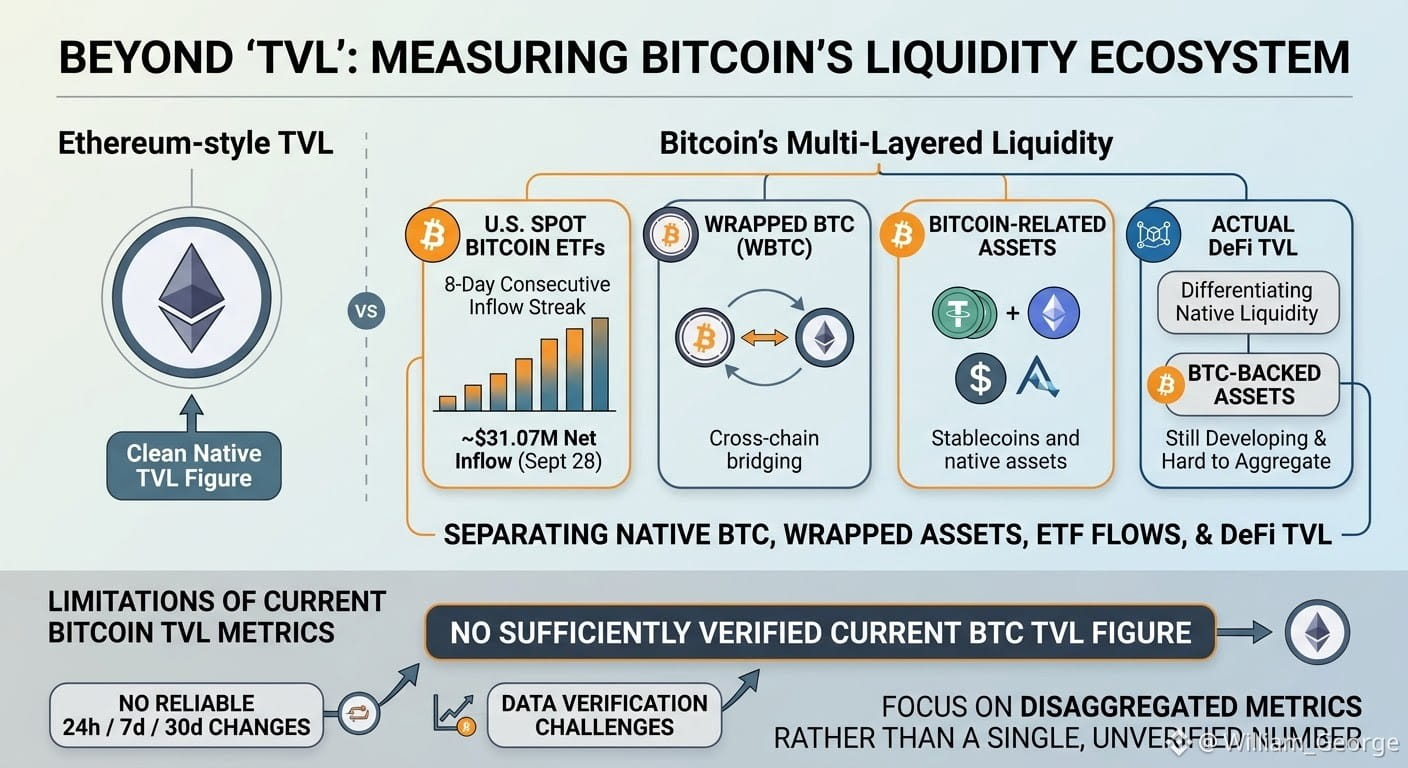

Bitcoin doesn’t have a clean native TVL figure like Ethereum or Solana, and that distinction is easy to miss.
What caught my attention is the liquidity around BTC is still showing up in other ways.
U.S. spot Bitcoin ETFs recorded about $31.07M in net inflows on September 28, marking an 8-day consecutive inflow streak.
At the same time, BTC has been trading around the $83K area.
But I wouldn’t call ETF assets, wrapped BTC, or Bitcoin-related liquidity “Bitcoin TVL.” They measure different things.
That’s actually the interesting part: when looking at Bitcoin’s DeFi ecosystem, we need to separate native BTC liquidity, BTC-backed assets, ETF flows, and actual DeFi TVL instead of putting everything under one number.
For now, there isn’t a sufficiently verified current BTC TVL figure with 24h/7d/30d changes available from the data I checked.
So I’d rather leave the number out than force a statistic that isn’t properly verified.
$BTC $BNB $ETH
What caught my attention is the liquidity around BTC is still showing up in other ways.
U.S. spot Bitcoin ETFs recorded about $31.07M in net inflows on September 28, marking an 8-day consecutive inflow streak.
At the same time, BTC has been trading around the $83K area.
But I wouldn’t call ETF assets, wrapped BTC, or Bitcoin-related liquidity “Bitcoin TVL.” They measure different things.
That’s actually the interesting part: when looking at Bitcoin’s DeFi ecosystem, we need to separate native BTC liquidity, BTC-backed assets, ETF flows, and actual DeFi TVL instead of putting everything under one number.
For now, there isn’t a sufficiently verified current BTC TVL figure with 24h/7d/30d changes available from the data I checked.
So I’d rather leave the number out than force a statistic that isn’t properly verified.
$BTC $BNB $ETH