
It’s still the same token—only the market environment has changed.
We need to make it happen at $ZEC . Doing it at this point might feel a bit sluggish, but I respect the market 🫡
As for the external big picture, the crypto world has only gotten hotter these past few years, and more and more people have started to know about it. On the other hand, as the whole industry embraces compliance, this causes what used to be “traditional” $BTC $ETH to lose its appeal to newcomers—the virtual coin doesn’t feel “virtual” anymore.
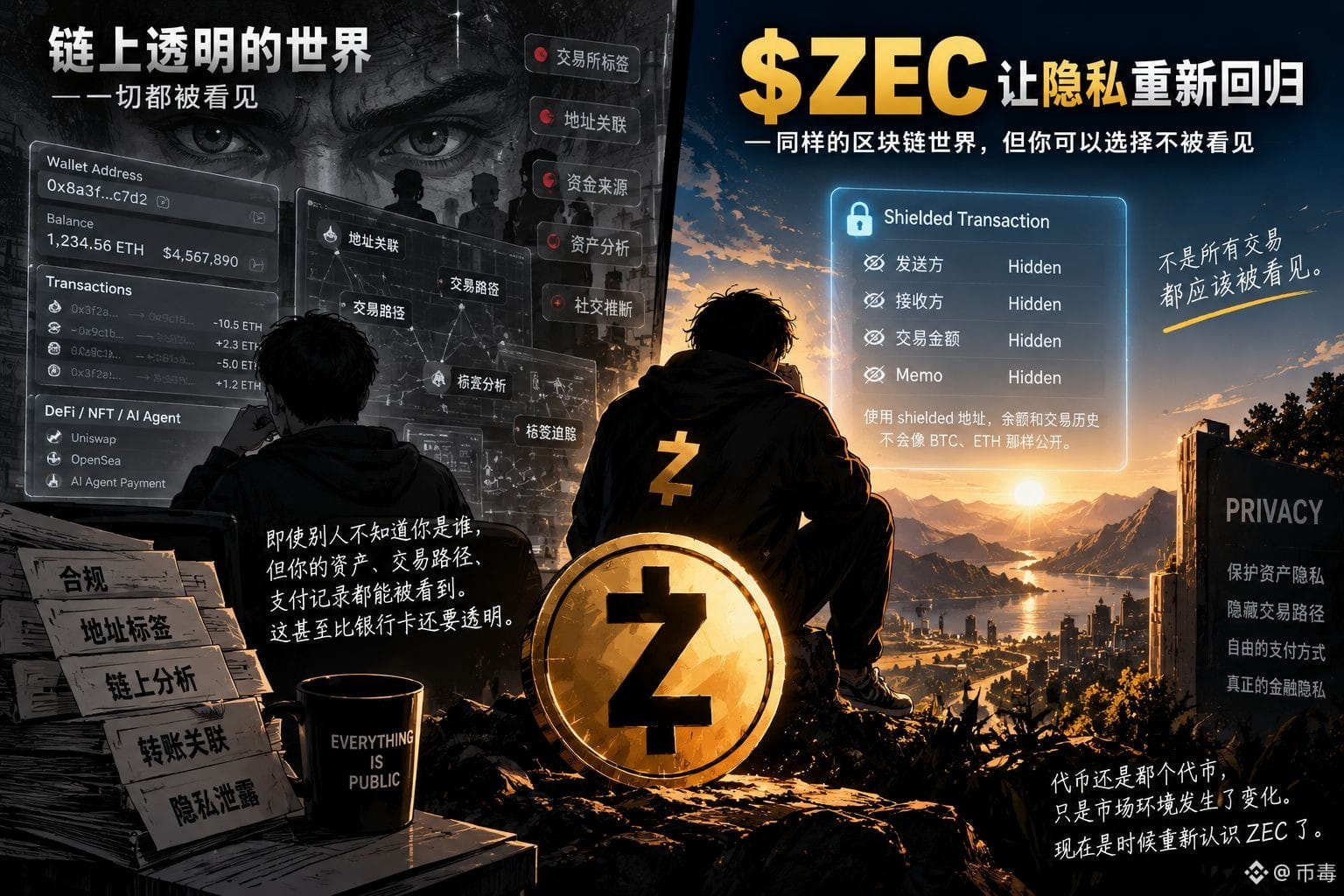
Another thing is that in the past couple of years, the market has become increasingly sensitive to the problems caused by “on-chain transparency.” Wallet balances, transaction paths, payment records, even AI Agent payments are all public. These directly conflict with real-world financial habits.
Even if you don’t know who the other person is, being watched all the time is still uncomfortable. And with compliance now, plus things like on-chain address transfer linkages, you often end up being unintentionally discovered and connected—tagged—into a chain of associations. This is even worse than traditional Web2 bank cards.
Because at most you can see the other party’s VIP card—you won’t know exactly how much money is in it.
And all of this is something ZEC can do. Its shielded transactions can hide the sender, receiver, amount, and memo. If users use shielded addresses throughout, balances and transaction history won’t be公开 like BTC and ETH.
So whether you’re an old OG or someone who just joined—whether you’re in gray-area activities or simply don’t want to have your life scrutinized—privacy coins are absolutely necessary, and must be used, just like BTC back then as a circulating currency in the darknet.
I’m starting to believe what Zcash co-founder EliBenSasson said about reaching $5,000 by the end of the year. After all, at today’s price, getting to $2,500 is already a pretty decent deal. #zec
We need to make it happen at $ZEC . Doing it at this point might feel a bit sluggish, but I respect the market 🫡
As for the external big picture, the crypto world has only gotten hotter these past few years, and more and more people have started to know about it. On the other hand, as the whole industry embraces compliance, this causes what used to be “traditional” $BTC $ETH to lose its appeal to newcomers—the virtual coin doesn’t feel “virtual” anymore.
Another thing is that in the past couple of years, the market has become increasingly sensitive to the problems caused by “on-chain transparency.” Wallet balances, transaction paths, payment records, even AI Agent payments are all public. These directly conflict with real-world financial habits.
Even if you don’t know who the other person is, being watched all the time is still uncomfortable. And with compliance now, plus things like on-chain address transfer linkages, you often end up being unintentionally discovered and connected—tagged—into a chain of associations. This is even worse than traditional Web2 bank cards.
Because at most you can see the other party’s VIP card—you won’t know exactly how much money is in it.
And all of this is something ZEC can do. Its shielded transactions can hide the sender, receiver, amount, and memo. If users use shielded addresses throughout, balances and transaction history won’t be公开 like BTC and ETH.
So whether you’re an old OG or someone who just joined—whether you’re in gray-area activities or simply don’t want to have your life scrutinized—privacy coins are absolutely necessary, and must be used, just like BTC back then as a circulating currency in the darknet.
I’m starting to believe what Zcash co-founder EliBenSasson said about reaching $5,000 by the end of the year. After all, at today’s price, getting to $2,500 is already a pretty decent deal. #zec