

When “AI godmother” Fei-Fei Li joined World Labs with AMD, the market received a clear signal: the next wave of AI won’t be conversational—it will be spatial.
On September 28, 2026, AMD announced it would acquire World Labs for $8.2 billion in an all-stock transaction. World Labs was founded by Stanford professor Fei-Fei Li, widely hailed as “AI godmother” for her foundational work in ImageNet and computer vision. Fei-Fei Li will join AMD as Executive Vice President and Chief Scientist.
World Labs focuses on spatial intelligence—enabling AI systems to understand, generate, and simulate 3D environments from text, images, and video. AMD CEO Lisa Su described this acquisition as a way to better understand the direction of how AI workloads are evolving and to guide its hardware roadmap.
This deal isn’t just about competition between AMD and NVIDIA. It’s about a fundamental shift in what AI is being asked to do.
---
From text to space: AI’s third wave
The first wave of generative AI is text. Large language models learn language structures and generate fluent text. The second wave is visual—diffusion models learn to generate and edit 2D images.
AMD is now betting on its $8.2 billion third wave—the spatial one. AI systems that can infer objects in 3D space, understand physical relationships, simulate environments, and generate interactive 3D scenes.
This shift matters because it bridges digital AI and embodied AI. Language models can write contracts. Spatial models can help robots navigate warehouses, enable self-driving cars to understand roads, or allow 3D AI agents to interact with virtual worlds in real time.
AMD is buying the model and hardware layers of this shift. But the model itself doesn’t create economic value. Applications do.
---
three.ws: the execution layer for 3D agents
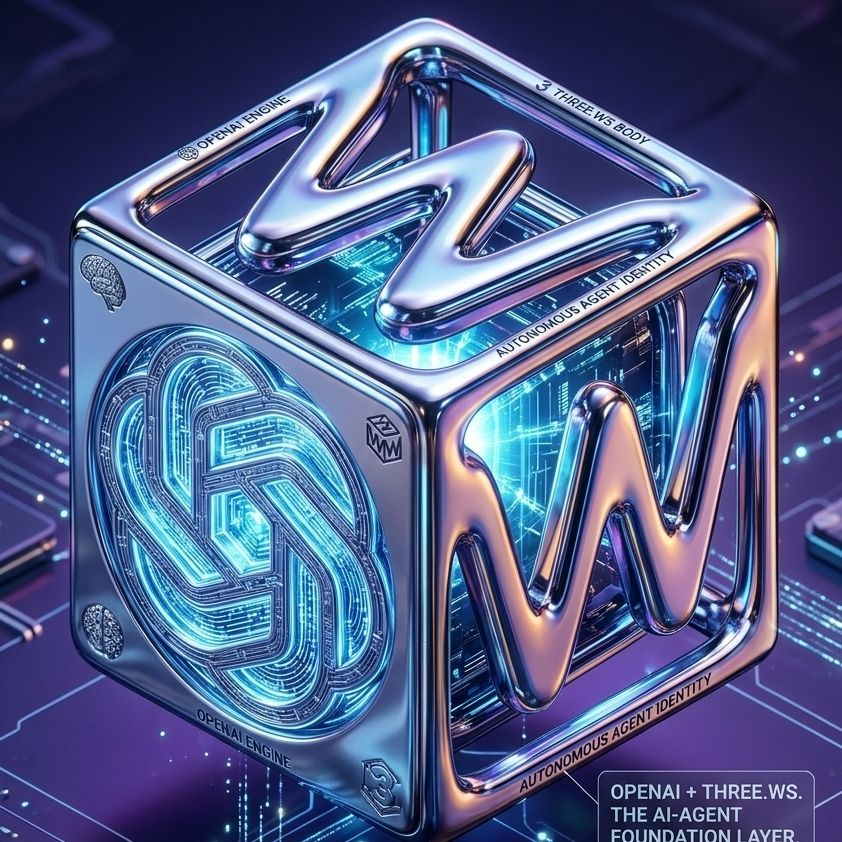
As AMD builds the infrastructure for spatial intelligence, three.ws ($THREE) has been building the application layer for 3D AI agents on Solana.
The core premise of the platform is simple: AI agents shouldn’t be just chat windows. They should have a body, a wallet, and the ability to trade autonomously.
three.ws capabilities already delivered:
· 3D bodies with rigging: users can generate textured, animated 3D virtual characters from a single sentence or a front-facing selfie.
· On-chain identity: agents are minted on Solana as Metaplex Core assets—each agent has a verifiable, transferable on-chain identity.
· Self-custody wallets: each agent can own its own Solana wallet, holding and spending funds.
· x402 machine payments: agents pay each other for APIs, data, and compute costs using USDC or $THREE via the x402 protocol—settling on-chain through a self-hosted facilitator.
· MCP integration: 72 MCP servers in the official registry let AI assistants like Claude directly manage agents, wallets, and transactions.
· Enterprise integration: IBM Business Partner, NVIDIA Inception members, OpenAI Select Partner, AWS and Alibaba Cloud marketplace listings.
The platform has processed over 110,000 on-chain USDC settlements and maintained more than 11,400 GitHub submissions, with 20–30 submissions per day on average.
---
Why AMD’s deal with three.ws matters
1. Category validation. When a company of AMD’s scale spends $8.2 billion on acquiring spatial intelligence, it tells the market: 3D AI isn’t niche. It’s the next platform-level shift. three.ws has been building for this long before institutional capital arrived.
2. Hardware tailwind. AMD’s acquisition is clearly aimed at optimizing its hardware roadmap for spatial AI workloads. That means more compute power, better tools, and lower costs for 3D generation and spatial reasoning—all of which benefit platforms that rely on GPU infrastructure for mesh generation, rigging, and animation.
3. Accelerating competition. AMD is directly challenging NVIDIA’s dominant position in 3D AI training tools. Competition between the two will accelerate innovation and expand the 3D AI application market—from games and robotics to AI agents with spatial awareness.
4. The application-layer gap. AMD is buying the model layer. World Labs builds spatial intelligence. But models need applications, and applications need an execution layer. That’s exactly where three.ws comes in—turning the spatial model into deployable, embeddable, on-chain economic agents.
---
Side-by-side comparison: infrastructure vs. execution
Layers Who is building What are they building
Hardware AMD, NVIDIA GPUs, DPUs, inference chips
World Labs, OpenAI, Anthropic spatial intelligence, large language models
Execution: three.ws 3D agent bodies, wallets, and x402 payments
Distribute ChatGPT, Claude, and browsers to embed agents into everyday workfl ows
AMD is buying the model layer. three.ws is building the execution layer. Both are necessary—neither alone is enough.
---
Market disconnect
three.ws currently has a market cap of about $716,000, down roughly 95% from its all-time high of $16.38 million reached in June 2026.
Its enterprise integrations, GitHub activity, and on-chain settlement volumes are all verifiable. The x402 payment rails are already live. 3D agents can be minted on Solana. The MCP server has been embedded into Claude and ChatGPT.
AMD’s $8.2 billion acquisition reminds us that markets sometimes price a category first, and then price individual projects within that category. Spatial intelligence is now a category with multi-billion-dollar price tags. Yet its execution layer—3D agents with wallets and payment capabilities—still trades at a micro market cap.
---
Conclusion
AMD’s acquisition of World Labs isn’t a direct endorsement of three.ws. But it validates an argument: 3D AI—spatial intelligence, embodied agents, interactive worlds—is the next major frontier.
three.ws has been building an execution layer for this frontier: machine-to-machine payments on bodies, wallets, and Solana. The infrastructure is already live. Enterprise partners are real. Code is delivered every day.
When the market connects the idea that “spatial intelligence is the next AI frontier” with “which agents run on that frontier,” three.ws will appear on the shortlist.
Charts may be quiet. Categories are not.
---
$THREE | three.ws
⚠️ Disclaimer: This article is for informational purposes only and does not constitute investment advice. $THREE is a low-market-cap, high-volatility asset. Please do your own research and manage risk accordingly.