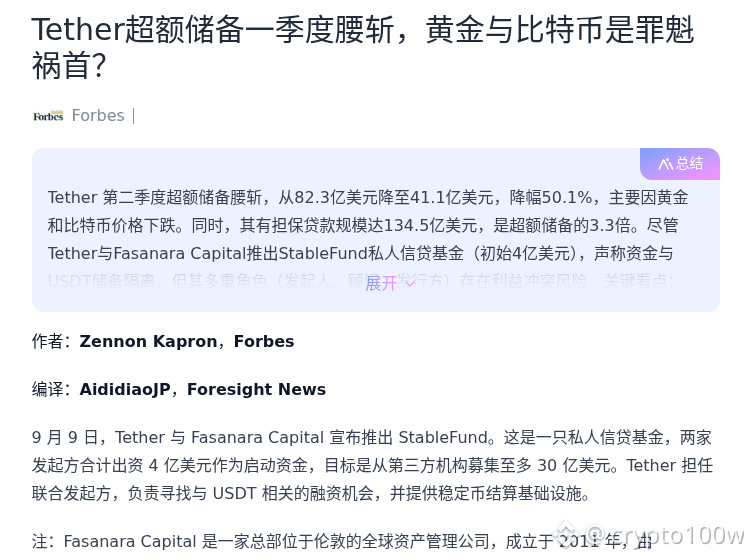
Tether’s excess reserves fell from $8.23 billion in the second quarter to $4.11 billion—almost halving. The safety buffer also dropped from 3.5% to 2.2%, with pressure primarily coming from fluctuations in gold and Bitcoin prices.
Don’t just look at this as a simple case of USDT losing its peg immediately. A more direct signal is this: when assets pull back, the market will scrutinize its reserve composition, the ability to withstand redemption pressure, and subsequent audits and reserve disclosures with greater sensitivity.
According to a report from Forbes cited by PANews, Tether’s secured loan exposure is as high as $13.45 billion—3.3 times its excess reserves. Meanwhile, gold and Bitcoin combined total $24.6 billion, and price movements will continue to squeeze this safety cushion.
One possible observation scenario is that if excess reserves rebound in the third-quarter reserve report, market sentiment may breathe a little easier. Another scenario is that if gold prices and Bitcoin continue to weaken, attention will shift even more toward reserve composition and the trend in loans. Would you rather see the reserves recover first, or see changes in loan size first?
Source: PANews
#BTC
Figure 1: Tether excess reserves cut in half quarter over quarter · Source: partial screenshot of the page
Image source: https://www.panewslab.com/zh/articles/01a0e884-4858-76f3-8e69-4415a32eb2b1
Don’t just look at this as a simple case of USDT losing its peg immediately. A more direct signal is this: when assets pull back, the market will scrutinize its reserve composition, the ability to withstand redemption pressure, and subsequent audits and reserve disclosures with greater sensitivity.
According to a report from Forbes cited by PANews, Tether’s secured loan exposure is as high as $13.45 billion—3.3 times its excess reserves. Meanwhile, gold and Bitcoin combined total $24.6 billion, and price movements will continue to squeeze this safety cushion.
One possible observation scenario is that if excess reserves rebound in the third-quarter reserve report, market sentiment may breathe a little easier. Another scenario is that if gold prices and Bitcoin continue to weaken, attention will shift even more toward reserve composition and the trend in loans. Would you rather see the reserves recover first, or see changes in loan size first?
Source: PANews
#BTC
Figure 1: Tether excess reserves cut in half quarter over quarter · Source: partial screenshot of the page
Image source: https://www.panewslab.com/zh/articles/01a0e884-4858-76f3-8e69-4415a32eb2b1