#USDT Tether’s latest move—worth taking apart to understand: On September 28, the official announcement said it has partnered with Shiga to roll out WDK-based self-custody financial products to Africa and the Gulf Cooperation Council region. The key question is how stablecoins enter everyday payments, and what permissions users, service providers, and banks each hold.
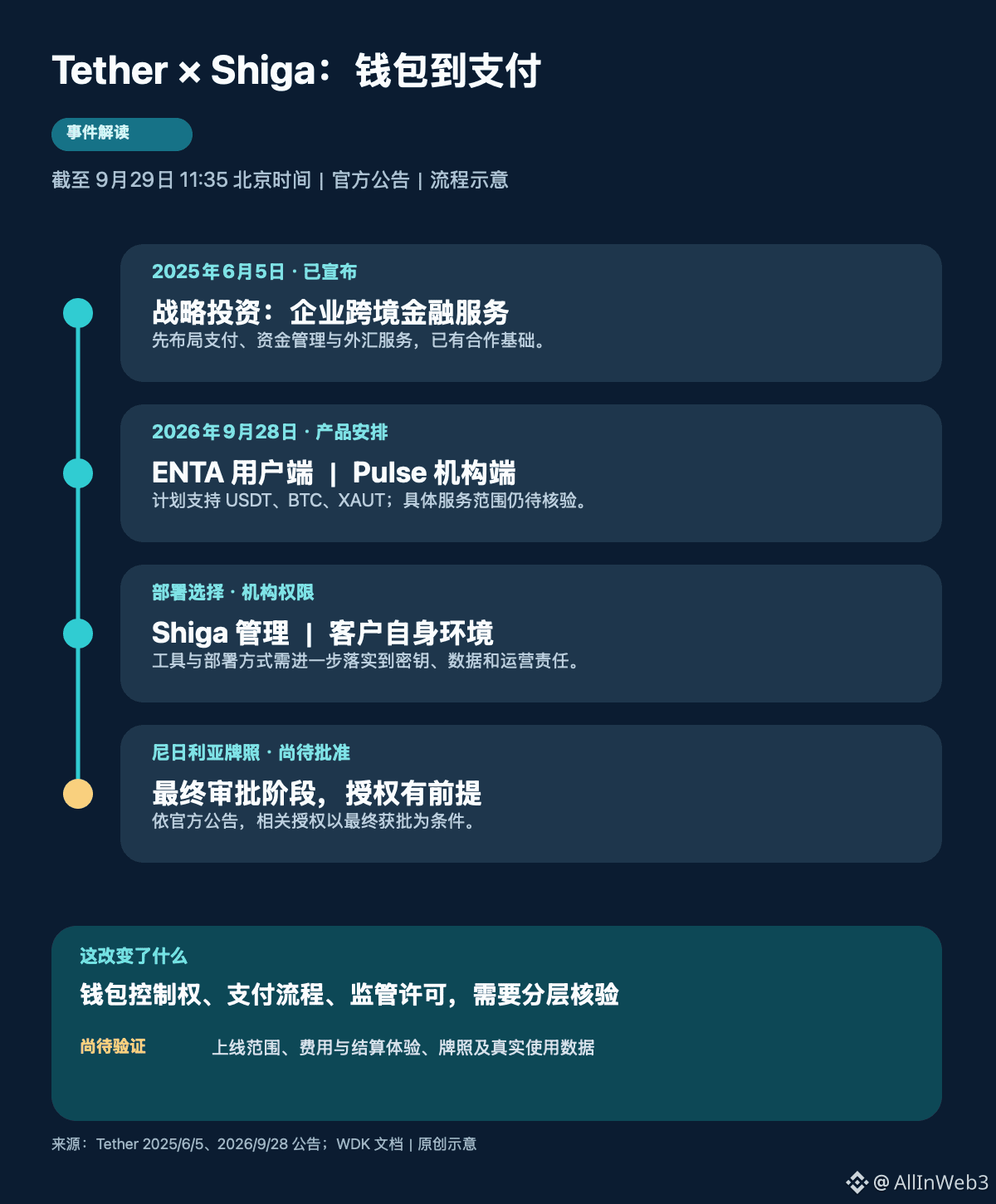
First, set the timeline straight. On June 5, 2025, Tether already announced an investment in Shiga, with a focus on cross-border enterprise payments, treasury and FX services. This latest announcement is the next phase of the two parties’ cooperation: releasing more specific product details and deployment plans. Odaily reported at 20:00 Beijing time on September 28; as of 11:35 today, what I’ve confirmed is the partnership announcement. We still need to wait for actual service coverage and usage data—so we cannot write the report time as the full launch time.
First, the problems solved for individual users and for institutions are different. The ENTA in the announcement is aimed at individuals and enterprises, planning to support holding and transferring USDT, BTC, and XAUT. Pulse, on the other hand, targets banks and fintech institutions, building services around payment rails, treasury management, and settlement. My understanding is: one side goes after users’ wallet entry points, while the other goes after financial institutions’ business workflows. To verify effectiveness, the former should look at real active users and the experience of topping up and exchanging; the latter should look at connected institutions, payment corridors, and ongoing trading volumes.
Second, self-custody still needs to be operationalized into key management and deployment methods. WDK’s official documentation defines it as an open-source, multi-chain wallet toolkit that provides core libraries and UI components. It can help teams build products, but getting from “tool availability” to “user availability” requires specific integration and operations. Institutions may use infrastructure managed by Shiga, or deploy it within their own environment. In evaluation, I will keep asking: who signs transactions, who can recover accounts, who keeps backups, and who responds if something goes wrong? Based on only the phrase “self-custody,” it’s hard to determine responsibility across the entire payment chain.
Third, regulatory licenses still have clear prerequisites. The announcement states that the placeholder license(s) for digital-asset-related activities in Nigeria are in the final approval stage, and that relevant authorizations are conditional on final approval. My view is that the sustainability of fiat on- and off-ramps and institutional connectivity in each region still needs to be verified one by one—both the scope of the license and the operational arrangements. Even the approval progress of a single country is not enough to conclude that the entire Africa and Gulf market has already opened.
I will put future observation into three checklists: regions and functions that are already open, actual fees and settlement experience, and licenses and business data that can be verified. Supporting USDT, BTC, and XAUT is a product-design fact—it cannot be directly converted into any specific coin’s incremental buy demand or price target. Source: Tether’s September 28 partnership announcement, the June 2025 investment announcement, WDK’s official documentation, and Odaily.
First, set the timeline straight. On June 5, 2025, Tether already announced an investment in Shiga, with a focus on cross-border enterprise payments, treasury and FX services. This latest announcement is the next phase of the two parties’ cooperation: releasing more specific product details and deployment plans. Odaily reported at 20:00 Beijing time on September 28; as of 11:35 today, what I’ve confirmed is the partnership announcement. We still need to wait for actual service coverage and usage data—so we cannot write the report time as the full launch time.
First, the problems solved for individual users and for institutions are different. The ENTA in the announcement is aimed at individuals and enterprises, planning to support holding and transferring USDT, BTC, and XAUT. Pulse, on the other hand, targets banks and fintech institutions, building services around payment rails, treasury management, and settlement. My understanding is: one side goes after users’ wallet entry points, while the other goes after financial institutions’ business workflows. To verify effectiveness, the former should look at real active users and the experience of topping up and exchanging; the latter should look at connected institutions, payment corridors, and ongoing trading volumes.
Second, self-custody still needs to be operationalized into key management and deployment methods. WDK’s official documentation defines it as an open-source, multi-chain wallet toolkit that provides core libraries and UI components. It can help teams build products, but getting from “tool availability” to “user availability” requires specific integration and operations. Institutions may use infrastructure managed by Shiga, or deploy it within their own environment. In evaluation, I will keep asking: who signs transactions, who can recover accounts, who keeps backups, and who responds if something goes wrong? Based on only the phrase “self-custody,” it’s hard to determine responsibility across the entire payment chain.
Third, regulatory licenses still have clear prerequisites. The announcement states that the placeholder license(s) for digital-asset-related activities in Nigeria are in the final approval stage, and that relevant authorizations are conditional on final approval. My view is that the sustainability of fiat on- and off-ramps and institutional connectivity in each region still needs to be verified one by one—both the scope of the license and the operational arrangements. Even the approval progress of a single country is not enough to conclude that the entire Africa and Gulf market has already opened.
I will put future observation into three checklists: regions and functions that are already open, actual fees and settlement experience, and licenses and business data that can be verified. Supporting USDT, BTC, and XAUT is a product-design fact—it cannot be directly converted into any specific coin’s incremental buy demand or price target. Source: Tether’s September 28 partnership announcement, the June 2025 investment announcement, WDK’s official documentation, and Odaily.