
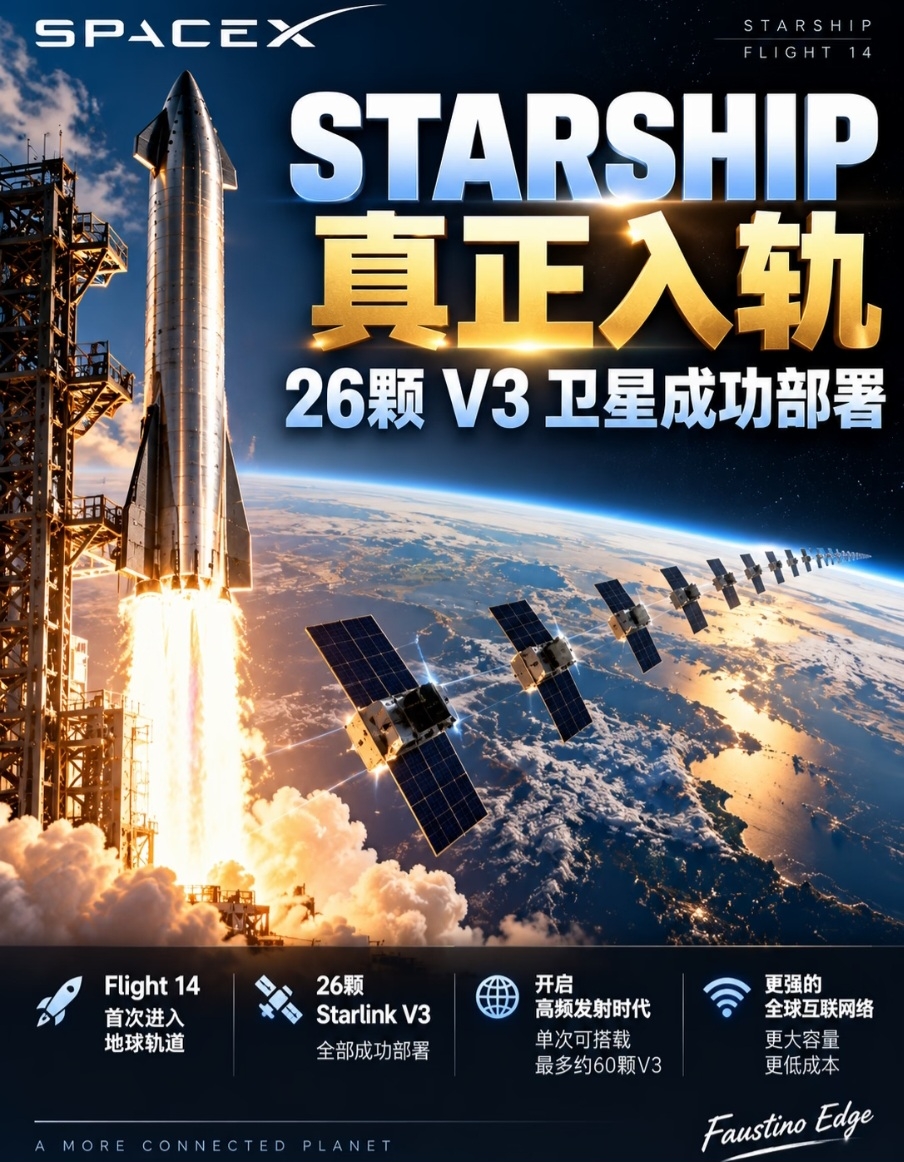
SpaceX has just completed a rather crucial milestone: Starship Flight 14 for the first time truly entered Earth orbit and successfully deployed the first batch of 26 Starlink V3 satellites. This is truly significant, mainly because:
First, Starship has finally moved from a “test rocket” to an “orbital transportation system.” Previously, all 13 Starship flights used suborbital trajectories, while Flight 14 was the first to carry out a real orbital mission. Even more noteworthy is that during this ascent, if one engine experienced an anomaly, Starship still managed to reach orbit and deploy the satellites. This means that in the future, the market’s focus when looking at Starship will shift from “Will this time succeed?” to “How many times can it fly in a year?”
Second, the 26 V3 satellites are only the beginning; what really matters is capacity. This time it carried only 26 Starlink V3 satellites, but SpaceX has previously said that in the future a single Starship mission could carry up to about 60 V3 satellites. If Starship enters a stable, high-frequency launch phase, the pace of Starlink expansion could change noticeably.
One of the biggest constraints in the past was “how to get a large number of satellites into orbit.” Now SpaceX is trying to bring the whole chain—“rocket → satellite → network → users”—under its own control.
Third, this is what SPCX investors should really be watching.
Today, SpaceX’s stock price didn’t jump directly just because “all 26 were successfully deployed”—it even dipped slightly at one point. But short-term stock prices and long-term commercial value are two different things.
Next, more worth tracking than whether a single launch succeeds is:
The intervals between Starship re-flights, the number of V3 satellites carried per mission, the number of launches per year, the growth in Starlink users and revenue, and whether Starship can develop into reliable commercial transportation capability. If these metrics continue to be met consistently, Starship’s significance won’t be just “the largest rocket in the world.” It could become the core infrastructure for SpaceX’s next phase of lowering the per-unit cost to get payloads into orbit and expanding Starlink capacity. The 26 satellites aren’t the main point—the real point is that Starship is finally starting to truly “deliver.”
#SpaceX #Starship #SPCX #美股 #马斯克 $SPCXB