【CJ Arbitrage Progression 04/14】
What automation should really do for you is to repeat execution and issue timely alerts—not to decide that the price will definitely come back.
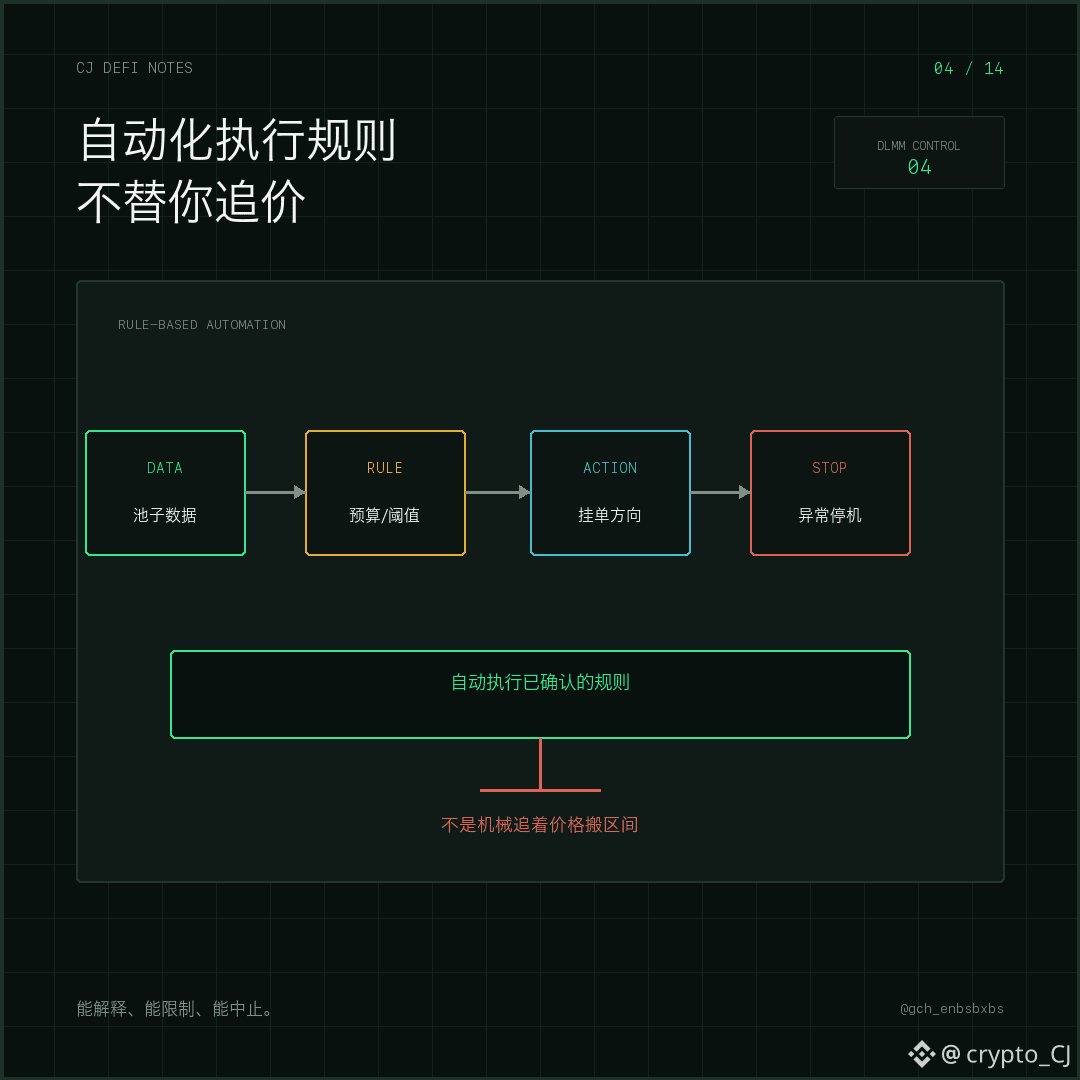
Meteora DLMM distributes liquidity across discrete bins, allowing Bid and Ask at different price levels to be arranged more precisely. CJ previously built a modular position-management tool: create positions in advance, deposit funds, have the program read pool data, adjust order directions based on preset conditions, and send reminders for new pools, abnormal fees, and price changes.
This is not the same as “wherever the price goes, the system mechanically moves the range there.” The former executes a strategy with a clearly defined budget, direction, and stop conditions; the latter might sell the freshly received coins when the price drops out of the lower bound, then buy them back when the price rises out of the upper bound—automating chasing rallies and killing dips. The faster it automates, the faster mistakes get realized.
When reviewing a market-making tool, I’d first ask four things: what data it reads, what conditions trigger actions, how many times it can adjust per day at most, and whether it can stop when there are consecutive losses or data anomalies. The APR shown on the interface and the “one-click custody” are not the core—what truly matters is whether each action can be explained, limited, and stopped.
Next post: Funding-rate arbitrage looks direction-neutral—so why might you ultimately lose money when closing the position?
#Meteora #Automation
What automation should really do for you is to repeat execution and issue timely alerts—not to decide that the price will definitely come back.
Meteora DLMM distributes liquidity across discrete bins, allowing Bid and Ask at different price levels to be arranged more precisely. CJ previously built a modular position-management tool: create positions in advance, deposit funds, have the program read pool data, adjust order directions based on preset conditions, and send reminders for new pools, abnormal fees, and price changes.
This is not the same as “wherever the price goes, the system mechanically moves the range there.” The former executes a strategy with a clearly defined budget, direction, and stop conditions; the latter might sell the freshly received coins when the price drops out of the lower bound, then buy them back when the price rises out of the upper bound—automating chasing rallies and killing dips. The faster it automates, the faster mistakes get realized.
When reviewing a market-making tool, I’d first ask four things: what data it reads, what conditions trigger actions, how many times it can adjust per day at most, and whether it can stop when there are consecutive losses or data anomalies. The APR shown on the interface and the “one-click custody” are not the core—what truly matters is whether each action can be explained, limited, and stopped.
Next post: Funding-rate arbitrage looks direction-neutral—so why might you ultimately lose money when closing the position?
#Meteora #Automation