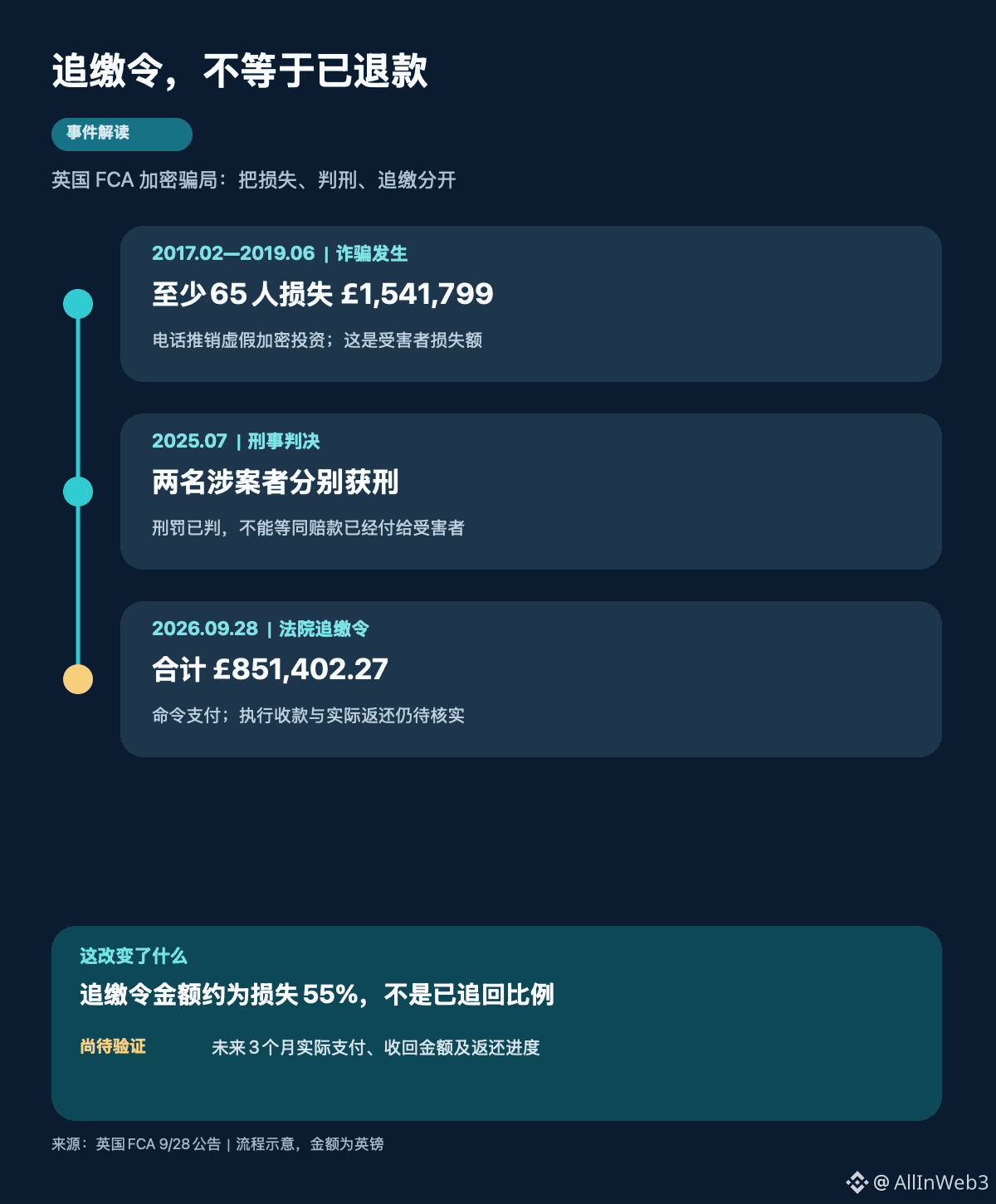
#UK FCA obtains court order to recover £851,400 The most easily mistaken point in this highly discussed news is that: the court order is for the payment of £851,400.14, which does not mean that 65 victims have already received refunds. On September 28, the UK Financial Conduct Authority (FCA) published new updates on the recovery case. The case itself dates back many years ago; separating the timeline and the amounts is the only way to see what this latest step has truly advanced.
The first paragraph is about the losses. The FCA said that between February 2017 and June 2019, two individuals promoted fake cryptocurrency investment by making unsolicited phone calls and showcasing websites that appeared professional. At least 65 investors suffered total losses of £1,541,799. This figure is the victims’ losses, not the amount in the court’s recovery order, and not the funds already recovered.
The second paragraph is about criminal responsibility. The FCA announced back in 2024 that the two were convicted. In July 2025, Raymondip Bedi was sentenced to 5 years and 4 months, and Patrick Mavanga to 6 years and 6 months. Sentencing addresses criminal liability; it cannot replace the task of finding enforceable assets, collecting funds, and distributing them to victims. The importance of this FCA announcement lies precisely in the fact that it pushes forward the asset recovery after sentencing.
The third paragraph is the court order dated September 28: Bedi must pay £603,404.28, and Mavanga must pay £247,997.99, for a total of £851,402.27. This total is roughly equivalent to 55.2% of the previously published losses, but 55.2% is only the ratio of the “ordered amount to the loss amount.” It cannot be written as the recovery rate, nor can it be used to imply that everyone will get back 55.2%. The FCA explained that the recovery order amount is determined by the lower of the criminal proceeds and the value of available assets. This likewise cannot prove that the remaining losses have disappeared, where they were transferred to, or that they are absolutely unrecoverable.
Next, there is still the enforcement stage. The FCA said it has identified and contacted the victims and will return to them the funds that are actually recovered through the recovery process. The two defendants have three months to comply with the order; delays may lead to additional imprisonment. The announcement does not provide, as of the publication date, the actual amount received, the per-person distribution proportions, or the return dates. Therefore, what can currently be confirmed is only that “the court has issued the order,” not that “all funds have been fully recovered or distributed.” What is most worth checking next is the actual payments, the amount the FCA recovers, and the progress of refunds to the victims. Source: the UK FCA September 28, 2026 announcement and the earlier announcements of conviction and sentencing.
The first paragraph is about the losses. The FCA said that between February 2017 and June 2019, two individuals promoted fake cryptocurrency investment by making unsolicited phone calls and showcasing websites that appeared professional. At least 65 investors suffered total losses of £1,541,799. This figure is the victims’ losses, not the amount in the court’s recovery order, and not the funds already recovered.
The second paragraph is about criminal responsibility. The FCA announced back in 2024 that the two were convicted. In July 2025, Raymondip Bedi was sentenced to 5 years and 4 months, and Patrick Mavanga to 6 years and 6 months. Sentencing addresses criminal liability; it cannot replace the task of finding enforceable assets, collecting funds, and distributing them to victims. The importance of this FCA announcement lies precisely in the fact that it pushes forward the asset recovery after sentencing.
The third paragraph is the court order dated September 28: Bedi must pay £603,404.28, and Mavanga must pay £247,997.99, for a total of £851,402.27. This total is roughly equivalent to 55.2% of the previously published losses, but 55.2% is only the ratio of the “ordered amount to the loss amount.” It cannot be written as the recovery rate, nor can it be used to imply that everyone will get back 55.2%. The FCA explained that the recovery order amount is determined by the lower of the criminal proceeds and the value of available assets. This likewise cannot prove that the remaining losses have disappeared, where they were transferred to, or that they are absolutely unrecoverable.
Next, there is still the enforcement stage. The FCA said it has identified and contacted the victims and will return to them the funds that are actually recovered through the recovery process. The two defendants have three months to comply with the order; delays may lead to additional imprisonment. The announcement does not provide, as of the publication date, the actual amount received, the per-person distribution proportions, or the return dates. Therefore, what can currently be confirmed is only that “the court has issued the order,” not that “all funds have been fully recovered or distributed.” What is most worth checking next is the actual payments, the amount the FCA recovers, and the progress of refunds to the victims. Source: the UK FCA September 28, 2026 announcement and the earlier announcements of conviction and sentencing.