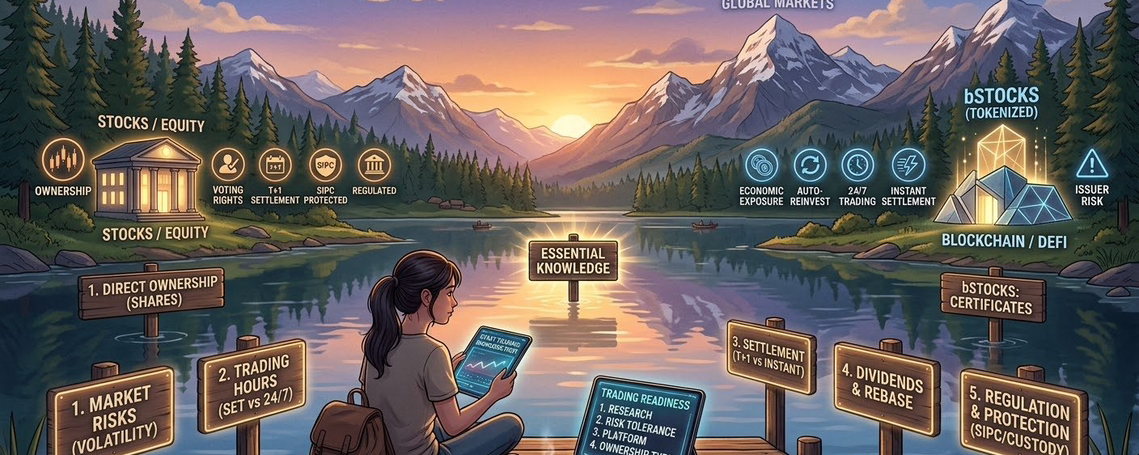

The following provides a detailed breakdown of the main differences between conventional stocks (Traditional Stocks) and blockchain-based token stocks (bStocks), as well as the important points that investors must know before trading.
1. Nature of ownership and management/rights (Ownership & Shareholder Rights)
The most fundamental difference between common stock shares and bStocks is the form of legal ownership.
Traditional Stocks
- When buying shares through a regulated brokerage account, you become the beneficial owner who has the company’s actual economic interest. This gives the investor full corporate rights, such as the ability to vote at annual general meetings (Proxy Voting) and to participate in director board elections.
bStocks (Tokenized Stocks)
- bStocks are not direct ownership of a company’s actual shares. Instead, they are certificates/tokens (Certificate/Token) issued in a 1:1 ratio representing shares that are genuinely held and backed by a custodian. Therefore, you only get full economic exposure related to the stock price movements and dividend distributions, and you do not receive the company’s voting rights or governance-related rights.
2. Trading hours and settlement system speed (Trading Hours & Settlement Speed)
The market trading cycle and the schedule for financial/asset transfers are completely different.
Trading schedule
- Traditional stock markets trade only during set office hours, typically Monday through Friday (e.g., for the US market, 9:30 AM to 4:00 PM ET). Trading is paused on weekends and evenings. However, bStocks are built on the Crypto Spot Market, so they can be traded any time, 7 days a week, 24 hours a day (24/7/365).
Settlement cycle
- Traditional stock trades are currently settled under a T+1 system (the next business day after the trade), so you must wait until funds are returned for withdrawal. bStocks, however, uses Blockchain smart contracts, so fund transfers and asset exchanges complete within seconds (Instant Settlement), and you can move them to other wallets immediately.
3. Structural Comparison table of key features
(1) Category - Traditional Stocks
Asset type - Electronic registered equity shares
Market opening hours - only within set office hours (e.g., Monday to Friday)
Settlement time - T+1 business days
Voting rights - fully available
Dividends - cash payouts or Broker DRIP
Custody model - Brokerage/Clearinghouse
Legal protection - government regulations and insurance scheme (SIPC/FSCS)
(2) Category - bStocks (tokenized shares)
Asset type - BEP-20 / On-chain Token
Market open - 24 hours a day, 7 days a week, no market holidays
Settlement/record date - immediate (Instant on Blockchain)
Voting rights - none available (only price-related economic benefits)
Dividends - a Rebase system that increases token balances
Custody model (Custody) - Exchange account or Web3 wallet
Legal protection depends on the issuer’s regulations and backing
4. Liquidity and Weekend Tracking risk
Being able to trade around the clock is an advantage, but you should watch out for the risk of price volatility.
When the main stock exchanges close on Friday evening, the bStocks price depends entirely on the buy and sell demand on that platform (Order-book Depth).
If any global news or corporate event occurs during the weekend period, bStocks trading volume may be thin, which can cause the stock price to deviate significantly from its true value (Price Divergence).
When the main stock market reopens on Monday morning, the bStock price is re-aligned with the global main market price, which can lead to sudden price jumps or drops (Price Gaps).
5. How dividends and corporate actions are managed (Dividends & Corporate Actions)
Dividend payments and share splitting are handled differently by companies.
Dividends
_ For regular stocks, dividends are either paid as cash into the brokerage account or handled via a DRIP (Dividend Reinvestment Plan) system that buys back shares. For bStocks, after tax withholding, the remaining net dividend is typically converted into an automatic investment using an On-chain Token Rebase mechanism, which increases the investor’s token quantity.
Stock Splits (share splitting)
_ If, in the main market, one stock share is split into two, the bStocks platform also automatically doubles the number of tokens and adjusts so that the value per unit is reduced by half.
6. Risks related to the regulatory framework and custodial custody (Regulatory Framework & Custodial Risk)
The safety of the investment is directly related to the legal framework.
Traditional Brokerages
_ Under strict national-level regulators such as the SEC and FINRA in the US, there are legal protections and assurances, including SIPC insurance (protecting up to $500,000) if a broker becomes insolvent.
Tokenized Issuers
_ bStocks issuers operate under specific local regulatory frameworks (e.g., rules like those of Abu Dhabi FSRA) and typically provide evidence of Collateral showing that the actual shares are segregated and held separately. However, since they may not include government-level protection schemes like traditional SIPC, investors need to conduct extra due diligence on the issuer’s robustness (counterparty risk), the custodian’s financial condition, and the security of the smart contracts.