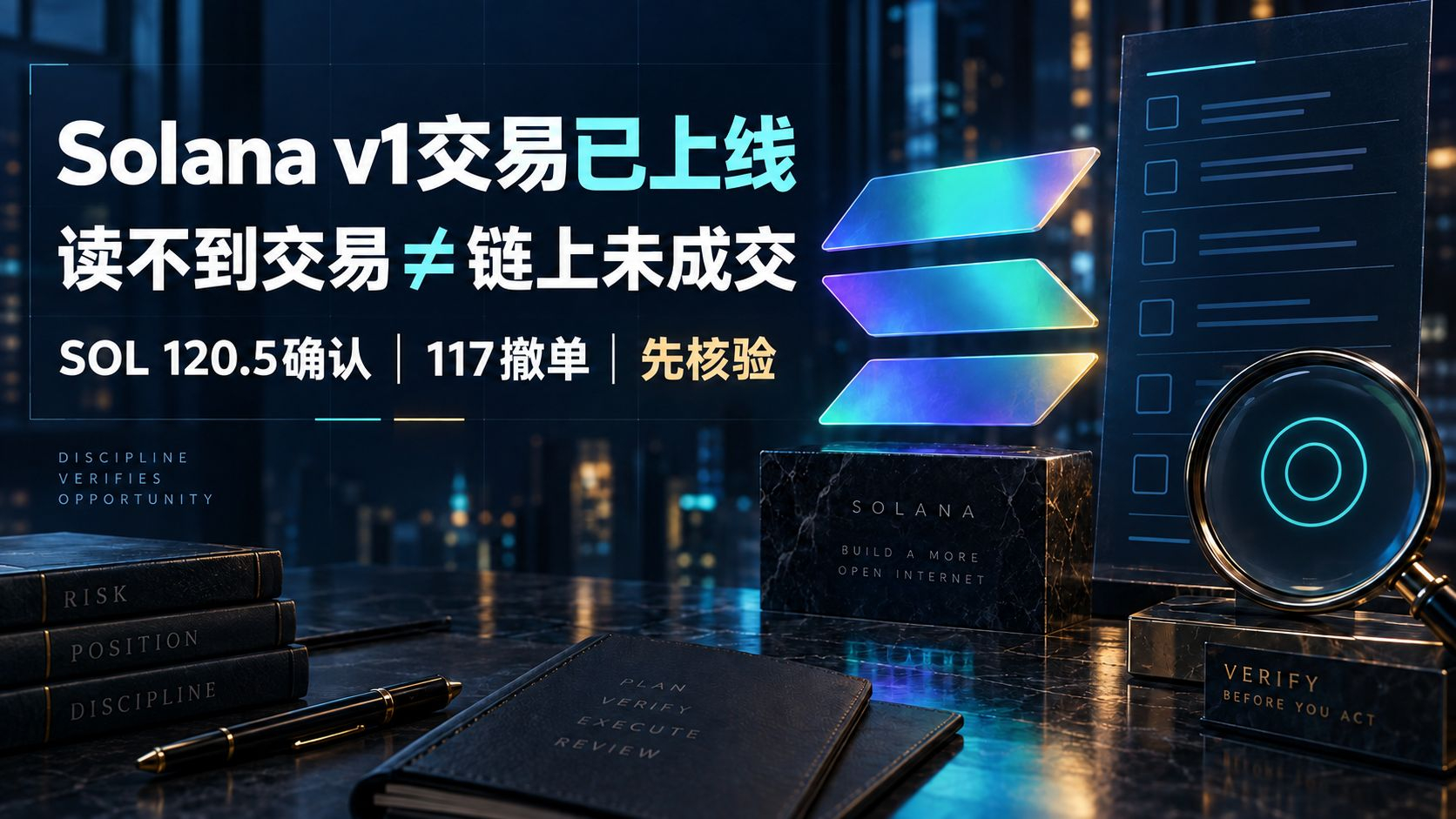
SOL transaction receipt pre-check|v1 is live, but it doesn’t mean all tools are adapted yet|Only consider a small position if above $120.5
My stance is to first confirm that the transaction can be read correctly, and then discuss whether there’s upside from capacity expansion. I don’t just repeat orders based on “query failed.” In Solana’s September update for larger transactions, it labels v1 transactions as “mainnet is live” and notes the activation time as September 15. This upgrade didn’t happen tonight, and you can’t treat the status of an old proposal as the current network state.
In this announcement, what ordinary traders should pay attention to more than the capacity numbers is compatibility: old query tools may not be able to read v1. Some earlier node versions’ storage/translation may incorrectly restore v1 as v0 and drop configuration fields. Anza’s official Agave fix submission also describes this issue. Query errors, displaying an incorrect transaction version, or showing a budget of zero do not automatically prove that the transaction didn’t happen—and they also don’t justify declaring that the chain has zero fees. “New format is live,” “wallet support,” and “query service upgrades” are three separate things that need to be verified individually.
How does this affect the market? My view is that large transaction capacity can give room to complex applications, but tool compatibility and receipt verification determine whether users can use it with confidence. Seeing no result on the interface and signing again could turn what was originally one operation into two independent transactions. Seeing an incorrect fee field and concluding the network is free could also skew cost judgment. For money discipline, checking the original transaction signature first, confirming the actual on-chain status next, and only then deciding whether to retry is just as important as choosing the entry point. When updating software, only use official channels from the project or the wallet. Any so-called compatibility upgrade doesn’t require sending your seed phrase to customer support.
How has the market reacted? As of 02:24 Beijing time on September 29, Kraken’s SOL-to-USD quote is about $119.86, with a rolling 24-hour range of $117.35 to $123.40. I can only confirm the price is still within this range; I can’t attribute all volatility solely to the September 15 upgrade, and I have no evidence that technical capability has turned into added spot-buy demand. Expanding the transaction capacity ceiling doesn’t automatically mean transactions per second increase proportionally, nor does it mean the coin price should rise proportionally. Between news and price, there needs to be a real bridge built by actual usage and capital demand.
If this were my own trading: I wouldn’t participate. For direction, I’d only consider going long based on spot conditions—no shorting, no leverage. Only if the hourly close is above $120.5, followed by a pullback that holds between $120 and $120.5, and the transaction signature, balance, and fees can be checked normally, would I use 0.3% of total funds for a trial position. Target $121.8 to cut the position in half; the remainder to be fully closed at $123.4. Stop loss immediately at $119, or if two consecutive hourly closes are below $120, I would exit entirely. If it breaks down below $117 before triggering, or if there’s a confirmed transaction read error or abnormal wallet signature, I would cancel this plan, keep cash, and not chase orders just because I missed the price.
The conditions that would overturn my cautious assessment are: the breakout has sustained trade support, and there’s a verifiable improvement from the way it’s used and tool adaptation. The conditions that would overturn the long plan are: the breakout fails, or the execution path is unreliable. The above is only an assumed plan not yet triggered; it cannot be written as already executed trades, and there are no profits to claim. Sources: Solana official larger transaction upgrade announcement; Anza official Agave fix submission.
#SOL
The above is only my personal market observation and does not constitute investment advice.
My stance is to first confirm that the transaction can be read correctly, and then discuss whether there’s upside from capacity expansion. I don’t just repeat orders based on “query failed.” In Solana’s September update for larger transactions, it labels v1 transactions as “mainnet is live” and notes the activation time as September 15. This upgrade didn’t happen tonight, and you can’t treat the status of an old proposal as the current network state.
In this announcement, what ordinary traders should pay attention to more than the capacity numbers is compatibility: old query tools may not be able to read v1. Some earlier node versions’ storage/translation may incorrectly restore v1 as v0 and drop configuration fields. Anza’s official Agave fix submission also describes this issue. Query errors, displaying an incorrect transaction version, or showing a budget of zero do not automatically prove that the transaction didn’t happen—and they also don’t justify declaring that the chain has zero fees. “New format is live,” “wallet support,” and “query service upgrades” are three separate things that need to be verified individually.
How does this affect the market? My view is that large transaction capacity can give room to complex applications, but tool compatibility and receipt verification determine whether users can use it with confidence. Seeing no result on the interface and signing again could turn what was originally one operation into two independent transactions. Seeing an incorrect fee field and concluding the network is free could also skew cost judgment. For money discipline, checking the original transaction signature first, confirming the actual on-chain status next, and only then deciding whether to retry is just as important as choosing the entry point. When updating software, only use official channels from the project or the wallet. Any so-called compatibility upgrade doesn’t require sending your seed phrase to customer support.
How has the market reacted? As of 02:24 Beijing time on September 29, Kraken’s SOL-to-USD quote is about $119.86, with a rolling 24-hour range of $117.35 to $123.40. I can only confirm the price is still within this range; I can’t attribute all volatility solely to the September 15 upgrade, and I have no evidence that technical capability has turned into added spot-buy demand. Expanding the transaction capacity ceiling doesn’t automatically mean transactions per second increase proportionally, nor does it mean the coin price should rise proportionally. Between news and price, there needs to be a real bridge built by actual usage and capital demand.
If this were my own trading: I wouldn’t participate. For direction, I’d only consider going long based on spot conditions—no shorting, no leverage. Only if the hourly close is above $120.5, followed by a pullback that holds between $120 and $120.5, and the transaction signature, balance, and fees can be checked normally, would I use 0.3% of total funds for a trial position. Target $121.8 to cut the position in half; the remainder to be fully closed at $123.4. Stop loss immediately at $119, or if two consecutive hourly closes are below $120, I would exit entirely. If it breaks down below $117 before triggering, or if there’s a confirmed transaction read error or abnormal wallet signature, I would cancel this plan, keep cash, and not chase orders just because I missed the price.
The conditions that would overturn my cautious assessment are: the breakout has sustained trade support, and there’s a verifiable improvement from the way it’s used and tool adaptation. The conditions that would overturn the long plan are: the breakout fails, or the execution path is unreliable. The above is only an assumed plan not yet triggered; it cannot be written as already executed trades, and there are no profits to claim. Sources: Solana official larger transaction upgrade announcement; Anza official Agave fix submission.
#SOL
The above is only my personal market observation and does not constitute investment advice.