#qnt从日内高点回落逾40%
Seven-day surge of 238%, then one day gives back 40%.
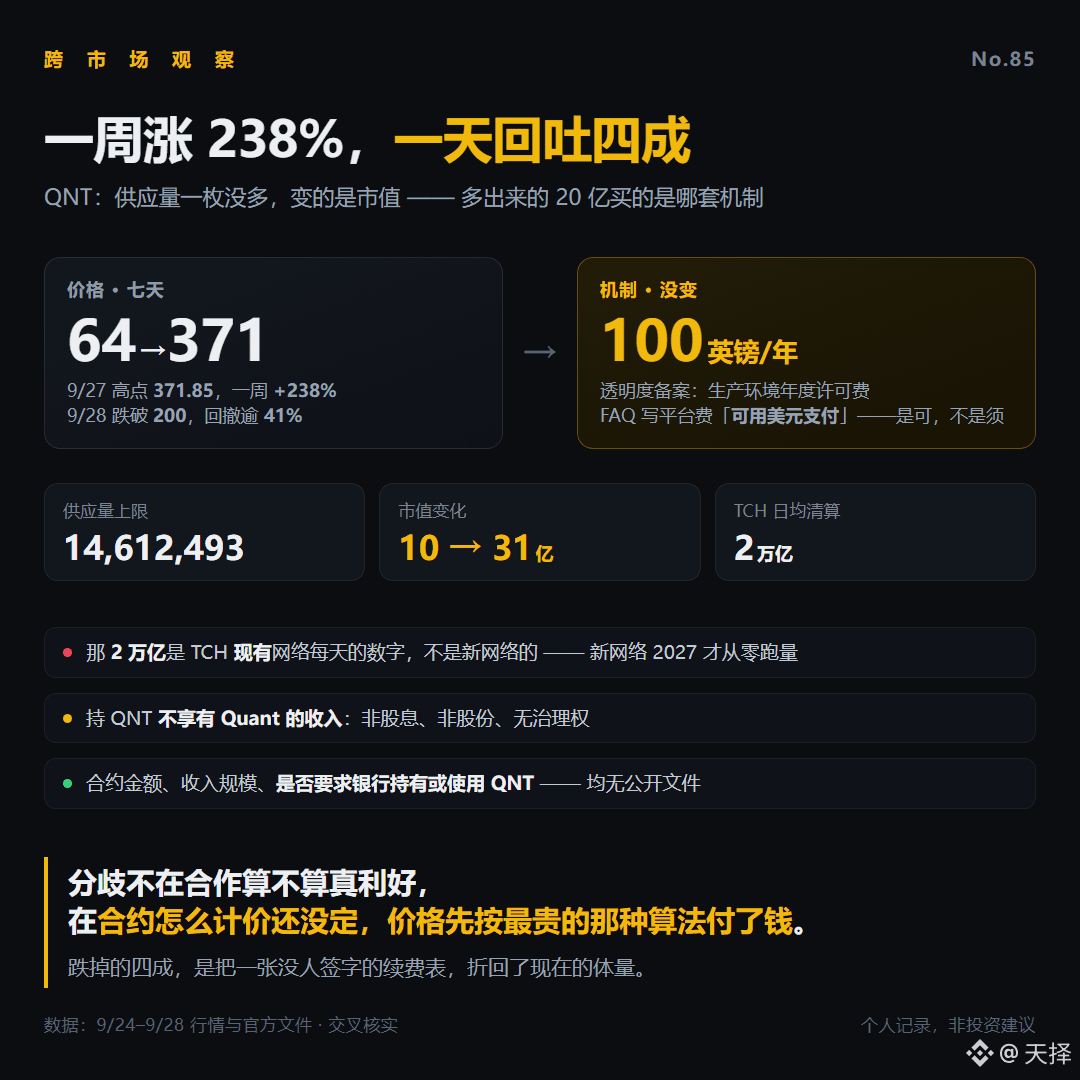
▪️ On 9/24, two announcements landed on the same day: the U.S. clearinghouse TCH selected Quant (QNT) to build an interoperability layer for its “on-chain currency program.” It involved 25 U.S. banks holding the stake, and the network won’t be open until the first half of 2027; on that same day, seven UK banks completed their first interbank tokenized GBP deposit settlement. QNT rose from about 64 to a peak of 371.85 by 9/27—+238% in a week; on 9/28 it fell below 200 and retraced more than 41%.
▪️ The supply didn’t increase by a single coin. The cap is 14,612,493 coins, and after being destroyed in 2018 it hasn’t been added to. What changed is the market cap: from under $1 billion to about $3.1 billion—an extra $2 billion. That additional $2 billion is what buys the “annual license fee paid by banks, with the fees converted into locked QNT” mechanism.
▪️ The mechanism is only described in Quant’s own documents: in the FAQ, it says the platform fee can be paid in USD, or paid by subscribing with QNT—meaning it’s optional, not mandatory; in the transparency filing, the annual license fee in the production environment is £100.
▪️ People can easily misread TCH’s “2 trillion”: that refers to its existing network’s daily clearing volume, not the new network’s. The new network only starts running in 2027 from zero volume, and there’s also no public confirmation from financial institutions that QNT will be written into contracts.
The dispute isn’t whether the cooperation counts as a real positive. It’s that the contract’s pricing has not been set yet—yet the price was already paid using the most expensive kind of algorithm.
The missing 40% was the conversion of a renewal fee sheet that nobody had signed, back into the current scale. When you read it as a pullback, or as a re-pricing? $QNT
Seven-day surge of 238%, then one day gives back 40%.
▪️ On 9/24, two announcements landed on the same day: the U.S. clearinghouse TCH selected Quant (QNT) to build an interoperability layer for its “on-chain currency program.” It involved 25 U.S. banks holding the stake, and the network won’t be open until the first half of 2027; on that same day, seven UK banks completed their first interbank tokenized GBP deposit settlement. QNT rose from about 64 to a peak of 371.85 by 9/27—+238% in a week; on 9/28 it fell below 200 and retraced more than 41%.
▪️ The supply didn’t increase by a single coin. The cap is 14,612,493 coins, and after being destroyed in 2018 it hasn’t been added to. What changed is the market cap: from under $1 billion to about $3.1 billion—an extra $2 billion. That additional $2 billion is what buys the “annual license fee paid by banks, with the fees converted into locked QNT” mechanism.
▪️ The mechanism is only described in Quant’s own documents: in the FAQ, it says the platform fee can be paid in USD, or paid by subscribing with QNT—meaning it’s optional, not mandatory; in the transparency filing, the annual license fee in the production environment is £100.
▪️ People can easily misread TCH’s “2 trillion”: that refers to its existing network’s daily clearing volume, not the new network’s. The new network only starts running in 2027 from zero volume, and there’s also no public confirmation from financial institutions that QNT will be written into contracts.
The dispute isn’t whether the cooperation counts as a real positive. It’s that the contract’s pricing has not been set yet—yet the price was already paid using the most expensive kind of algorithm.
The missing 40% was the conversion of a renewal fee sheet that nobody had signed, back into the current scale. When you read it as a pullback, or as a re-pricing? $QNT