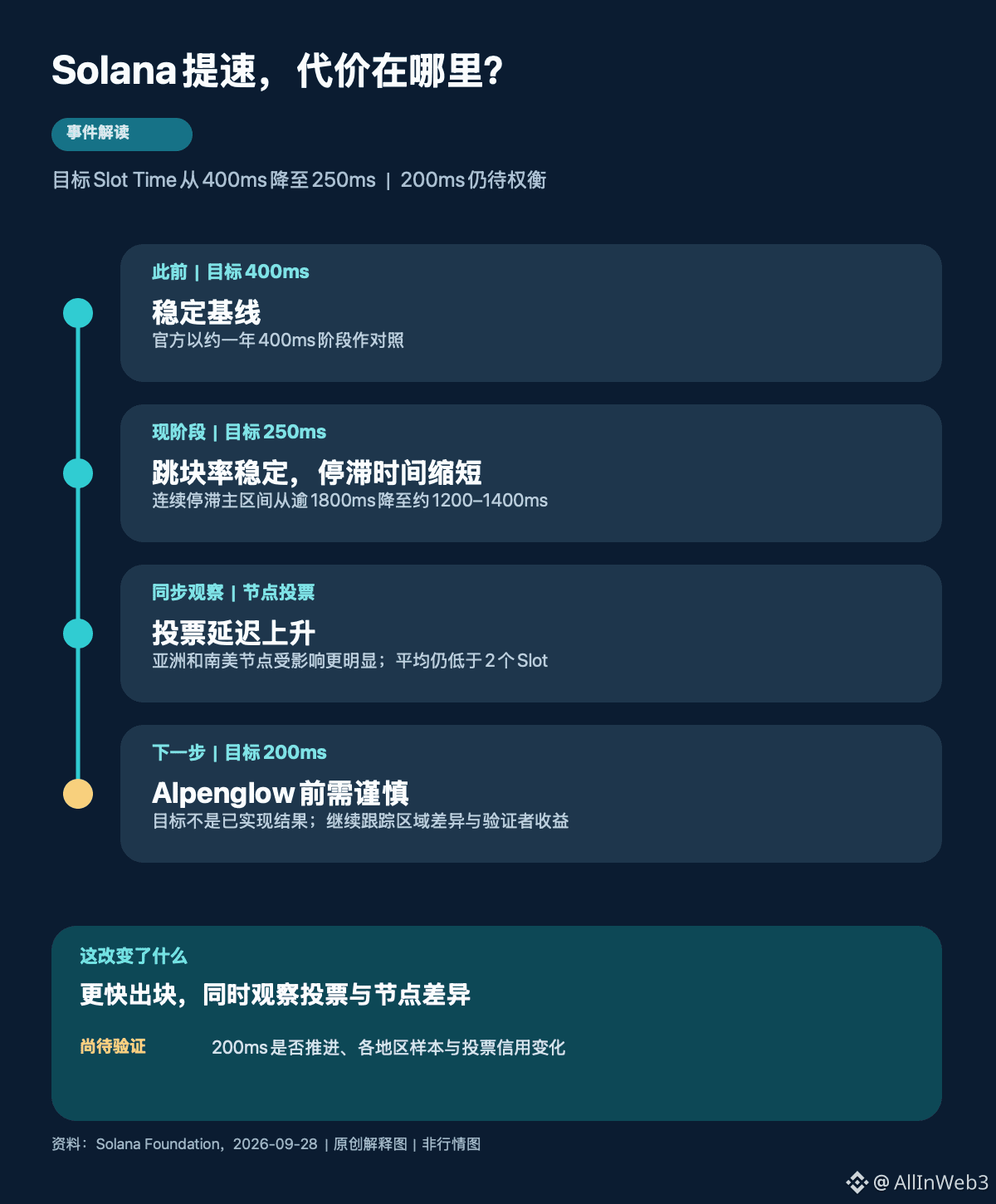
#Solana #SOL After Solana gradually reduced its target Slot Time from 400 milliseconds to 250 milliseconds, how much faster did the network get—and what trade-offs came with it? A performance retrospective published by the Solana Foundation on September 28 provides an answer that’s more informative than “nearly 200 milliseconds”: the skip-block rate stays low and does not noticeably worsen with the speed-up, but validator vote delays rise, and regional differences still need close monitoring.
First, get the timeline right. Previously, the network’s target was about one year at 400 milliseconds; afterward, it was adjusted step by step to 350, 300, and 250 milliseconds. What the Foundation observed this time is the intervals in which the speed was already reduced—not an announcement that “200 milliseconds is live.” Odaily reported the original article at 23:47 Beijing time on September 28. In the text, “200 milliseconds” is still the next step that needs cautious evaluation before Alpenglow goes live.
On the first layer, look at the user-perceived benefits. Official data shows that when the target interval is shortened, the skip-block rate remains stable. The main periods of stalling caused by consecutive skipped blocks were reduced from more than 1,800 milliseconds to roughly 1,200–1,400 milliseconds. For a single leader’s consecutive control over the ordering window, the 99th percentile dropped from about 3 seconds to about 2 seconds. This suggests that the window for waiting and for a single leader to extract value may narrow—but it does not mean that every transaction is confirmed in 250 milliseconds, and you definitely can’t directly equate the target interval to finality.
On the second layer, look at validator costs. Voting itself must be written on-chain, and packing blocks more closely increases vote delay; the impact is more pronounced for nodes in Asia and South America. The Foundation also notes that the average vote delay across the whole network remains below 2 slots, and the current data does not indicate consensus instability. In other words, “paying a latency cost” is not the same conclusion as “the network has lost stability.” The sample size for regional handoffs is still small, so you can’t claim that specific regions are being punished systematically over the long term.
On the third layer, consider the economic boundary. In the official table, in the 250-millisecond stage, the proportion of voting-credit loss based on node averages is about 1.636%, and about 0.0874% when weighted by stake. The gap between the two metrics reminds us that nodes of different sizes—large nodes versus small nodes—may bear different impacts. The sample period for this stage is limited, so you can’t treat the short-term numbers as a prediction for 200 milliseconds.
My view is that what’s truly worth tracking isn’t just a smaller milliseconds figure, but whether the speed-up can maintain acceptable voting performance across different regions and validators of different sizes. Next, we should watch the 200-millisecond decision, the expansion of regional samples, the distribution of voting credits, and mechanism changes after Alpenglow. The original article did not provide a single clear catalyst for SOL price increases, and technical progress does not automatically mean the token price will benefit.
Source: Solana Foundation, “Slot Time Reduction Effects,” September 28, 2026.
First, get the timeline right. Previously, the network’s target was about one year at 400 milliseconds; afterward, it was adjusted step by step to 350, 300, and 250 milliseconds. What the Foundation observed this time is the intervals in which the speed was already reduced—not an announcement that “200 milliseconds is live.” Odaily reported the original article at 23:47 Beijing time on September 28. In the text, “200 milliseconds” is still the next step that needs cautious evaluation before Alpenglow goes live.
On the first layer, look at the user-perceived benefits. Official data shows that when the target interval is shortened, the skip-block rate remains stable. The main periods of stalling caused by consecutive skipped blocks were reduced from more than 1,800 milliseconds to roughly 1,200–1,400 milliseconds. For a single leader’s consecutive control over the ordering window, the 99th percentile dropped from about 3 seconds to about 2 seconds. This suggests that the window for waiting and for a single leader to extract value may narrow—but it does not mean that every transaction is confirmed in 250 milliseconds, and you definitely can’t directly equate the target interval to finality.
On the second layer, look at validator costs. Voting itself must be written on-chain, and packing blocks more closely increases vote delay; the impact is more pronounced for nodes in Asia and South America. The Foundation also notes that the average vote delay across the whole network remains below 2 slots, and the current data does not indicate consensus instability. In other words, “paying a latency cost” is not the same conclusion as “the network has lost stability.” The sample size for regional handoffs is still small, so you can’t claim that specific regions are being punished systematically over the long term.
On the third layer, consider the economic boundary. In the official table, in the 250-millisecond stage, the proportion of voting-credit loss based on node averages is about 1.636%, and about 0.0874% when weighted by stake. The gap between the two metrics reminds us that nodes of different sizes—large nodes versus small nodes—may bear different impacts. The sample period for this stage is limited, so you can’t treat the short-term numbers as a prediction for 200 milliseconds.
My view is that what’s truly worth tracking isn’t just a smaller milliseconds figure, but whether the speed-up can maintain acceptable voting performance across different regions and validators of different sizes. Next, we should watch the 200-millisecond decision, the expansion of regional samples, the distribution of voting credits, and mechanism changes after Alpenglow. The original article did not provide a single clear catalyst for SOL price increases, and technical progress does not automatically mean the token price will benefit.
Source: Solana Foundation, “Slot Time Reduction Effects,” September 28, 2026.