#chainlink上线ccip2支持企业验证
Cross-chain security has been added with an extra layer, and the original layer has been removed.
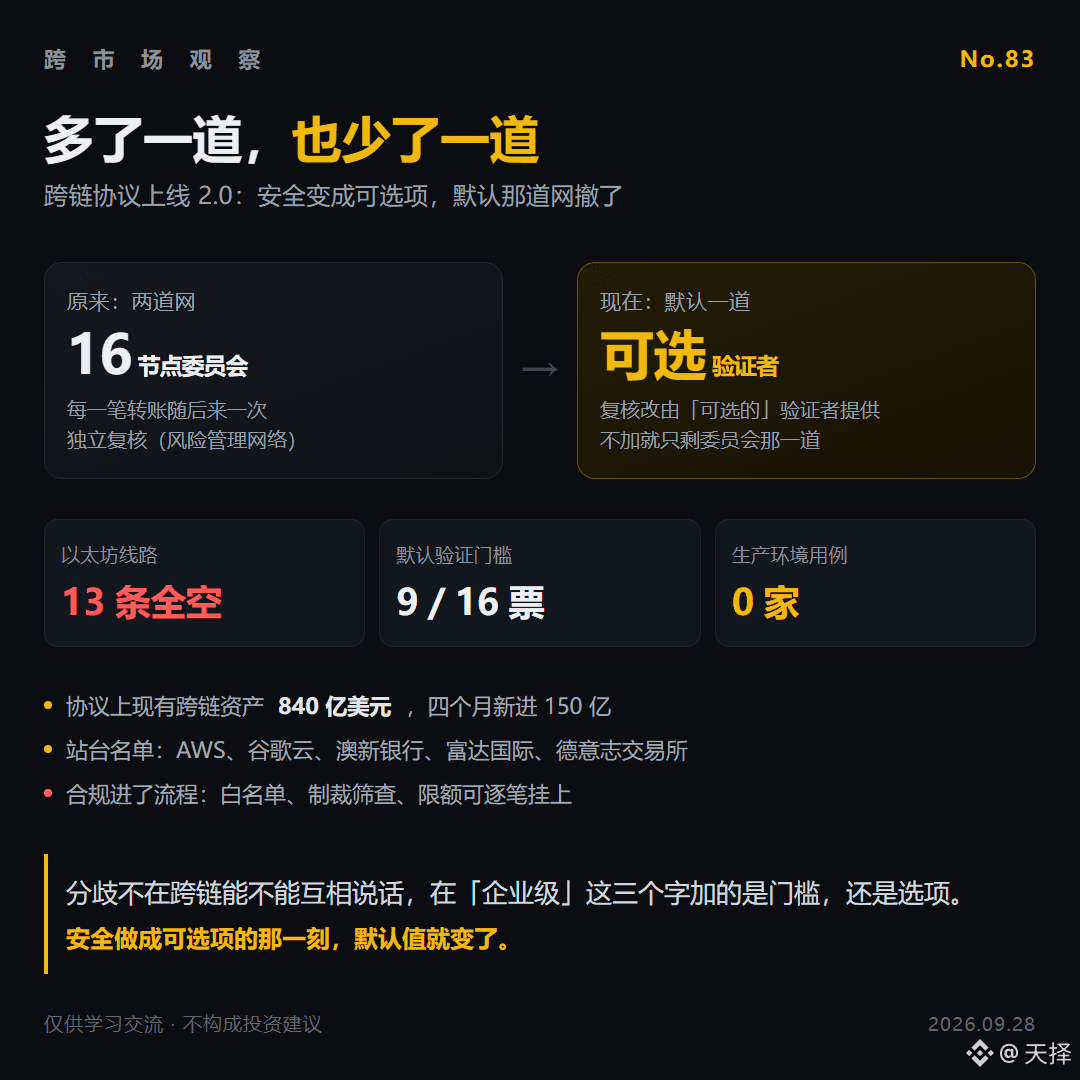
▪️ Chainlink 9/28 launches CCIP 2.0: institutions can either run it themselves, or hire someone to run a “cross-chain validator” machine. Transfers must be approved with its signature before they are allowed to proceed, alongside the committee made up of the original 16 nodes, which also signs.
▪️ At the same time, the original risk management network is being decommissioned—those nodes previously performed a second independent review for every transfer. The official position is that this review is now provided by optional validators.
▪️ In other words, nothing extra is added; by default, it changes from two networks to one. On-chain analytics at the same point in time recorded that the mandatory validator lists for 13 Ethereum routes are all empty; the default single network is supported by 9 votes among the 16 signers.
▪️ The public validator lineup includes AWS, Google Cloud, ANZ, and Fidelity International, but so far none has publicly said they are running the new validators in production.
▪️ The protocol currently has cross-chain assets exceeding $84 billion, and within four months, another $15 billion has come in. Compliance has also been integrated into the transfer flow: allowlists, sanctions screening, and limits can be attached per transaction. Ca
Optional validators can collect fees—whether those fees will return to the token is not mentioned in the announcement.
The disagreement isn’t about whether cross-chain systems can communicate with each other; it’s about whether the “enterprise-grade” label adds a barrier, or is just an option.
The moment security is made optional, the true default value changes. The choice is handed to each issuer—do you think it will be tightened or loosened? $LINK
Cross-chain security has been added with an extra layer, and the original layer has been removed.
▪️ Chainlink 9/28 launches CCIP 2.0: institutions can either run it themselves, or hire someone to run a “cross-chain validator” machine. Transfers must be approved with its signature before they are allowed to proceed, alongside the committee made up of the original 16 nodes, which also signs.
▪️ At the same time, the original risk management network is being decommissioned—those nodes previously performed a second independent review for every transfer. The official position is that this review is now provided by optional validators.
▪️ In other words, nothing extra is added; by default, it changes from two networks to one. On-chain analytics at the same point in time recorded that the mandatory validator lists for 13 Ethereum routes are all empty; the default single network is supported by 9 votes among the 16 signers.
▪️ The public validator lineup includes AWS, Google Cloud, ANZ, and Fidelity International, but so far none has publicly said they are running the new validators in production.
▪️ The protocol currently has cross-chain assets exceeding $84 billion, and within four months, another $15 billion has come in. Compliance has also been integrated into the transfer flow: allowlists, sanctions screening, and limits can be attached per transaction. Ca
Optional validators can collect fees—whether those fees will return to the token is not mentioned in the announcement.
The disagreement isn’t about whether cross-chain systems can communicate with each other; it’s about whether the “enterprise-grade” label adds a barrier, or is just an option.
The moment security is made optional, the true default value changes. The choice is handed to each issuer—do you think it will be tightened or loosened? $LINK