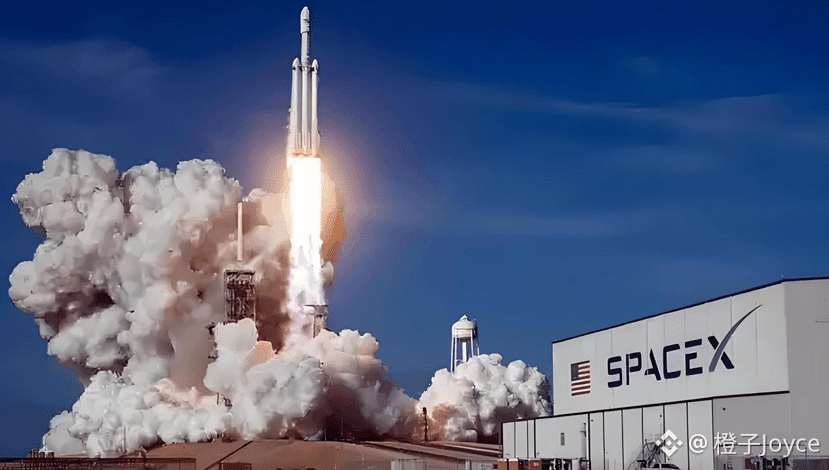

[Major News] SpaceX’s “Starship” achieves successful orbit insertion for the first time! Is Musk going to build AI data centers in space? 🚀
SpaceX’s massive reusable rocket “Starship” (Starship) has reached a historic milestone, successfully entering Earth orbit for the first time! Although a failure in one of the upper-stage engines caused the mission to end early, Starship still deployed 26 third-generation (V3) “Starlink” satellites without issue, showcasing impressive payload capacity.
💡 Key takeaways:
📡 Boosting mobile communications: More powerful V3 satellites will help expand Starlink’s services into the mobile wireless communications market. Currently, Starlink already has over 11,000 satellites and serves more than 12 million users.
🤖 Space AI data center: Musk plans that in the future, by launching Starships at high frequency, StarMind AI computing satellites will be deployed in orbit to build a massive space-based AI data center. With abundant solar energy and the heat-dissipation advantages of space vacuum, it could directly break through the power and cooling bottlenecks on Earth.
⏱️ Goal: “one flight per hour”: Musk says it will take another 2–3 years before Starship can achieve one launch per hour. At that time, its operating costs will be far lower than those of terrestrial data centers.
📈 Capital markets are optimistic: According to FactSet data, 76% of analysts give SpaceX a “Buy” rating, with an average target price of about $224.
From controlling most of the world’s launch missions (with 165 Falcon 9 launches in 2025), to laying out space computing power and communication networks, SpaceX is redefining the boundaries of commercial spaceflight and artificial intelligence.
Do you think Musk’s grand plan for “space computing power” will pay off? Share your thoughts in the comments!👇
#SpaceX #Starship #Musk #AI data center #商业航天
$NVDA.US
$SPCX.US
SpaceX’s massive reusable rocket “Starship” (Starship) has reached a historic milestone, successfully entering Earth orbit for the first time! Although a failure in one of the upper-stage engines caused the mission to end early, Starship still deployed 26 third-generation (V3) “Starlink” satellites without issue, showcasing impressive payload capacity.
💡 Key takeaways:
📡 Boosting mobile communications: More powerful V3 satellites will help expand Starlink’s services into the mobile wireless communications market. Currently, Starlink already has over 11,000 satellites and serves more than 12 million users.
🤖 Space AI data center: Musk plans that in the future, by launching Starships at high frequency, StarMind AI computing satellites will be deployed in orbit to build a massive space-based AI data center. With abundant solar energy and the heat-dissipation advantages of space vacuum, it could directly break through the power and cooling bottlenecks on Earth.
⏱️ Goal: “one flight per hour”: Musk says it will take another 2–3 years before Starship can achieve one launch per hour. At that time, its operating costs will be far lower than those of terrestrial data centers.
📈 Capital markets are optimistic: According to FactSet data, 76% of analysts give SpaceX a “Buy” rating, with an average target price of about $224.
From controlling most of the world’s launch missions (with 165 Falcon 9 launches in 2025), to laying out space computing power and communication networks, SpaceX is redefining the boundaries of commercial spaceflight and artificial intelligence.
Do you think Musk’s grand plan for “space computing power” will pay off? Share your thoughts in the comments!👇
#SpaceX #Starship #Musk #AI data center #商业航天
$NVDA.US
$SPCX.US