Hong Kong has tightened the compliance foundation for virtual assets another notch.
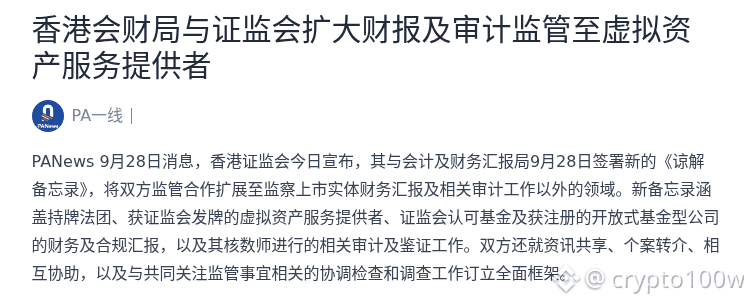
On September 28, the Hong Kong Securities and Futures Commission (SFC) and the Financial Reporting Council signed a new Memorandum of Understanding (MoU). Regulatory cooperation has expanded beyond the financial reporting of listed entities and related audit work to include licensed corporations, virtual asset service providers licensed by the SFC, SFC-authorized funds, and registered open-ended fund companies—bringing financial and compliance reporting, as well as audit and assurance work by auditors, under the same umbrella.
This is a somewhat positive signal, especially for Hong Kong’s compliant trading platforms and licensed firms, as it may further improve financial-report transparency and institutional trust. On the other hand, it’s also clear that audit, disclosure, and compliance pressure will increase in parallel. What’s worth watching next is whether the expansion pace of licensed platforms in Hong Kong will be further amplified by this framework, or whether it will first be weighed down by higher compliance costs. Which do you care more about: “trust building” or “cost increase”?
Source: PANews
Figure 1: Hong Kong expands virtual-asset audit and supervision · Partial screenshot of the source page
Image source: https://www.panewslab.com/zh/articles/01a0e7ae-4c98-75ca-a657-896cb7cb2ace
On September 28, the Hong Kong Securities and Futures Commission (SFC) and the Financial Reporting Council signed a new Memorandum of Understanding (MoU). Regulatory cooperation has expanded beyond the financial reporting of listed entities and related audit work to include licensed corporations, virtual asset service providers licensed by the SFC, SFC-authorized funds, and registered open-ended fund companies—bringing financial and compliance reporting, as well as audit and assurance work by auditors, under the same umbrella.
This is a somewhat positive signal, especially for Hong Kong’s compliant trading platforms and licensed firms, as it may further improve financial-report transparency and institutional trust. On the other hand, it’s also clear that audit, disclosure, and compliance pressure will increase in parallel. What’s worth watching next is whether the expansion pace of licensed platforms in Hong Kong will be further amplified by this framework, or whether it will first be weighed down by higher compliance costs. Which do you care more about: “trust building” or “cost increase”?
Source: PANews
Figure 1: Hong Kong expands virtual-asset audit and supervision · Partial screenshot of the source page
Image source: https://www.panewslab.com/zh/articles/01a0e7ae-4c98-75ca-a657-896cb7cb2ace