119 US dollars SOL—are you still willing to board?
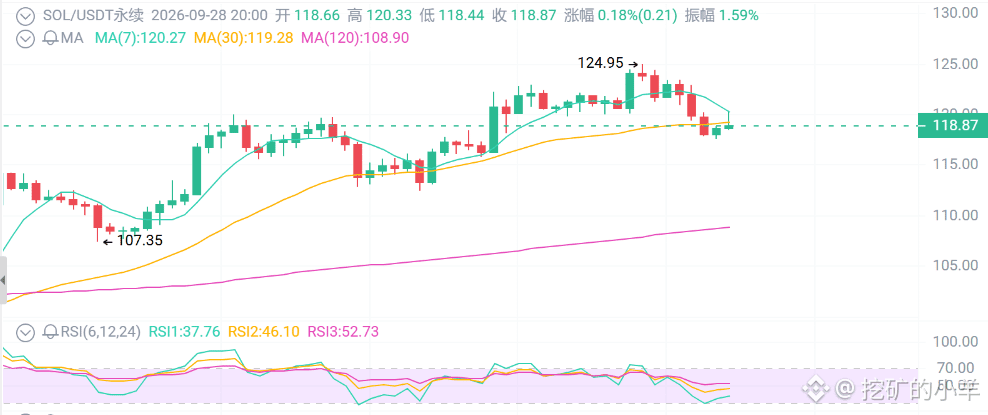
First, look at the surface: from mid-September 96–100 surged all the way to 125, up nearly 30%. In the past week alone, it’s still up 10%. The weekend attempt at 125 failed, and on Monday it pulled back to 119. Market cap is 70 billion, with about 60% room from the ATH of 296. The daily chart is still within an upward channel; the 4-hour timeframe is weak, and volume is tightening—this is digestion, not a breakdown.
First thing: the ETF is buying—and buying faster
From Sep 21–25, the US spot SOL ETF saw net inflows of 188 million USD, the highest single-week net inflow since launch. Bitwise’s BSOL alone accounted for 128 million. Cumulative net inflows are 1.6 billion USD, with assets under management nearing 2 billion.
Institutions aren’t here to speculate—they’re here to position and allocate. Multiple consecutive weeks of net inflows are the real backing for SOL to rise from 96 back to 120.
Second thing: Alpenglow upgrades—SOL is going to get a new “heart”
Anza replaces TowerBFT with Votor, aiming to compress finality from 12.8 seconds down to 150 milliseconds—85 times faster. Voting is moved off-chain, and the fault-tolerance threshold increases. Firedancer’s second client is already running on the mainnet, improving client diversity.
SOL is shifting from “fast but sometimes stalls” to “fast and stable.” This is on the same level as the ETH narrative when it moved from PoW to PoS—back then nobody believed it; later everyone slapped their thighs.
Third thing: on-chain data is speaking—not just empty talk
Stablecoin supply hit a new all-time high of about 17.6 billion USD. On-chain tokenized ETFs are growing, and RWA is growing. DEX trading volumes often reach the scale of traditional markets. Staking ratio is around 70%. In August governance also passed accelerated deflation (SGP-0002), and terminal 1.5% inflation will arrive even faster.
Treasury-style holders like Forward Industries continue to accumulate SOL. The foundation is also recruiting Binance/Polygon veterans to bring institutions and payments.
Trading strategy
Aggressive:
Try going long with a light position near 119; stop-loss at 114.8. First target 123, second target 125. At 123, cut half.
Conservative:
Consider going long only after 114–116, with stop-loss at 111.5. A better entry is 107–110—if it doesn’t come, hold a smaller position. Patience is worth more than courage.
Breakout play:
Only consider chasing the second leg if it breaks out on volume and holds above 126, and the pullback doesn’t break 122. Target 130. If it’s a fake breakout, abandon the idea.
Bears:
Going short while things are quiet is easily squeezed by ETF inflows and upgrade news. Only if the daily chart closes below 112 with volume should you consider flipping; targets first 108, then 104.
If BTC breaks below 82,000 and accelerates downward → reduce SOL positions first.
If Alpenglow clearly delays or validator upgrades don’t meet the standard → smash short-term expectations first.
If SOL ETF continues net outflows → 119–115 is likely to lose support.
First, look at the surface: from mid-September 96–100 surged all the way to 125, up nearly 30%. In the past week alone, it’s still up 10%. The weekend attempt at 125 failed, and on Monday it pulled back to 119. Market cap is 70 billion, with about 60% room from the ATH of 296. The daily chart is still within an upward channel; the 4-hour timeframe is weak, and volume is tightening—this is digestion, not a breakdown.
First thing: the ETF is buying—and buying faster
From Sep 21–25, the US spot SOL ETF saw net inflows of 188 million USD, the highest single-week net inflow since launch. Bitwise’s BSOL alone accounted for 128 million. Cumulative net inflows are 1.6 billion USD, with assets under management nearing 2 billion.
Institutions aren’t here to speculate—they’re here to position and allocate. Multiple consecutive weeks of net inflows are the real backing for SOL to rise from 96 back to 120.
Second thing: Alpenglow upgrades—SOL is going to get a new “heart”
Anza replaces TowerBFT with Votor, aiming to compress finality from 12.8 seconds down to 150 milliseconds—85 times faster. Voting is moved off-chain, and the fault-tolerance threshold increases. Firedancer’s second client is already running on the mainnet, improving client diversity.
SOL is shifting from “fast but sometimes stalls” to “fast and stable.” This is on the same level as the ETH narrative when it moved from PoW to PoS—back then nobody believed it; later everyone slapped their thighs.
Third thing: on-chain data is speaking—not just empty talk
Stablecoin supply hit a new all-time high of about 17.6 billion USD. On-chain tokenized ETFs are growing, and RWA is growing. DEX trading volumes often reach the scale of traditional markets. Staking ratio is around 70%. In August governance also passed accelerated deflation (SGP-0002), and terminal 1.5% inflation will arrive even faster.
Treasury-style holders like Forward Industries continue to accumulate SOL. The foundation is also recruiting Binance/Polygon veterans to bring institutions and payments.
Trading strategy
Aggressive:
Try going long with a light position near 119; stop-loss at 114.8. First target 123, second target 125. At 123, cut half.
Conservative:
Consider going long only after 114–116, with stop-loss at 111.5. A better entry is 107–110—if it doesn’t come, hold a smaller position. Patience is worth more than courage.
Breakout play:
Only consider chasing the second leg if it breaks out on volume and holds above 126, and the pullback doesn’t break 122. Target 130. If it’s a fake breakout, abandon the idea.
Bears:
Going short while things are quiet is easily squeezed by ETF inflows and upgrade news. Only if the daily chart closes below 112 with volume should you consider flipping; targets first 108, then 104.
If BTC breaks below 82,000 and accelerates downward → reduce SOL positions first.
If Alpenglow clearly delays or validator upgrades don’t meet the standard → smash short-term expectations first.
If SOL ETF continues net outflows → 119–115 is likely to lose support.