

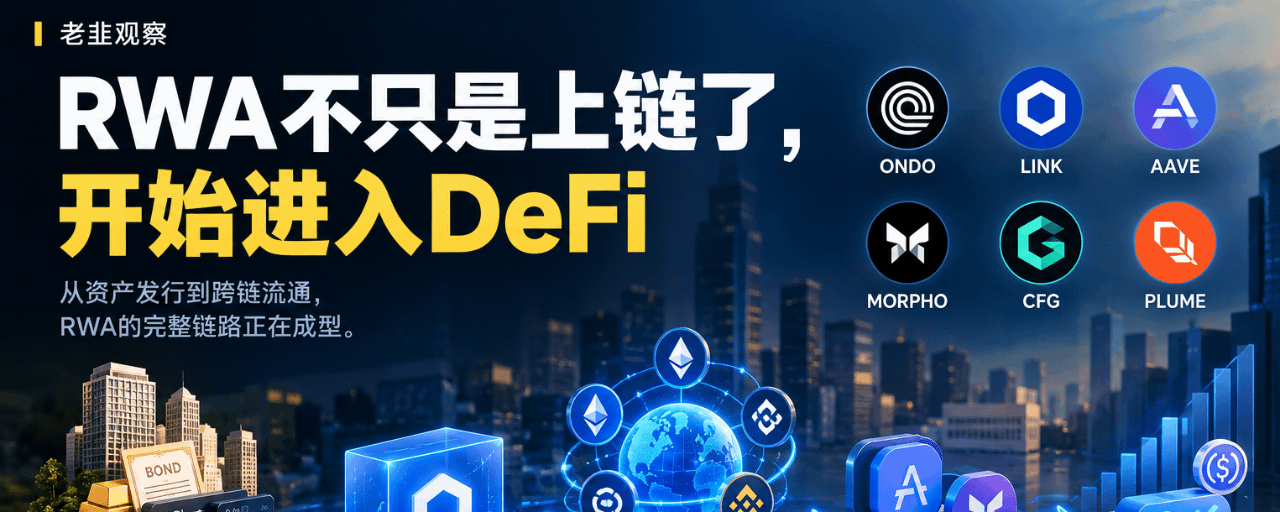

【Old-Crop Observation】
Recently, this RWA track has begun to show a fairly noticeable change.
When people talked about RWA before, it was basically just one sentence:
Move traditional assets like stocks, bonds, and funds onto the blockchain.
But moving assets onto the chain is actually just the first step.
What’s really interesting is that recently, people have started connecting these assets further into DeFi.
And this pathway has gradually been connected together.
First, look at the asset side.
What $ONDO is doing is to turn traditional financial assets like stocks and ETFs into on-chain assets.
This year in February, Ondo's SPYon and QQQon have already entered the Morpho lending market and can be used as collateral to borrow other assets.
This step is important.
Before, once a stock was tokenized, it was basically:
Buy it → hold it.
Once it enters the lending market, it becomes:
Buy it → post it as collateral → borrow money → then participate in other on-chain financial activities.
Traditional assets gain “production capacity” from DeFi.
Then it’s $MORPHO.
What Morpho solves is how, after these new assets enter the lending system, to establish a standalone lending market with risk isolation.
That’s why tokenized stocks are truly valuable—not just because it lets you buy a stock on-chain.
Instead, it makes stocks into collateral that can enter the on-chain financial system.
Recently, Aave has taken another step forward.
$AAVE V4 is already live on Base with the Equities Hub.
These 7 tokenized U.S. stocks—Apple, Amazon, Google, Meta, Microsoft, Nvidia, and Tesla—can already be used as collateral to borrow USDC.
In other words:
Nvidia stock on-chain → post Nvidia as collateral → borrow USDC.
This is no longer just “putting U.S. stocks on-chain.”
Instead, traditional financial assets are beginning to truly enter the DeFi lending system.
And that’s when the importance of $LINK becomes clear.
After stocks are on-chain, the system must know:
How much is Nvidia actually worth right now?
What is the collateralization ratio?
When should liquidation happen?
If the price data is wrong, the entire lending market will be affected.
So Aave’s tokenized stock market directly uses the price data provided by Chainlink.
But today, Chainlink has pushed this further.
CCIP 2.0 is officially live.
The biggest change this time isn’t only an upgrade of cross-chain functionality.
Instead, it starts to solve a bigger problem:
Once an institution’s assets are on the blockchain, how can they move safely and in compliance across different chains?
CCIP 2.0 allows institutions to run their own Cross-Chain Verifier, adding their own verification steps to cross-chain transactions.
It can also connect to third-party verification institutions.
At the same time, add compliance controls such as KYC, AML, and sanctions screening.
That means institutions can embed their own risk controls and compliance requirements directly into the cross-chain process.
This is crucial for traditional financial institutions.
Because what a bank or asset management company truly cares about has never been only:
“Can the assets be moved over?”
No—
Who verifies?
Who approves?
Are there compliance restrictions?
After moving to another chain, do the original rules still hold?
This is the layer that CCIP 2.0 starts to solve.
And the list of institutions behind this launch is also quite interesting.
AWS, ANZ, Fidelity International, Deutsche Börse, SBI Digital Markets, Sygnum, Taurus, and so on all appear in the CCIP 2.0 partner ecosystem.
Looking back at the entire RWA track this way, the positions of those six coins are much clearer.
$ONDO
Responsible for turning traditional assets into on-chain assets.
$LINK
Responsible for price data, oracles, and now increasingly important cross-chain infrastructure.
$AAVE
Responsible for getting these on-chain assets into the lending system.
$MORPHO
Provide more flexible and isolated on-chain lending infrastructure.
$CFG
Responsible for the RWA infrastructure layer and bringing assets on-chain.
$PLUME
Build dedicated on-chain financial infrastructure specifically around RWA.
These six are actually not six completely independent stories.
More like a single chain:
Asset issuance → data validation → cross-chain circulation → lending → settlement → liquidity
Previously, the biggest awkwardness for RWA was:
Assets can indeed be put on-chain—but what do you do after they’re on-chain?
Now the answers are starting to show up.
Stocks can be brought on-chain.
After going on-chain, it can be used as collateral.
After posting collateral, you can borrow USDC.
The borrowed funds can continue to enter DeFi.
Assets can also enter other networks via cross-chain infrastructure.
And institutions’ own verification, KYC, AML, and risk controls can also be embedded into this process.
This is completely different from simply “turning stocks into Tokens.”
The real big change is:
Traditional financial assets begin to gain on-chain financial characteristics.
If in the future more and more stocks, ETFs, funds, bonds, gold, and even other real-world assets enter this system, then the competition won’t be just about which project issues the most RWA.
What will become truly important is:
Who is responsible for issuing the assets?
Who is responsible for the data?
Who is responsible for cross-chain transfers?
Who is responsible for lending?
Who is responsible for liquidity?
So what this round of RWA is truly worth watching isn’t how much a single coin suddenly pumps.
Instead, this whole stack is gradually being filled in piece by piece.
Before, it was only:
Bring assets on-chain.
Now it starts to become:
Asset on-chain → can be made liquid → can be used as collateral → can be borrowed → can be cross-chained → can enter the institutional financial system.
This is the most worth关注 change after RWA truly begins entering DeFi.