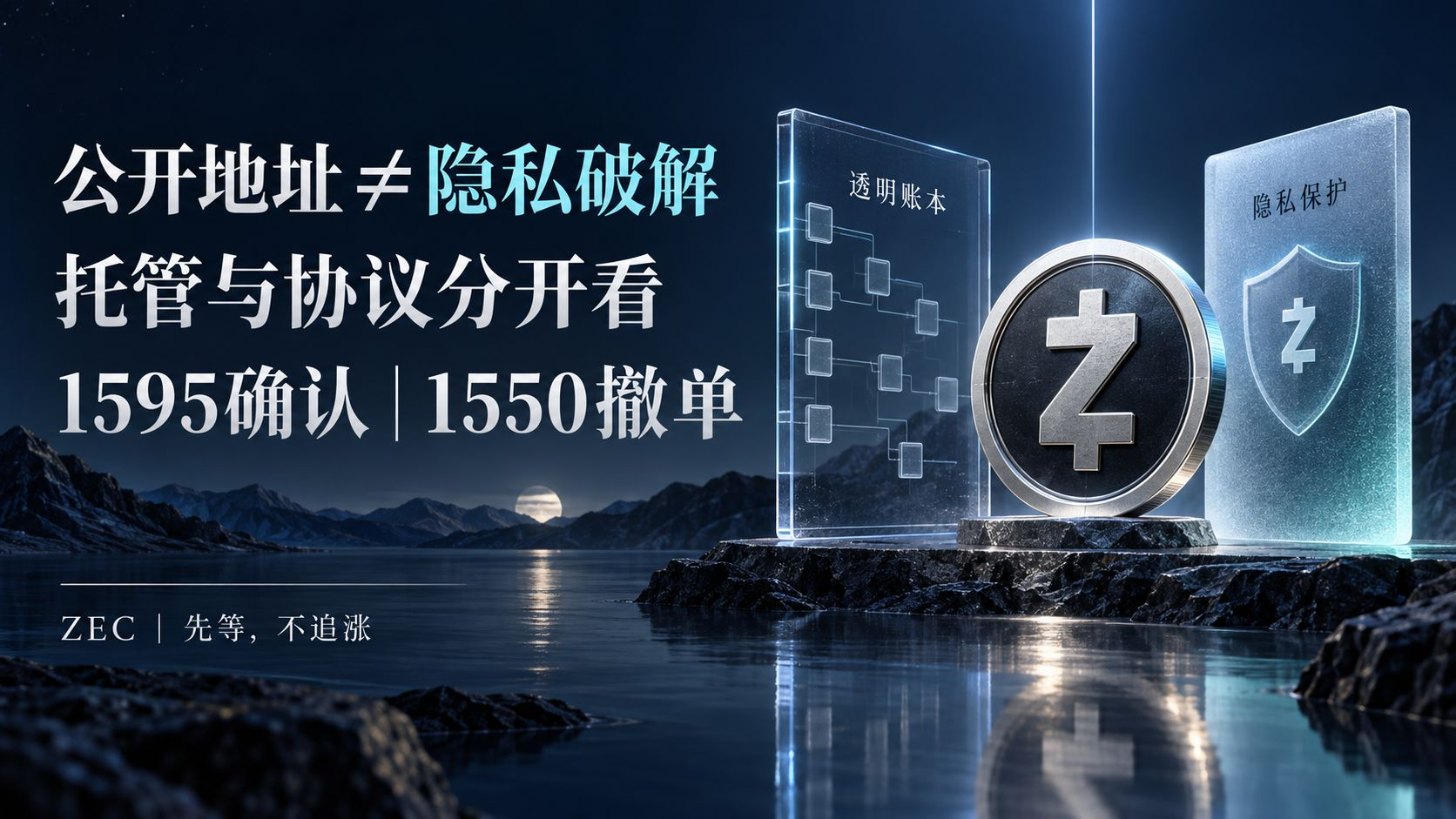
Bitget timeline is still trending on the forum hot list|Publicly sharing a ZEC address does not mean the privacy protocol has been broken|Around $1,588, I’ll wait
My stance: I won’t swap a custodial incident for a claim that the protocol has failed, and I won’t chase pumps. The “forum safety timeline” topic has 249 views and 45 participants—same as the previous round; ZEC appears in a six-hour search list, but there’s no rapid upward marker. Hype is not proof of buy pressure.
Verified facts: Bitget’s official update on September 25 lists ZEC involved receiving addresses starting with “t1,” confirming that the affected assets include ZEC. Investigation and tracking are still ongoing; the updated version explained on September 27 also lists the Zcash network. The event scope is some exchanges’ hot wallets and the base infrastructure of warm wallets. This is not another attack today, and it’s not an already published, system-wide cryptography vulnerability.
Zcash official explanation and technical glossary: Transparent addresses that start with “t” have their address and related amounts publicly recorded on-chain. Shielded transaction protection corresponds to privacy data; mixed transactions can’t be broadly said to hide everything. This is an existing mechanism, not a feature added today; a receiving address is not a complete conclusion for “tracking the funds back.”
Why does this affect the market? This is my judgment: If you interpret “ZEC address disclosed” as “privacy technology has failed,” it’s easy to panic-sell for the wrong reason. Conversely, if you interpret “coin name includes privacy” as “every transfer is inherently not visible,” you may also underestimate information exposure. Publishing a portion of a transparent record cannot prove that all fund paths have been fully identified, nor can it prove that the shielding mechanism has been compromised. Custody permissions, transaction privacy, and an exchange’s withdrawal capability must be verified separately; privacy does not replace account security.
As for actual market quotes: Kraken’s ZEC/USD is rechecked at $1,588.40. The 24-hour range is $1,536.24 to $1,678.70. The price has rebounded somewhat from the low point, but the quote is still below my set confirmation line of $1,595; changes in the quote cannot prove that this old announcement is the cause of the reaction. I’m not fabricating institutional inflows, and I’m not saying other coins restored withdrawals means ZEC has already restored withdrawals.
If this were my own trading: I won’t participate. Position 0%, no shorting. I’d only consider testing long positions under unleveraged spot conditions. If the hourly close is above 1,595, then it pulls back to 1,590–1,595 and holds there—and the platform quotes and deposits/withdrawals are normal—then I would participate with up to 0.3% of total funds. After 1,610, halve the position; close the rest at 1,630. After entry, a hard stop-loss at 1,575, or if two consecutive hourly closes fall below 1,590, exit everything. Before entry, if it breaks below 1,550, I cancel the order and do not add. A valid recovery and confirmation above the line would overturn the “not participating” judgment. If an official technical report confirms a protocol-level issue, or if the transaction channel is abnormal, even if it breaks above, I will cancel the plan. If none of the triggers are hit, it doesn’t count as a fill, let alone a profit.
Sources: [Bitget update](https://www.bitget.com/support/articles/12560603896108), [Zcash transparent vs. shielded explanation](https://z.cash/learn/what-is-the-difference-between-shielded-and-transparent-zcash/), [Technical glossary](https://zcash.readthedocs.io/en/latest/rtd_pages/glossary.html); market data: Kraken.
#BitgetDetailsSecurityIncidentTimeline #ZEC
The above is only personal market observation and does not constitute investment advice.
My stance: I won’t swap a custodial incident for a claim that the protocol has failed, and I won’t chase pumps. The “forum safety timeline” topic has 249 views and 45 participants—same as the previous round; ZEC appears in a six-hour search list, but there’s no rapid upward marker. Hype is not proof of buy pressure.
Verified facts: Bitget’s official update on September 25 lists ZEC involved receiving addresses starting with “t1,” confirming that the affected assets include ZEC. Investigation and tracking are still ongoing; the updated version explained on September 27 also lists the Zcash network. The event scope is some exchanges’ hot wallets and the base infrastructure of warm wallets. This is not another attack today, and it’s not an already published, system-wide cryptography vulnerability.
Zcash official explanation and technical glossary: Transparent addresses that start with “t” have their address and related amounts publicly recorded on-chain. Shielded transaction protection corresponds to privacy data; mixed transactions can’t be broadly said to hide everything. This is an existing mechanism, not a feature added today; a receiving address is not a complete conclusion for “tracking the funds back.”
Why does this affect the market? This is my judgment: If you interpret “ZEC address disclosed” as “privacy technology has failed,” it’s easy to panic-sell for the wrong reason. Conversely, if you interpret “coin name includes privacy” as “every transfer is inherently not visible,” you may also underestimate information exposure. Publishing a portion of a transparent record cannot prove that all fund paths have been fully identified, nor can it prove that the shielding mechanism has been compromised. Custody permissions, transaction privacy, and an exchange’s withdrawal capability must be verified separately; privacy does not replace account security.
As for actual market quotes: Kraken’s ZEC/USD is rechecked at $1,588.40. The 24-hour range is $1,536.24 to $1,678.70. The price has rebounded somewhat from the low point, but the quote is still below my set confirmation line of $1,595; changes in the quote cannot prove that this old announcement is the cause of the reaction. I’m not fabricating institutional inflows, and I’m not saying other coins restored withdrawals means ZEC has already restored withdrawals.
If this were my own trading: I won’t participate. Position 0%, no shorting. I’d only consider testing long positions under unleveraged spot conditions. If the hourly close is above 1,595, then it pulls back to 1,590–1,595 and holds there—and the platform quotes and deposits/withdrawals are normal—then I would participate with up to 0.3% of total funds. After 1,610, halve the position; close the rest at 1,630. After entry, a hard stop-loss at 1,575, or if two consecutive hourly closes fall below 1,590, exit everything. Before entry, if it breaks below 1,550, I cancel the order and do not add. A valid recovery and confirmation above the line would overturn the “not participating” judgment. If an official technical report confirms a protocol-level issue, or if the transaction channel is abnormal, even if it breaks above, I will cancel the plan. If none of the triggers are hit, it doesn’t count as a fill, let alone a profit.
Sources: [Bitget update](https://www.bitget.com/support/articles/12560603896108), [Zcash transparent vs. shielded explanation](https://z.cash/learn/what-is-the-difference-between-shielded-and-transparent-zcash/), [Technical glossary](https://zcash.readthedocs.io/en/latest/rtd_pages/glossary.html); market data: Kraken.
#BitgetDetailsSecurityIncidentTimeline #ZEC
The above is only personal market observation and does not constitute investment advice.