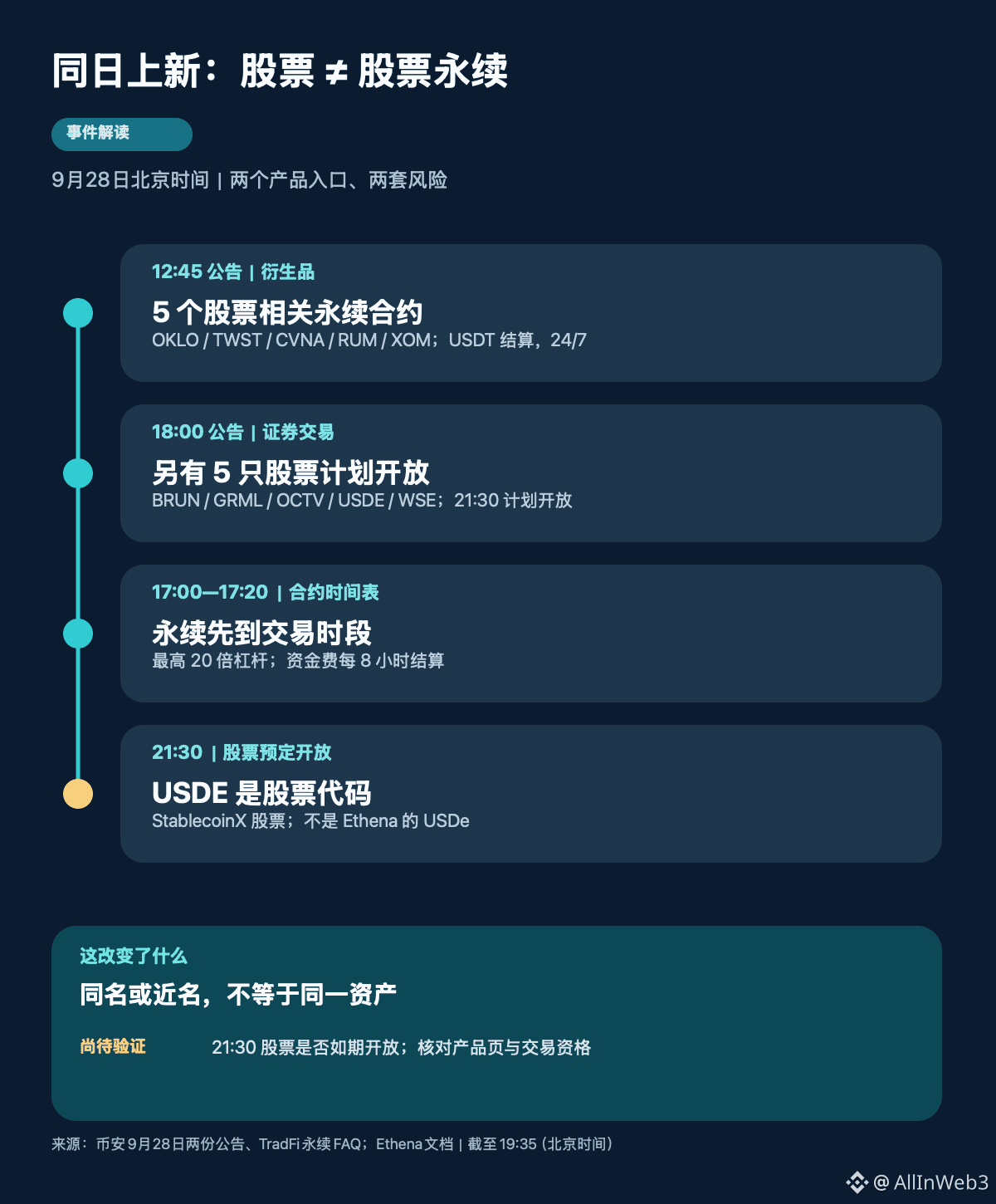
#币安股票 #TradFi合约 #USDE On the same day, Binance arranged trading for five stocks and also set up five stock-related perpetual futures. The easiest thing to confuse is not the quantity, but the product identity: the stock ticker USDE corresponds to the common shares of StablecoinX, not Ethena’s synthetic dollar USDe; and a stock perpetual with a “USDT” suffix is not a purchase of the underlying company’s shares.
First, get the timing right. In its September 28 (Beijing time) announcement, Binance said that the five USDT-margined perpetual contracts corresponding to OKLO, TWST, CVNA, RUM, and XOM would open one after another from 17:00 to 17:20. They are USDT-settled, tradable 24/7, with a maximum leverage of 20x, and funding fees are calculated and settled on an eight-hour cycle. What’s being traded here is contract exposure that tracks traditional assets—not shareholder equity. Even if the contracts are live, you cannot use that as evidence that U.S. stock spot markets are open 24/7.
Another announcement around 18:00 stated that five additional securities—BRUN, GRML, OCTV, USDE, and WSE—would be added at 21:30 (Beijing time). Those are a different set of underlying assets, not the spot equivalents of the first five contracts. As of 19:35 at the time of this article, 21:30 was still planned; it cannot be written as already open. The announcement also clarifies that stock orders are routed from Nest Trading to be executed, cleared, settled, and held by Alpaca Securities, and regional availability differs as well. Seeing the same Binance entry point doesn’t mean the actual trading and custody relationships are the same.
I think what’s truly worth discussing is the “misalignment of trading hours.” Stock-related perpetuals say 24/7, but the underlying stock price formation differs between pre-market, regular hours, after-hours, and market closures. Binance’s TradFi contract documentation notes that during non-trading periods, the method for calculating the price index switches; for equity-type contracts, during weekends and holidays, the order book EWMA inputs are used. So a weekend contract quote shouldn’t be mechanically treated as the opening price of the next U.S. trading day. You also need to consider, at the same time, the index methodology, order-book depth, bid-ask spreads, and funding fees.
If the stocks do open as scheduled at 21:30, first verify the exact product page, trading eligibility, and the security name. Especially for USDE: it’s a stock ticker, while Ethena’s USDe is a different asset. Similar names do not imply any value linkage. If the announcement is rescheduled or the product-page information changes, your assessment should be updated accordingly too. When you see a 24/7 stock perpetual price, will you treat it as an overnight expectation—or will you first check the gap between it and the underlying’s price index?
First, get the timing right. In its September 28 (Beijing time) announcement, Binance said that the five USDT-margined perpetual contracts corresponding to OKLO, TWST, CVNA, RUM, and XOM would open one after another from 17:00 to 17:20. They are USDT-settled, tradable 24/7, with a maximum leverage of 20x, and funding fees are calculated and settled on an eight-hour cycle. What’s being traded here is contract exposure that tracks traditional assets—not shareholder equity. Even if the contracts are live, you cannot use that as evidence that U.S. stock spot markets are open 24/7.
Another announcement around 18:00 stated that five additional securities—BRUN, GRML, OCTV, USDE, and WSE—would be added at 21:30 (Beijing time). Those are a different set of underlying assets, not the spot equivalents of the first five contracts. As of 19:35 at the time of this article, 21:30 was still planned; it cannot be written as already open. The announcement also clarifies that stock orders are routed from Nest Trading to be executed, cleared, settled, and held by Alpaca Securities, and regional availability differs as well. Seeing the same Binance entry point doesn’t mean the actual trading and custody relationships are the same.
I think what’s truly worth discussing is the “misalignment of trading hours.” Stock-related perpetuals say 24/7, but the underlying stock price formation differs between pre-market, regular hours, after-hours, and market closures. Binance’s TradFi contract documentation notes that during non-trading periods, the method for calculating the price index switches; for equity-type contracts, during weekends and holidays, the order book EWMA inputs are used. So a weekend contract quote shouldn’t be mechanically treated as the opening price of the next U.S. trading day. You also need to consider, at the same time, the index methodology, order-book depth, bid-ask spreads, and funding fees.
If the stocks do open as scheduled at 21:30, first verify the exact product page, trading eligibility, and the security name. Especially for USDE: it’s a stock ticker, while Ethena’s USDe is a different asset. Similar names do not imply any value linkage. If the announcement is rescheduled or the product-page information changes, your assessment should be updated accordingly too. When you see a 24/7 stock perpetual price, will you treat it as an overnight expectation—or will you first check the gap between it and the underlying’s price index?