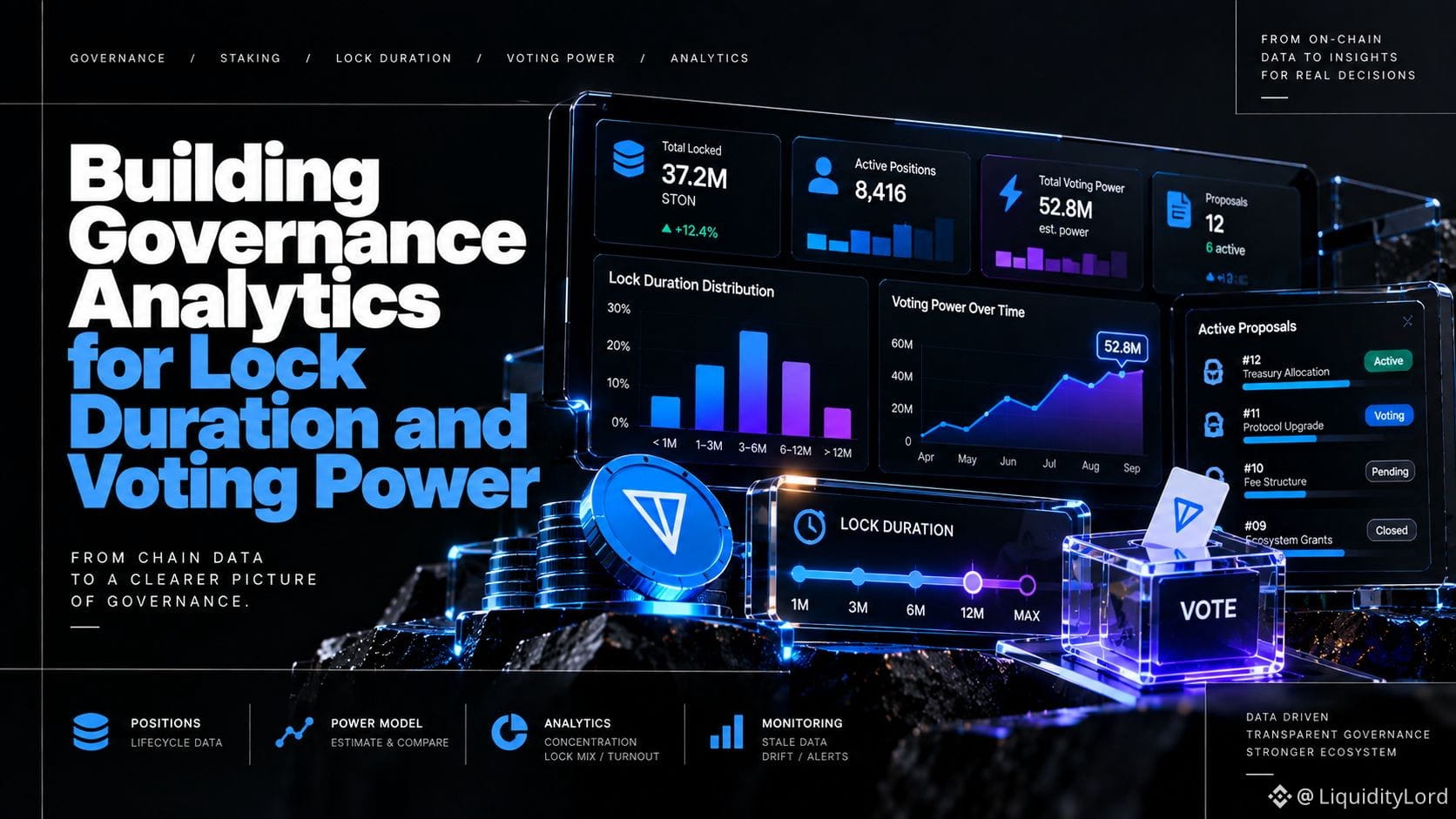
📊 Building Governance Analytics for STONfi Lock Duration and Voting Power
Governance analytics starts by treating each STON lock as a position with a life cycle: it opens, runs, can unlock, and may later be closed. That structure makes it possible to reconstruct historical voting power instead of relying on a single wallet balance.
🧩 FROM CHAIN TO DASHBOARD
The article organizes the pipeline into five layers:
- Data model — positions, power snapshots, proposals and votes.
- Ingestion — confirmed staking events written idempotently with a contract-specific cursor.
- Power model — an estimate compared with the value read from the chain.
- Queries — concentration, lock mix, expiry schedules and turnout.
- Monitoring — stale data, drift and important moments before voting closes.
The pipeline is read-only and traceable to on-chain activity.
⚖ MEASURE THE POWER MODEL, DON'T ASSUME IT
STONfi states that voting power grows with the amount staked and the length of the lock. The article does not verify an exact official weighting formula, so its example formula is explicitly a stand-in, not the published rule.
The key is comparison: store the modelled value beside the actual chain value and measure the error over time. A mismatch can reveal a missing multiplier or changing power. The goal is knowing how closely the model matches reality.
📈 WHAT THE ANALYTICS CAN SHOW
With reliable positions and snapshots, you can examine concentration, lock duration, expiry schedules and turnout. But these numbers describe wallets, not people: one person may use several wallets, while one address may represent a treasury, exchange or custodian.
The core principle is simple: build the record of what happened before building conclusions on top of it. Analytics adds memory and context to on-chain governance.
Not investment advice - research on your own! 🚀
$PUMP
Governance analytics starts by treating each STON lock as a position with a life cycle: it opens, runs, can unlock, and may later be closed. That structure makes it possible to reconstruct historical voting power instead of relying on a single wallet balance.
🧩 FROM CHAIN TO DASHBOARD
The article organizes the pipeline into five layers:
- Data model — positions, power snapshots, proposals and votes.
- Ingestion — confirmed staking events written idempotently with a contract-specific cursor.
- Power model — an estimate compared with the value read from the chain.
- Queries — concentration, lock mix, expiry schedules and turnout.
- Monitoring — stale data, drift and important moments before voting closes.
The pipeline is read-only and traceable to on-chain activity.
⚖ MEASURE THE POWER MODEL, DON'T ASSUME IT
STONfi states that voting power grows with the amount staked and the length of the lock. The article does not verify an exact official weighting formula, so its example formula is explicitly a stand-in, not the published rule.
The key is comparison: store the modelled value beside the actual chain value and measure the error over time. A mismatch can reveal a missing multiplier or changing power. The goal is knowing how closely the model matches reality.
📈 WHAT THE ANALYTICS CAN SHOW
With reliable positions and snapshots, you can examine concentration, lock duration, expiry schedules and turnout. But these numbers describe wallets, not people: one person may use several wallets, while one address may represent a treasury, exchange or custodian.
The core principle is simple: build the record of what happened before building conclusions on top of it. Analytics adds memory and context to on-chain governance.
Not investment advice - research on your own! 🚀
$PUMP