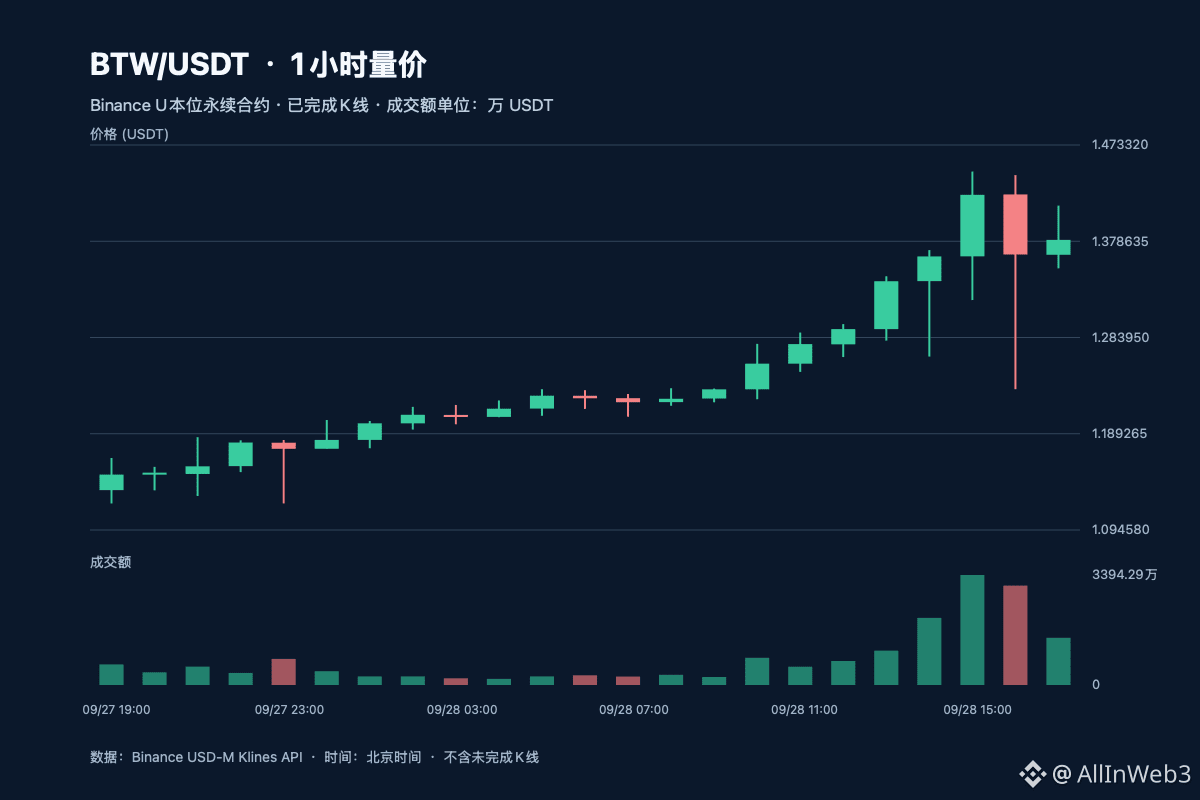
#BTW $BTW At 18:02 Beijing time, Binance U-margined USDT perpetual contracts still ranked #1 on the 24-hour movers list; by 18:06, after a rescan it was already #2. Right now I’m leaning toward watching and waiting: the rank is still near the top, but the volume during the pullback is clearly much smaller. The key issue has shifted from “can it push higher?” to “after it falls back, is there enough buy-side demand to push the price back above the high from the previous hour?”
In the full chart at 18:02, BTW is up about 25.01% over 24 hours, and contract turnover is about 197 million USDT. If you only look at these two rolling numbers, it’s easy to assume a continuous climb; the full hourly candlestick chart is more complicated. From 15:00 to 16:00 it closed at 1.4243, with turnover around 33.94 million USDT. From 16:00 to 17:00 it dipped as low as 1.2331, then closed at 1.3656, with turnover still around 30.66 million. That long lower wick suggests there were buyers stepping in at lower levels, but it also exposes selling pressure at the highs.
New information appeared from 17:00 to 18:00: the price bounced back, closing at 1.3800, but the highest it reached was only 1.4137—it didn’t reclaim the 1.4243 level discussed in the prior hour. Turnover fell to about 14.57 million, roughly 57% less than during the spike period. This isn’t proof that the “bounce must be over,” but it does indicate that this pullback has not yet demonstrated a breakout with the same level of trade strength. In the previous post, I was waiting for a complete hourly candle to stand back above 1.4243—so far, that condition still hasn’t occurred.
Now let’s look at positions. On Binance’s same basis, the open interest that’s not been closed went from about 123.154 million BTW at 16:00 to about 123.152 million BTW at 18:00—almost back to where it started; there was a brief dip at 17:00. This can’t be interpreted as net inflows of funds, and you also can’t judge the direction of new positions solely from the total open interest. The long/short ratio at 18:00 is about 0.54, meaning the number of accounts is skewed bearish—but that still doesn’t necessarily imply that short positions have a dominant amount of capital.
So far, I haven’t found any new fundamental announcement sufficient on its own to explain this round of volatility. I’d rather treat this move as a confirmation phase after heavy rotation: if later full hourly candles reclaim 1.4243 and turnover expands again, then doubts about a low-volume pullback should ease; if it drops back below the 17:00–18:00 low of 1.3520, then the short-term “supportive hold” narrative will need to be re-evaluated.
Compared with the rank on the movers list, would you put more weight on the change that, during the pullback, turnover has fallen to just over 40% of the spike period? #Bitway
In the full chart at 18:02, BTW is up about 25.01% over 24 hours, and contract turnover is about 197 million USDT. If you only look at these two rolling numbers, it’s easy to assume a continuous climb; the full hourly candlestick chart is more complicated. From 15:00 to 16:00 it closed at 1.4243, with turnover around 33.94 million USDT. From 16:00 to 17:00 it dipped as low as 1.2331, then closed at 1.3656, with turnover still around 30.66 million. That long lower wick suggests there were buyers stepping in at lower levels, but it also exposes selling pressure at the highs.
New information appeared from 17:00 to 18:00: the price bounced back, closing at 1.3800, but the highest it reached was only 1.4137—it didn’t reclaim the 1.4243 level discussed in the prior hour. Turnover fell to about 14.57 million, roughly 57% less than during the spike period. This isn’t proof that the “bounce must be over,” but it does indicate that this pullback has not yet demonstrated a breakout with the same level of trade strength. In the previous post, I was waiting for a complete hourly candle to stand back above 1.4243—so far, that condition still hasn’t occurred.
Now let’s look at positions. On Binance’s same basis, the open interest that’s not been closed went from about 123.154 million BTW at 16:00 to about 123.152 million BTW at 18:00—almost back to where it started; there was a brief dip at 17:00. This can’t be interpreted as net inflows of funds, and you also can’t judge the direction of new positions solely from the total open interest. The long/short ratio at 18:00 is about 0.54, meaning the number of accounts is skewed bearish—but that still doesn’t necessarily imply that short positions have a dominant amount of capital.
So far, I haven’t found any new fundamental announcement sufficient on its own to explain this round of volatility. I’d rather treat this move as a confirmation phase after heavy rotation: if later full hourly candles reclaim 1.4243 and turnover expands again, then doubts about a low-volume pullback should ease; if it drops back below the 17:00–18:00 low of 1.3520, then the short-term “supportive hold” narrative will need to be re-evaluated.
Compared with the rank on the movers list, would you put more weight on the change that, during the pullback, turnover has fallen to just over 40% of the spike period? #Bitway