$5 worth of NEAR—do you chase buy, or wait for the ETF to open?
First, the surface:
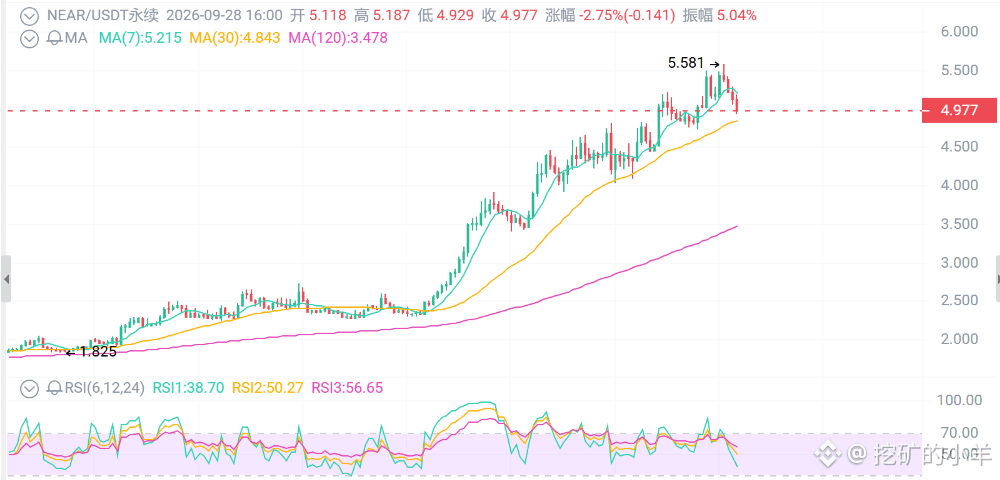
It started around $2. In mid-to-late September, it broke $3 and then $4. By the weekend, it violently surged to $5.55–$5.58, setting a new one-year high. Then on Monday, the profit-taking in the US and Europe session dumped it, pulling it back to the $5.00 psychological level. In 24 hours it fell 5–6%, but over 7 days it’s still up 16%, and over 30 days it’s up 170%. Market cap is $6.7B, and volume is converging compared to the spike—classic “pre-expectation fulfillment” chop.
First thing: the ETF is coming—this is NEAR’s first time entering a US broker account.
NYSE Arca has approved the listing. The registration statement takes effect on September 24, with a target opening around September 29. Coinbase will act as custodian; the held NEAR will be used for staking. Most rewards go to shareholders, with a management fee of 0.75%.
That weekend surge to a one-year high? That’s buying into this expectation.
Second thing: but the most dangerous scenario is right ahead.
“Buy the expectation, sell the fact”—those six words have buried countless late chasers.
On the day the ETF lists (or right around then), it often first spikes and then gives it back. That is the most common historical script. After the BTC ETF was approved, it dropped 20%. After the ETH ETF was approved, it moved sideways for three months—when the good news is actually realized, that moment signals short-term capital to retreat.
What you need to watch isn’t the price—it’s the first-day NRR capital flow direction. If inflows keep coming and $5.60 holds, you look for $6.00. If it’s delayed or turns into net outflows, that’s the “sell the fact” signal.
Third thing: fundamentals really are lining up, but $5 is already buying tomorrow.
NEAR is still the same setup: chain abstraction + Intents cross-chain settlement + AI Agent infrastructure. Nightshade sharded blocks produce in 600ms; 70% of gas fees are burned. Intents revenue is used to buy back NEAR, and the token is nearly fully circulating (1.31B).
Ecosystem execution is more solid than simply talking TPS: Brave wallet uses NEAR Intents, Ondo tokenizes US stocks, and Intents handle cross-chain settlement.
But $5 isn’t a bargain—it’s an integer psychology zone.
Hold to build momentum into ETF opening. If it breaks below $4.80, treat it as a deep pullback on a short-term basis.
Trading plan
Aggressive:
Light position long around $5.00, stop loss at $4.78–$4.80. First target $5.20—trim half. Second target $5.50.
Conservative:
Add only after $4.75–$4.90. Stop loss at $4.50.
Breakout style:
Only consider chasing the second leg if it holds $5.60 on strong volume and does not break $5.40 on the retest. Target $6.00. If it’s a false breakout, abandon.
Bears:
Only consider flipping short if the daily closes below $4.70 with strong volume.
First, the surface:
It started around $2. In mid-to-late September, it broke $3 and then $4. By the weekend, it violently surged to $5.55–$5.58, setting a new one-year high. Then on Monday, the profit-taking in the US and Europe session dumped it, pulling it back to the $5.00 psychological level. In 24 hours it fell 5–6%, but over 7 days it’s still up 16%, and over 30 days it’s up 170%. Market cap is $6.7B, and volume is converging compared to the spike—classic “pre-expectation fulfillment” chop.
First thing: the ETF is coming—this is NEAR’s first time entering a US broker account.
NYSE Arca has approved the listing. The registration statement takes effect on September 24, with a target opening around September 29. Coinbase will act as custodian; the held NEAR will be used for staking. Most rewards go to shareholders, with a management fee of 0.75%.
That weekend surge to a one-year high? That’s buying into this expectation.
Second thing: but the most dangerous scenario is right ahead.
“Buy the expectation, sell the fact”—those six words have buried countless late chasers.
On the day the ETF lists (or right around then), it often first spikes and then gives it back. That is the most common historical script. After the BTC ETF was approved, it dropped 20%. After the ETH ETF was approved, it moved sideways for three months—when the good news is actually realized, that moment signals short-term capital to retreat.
What you need to watch isn’t the price—it’s the first-day NRR capital flow direction. If inflows keep coming and $5.60 holds, you look for $6.00. If it’s delayed or turns into net outflows, that’s the “sell the fact” signal.
Third thing: fundamentals really are lining up, but $5 is already buying tomorrow.
NEAR is still the same setup: chain abstraction + Intents cross-chain settlement + AI Agent infrastructure. Nightshade sharded blocks produce in 600ms; 70% of gas fees are burned. Intents revenue is used to buy back NEAR, and the token is nearly fully circulating (1.31B).
Ecosystem execution is more solid than simply talking TPS: Brave wallet uses NEAR Intents, Ondo tokenizes US stocks, and Intents handle cross-chain settlement.
But $5 isn’t a bargain—it’s an integer psychology zone.
Hold to build momentum into ETF opening. If it breaks below $4.80, treat it as a deep pullback on a short-term basis.
Trading plan
Aggressive:
Light position long around $5.00, stop loss at $4.78–$4.80. First target $5.20—trim half. Second target $5.50.
Conservative:
Add only after $4.75–$4.90. Stop loss at $4.50.
Breakout style:
Only consider chasing the second leg if it holds $5.60 on strong volume and does not break $5.40 on the retest. Target $6.00. If it’s a false breakout, abandon.
Bears:
Only consider flipping short if the daily closes below $4.70 with strong volume.